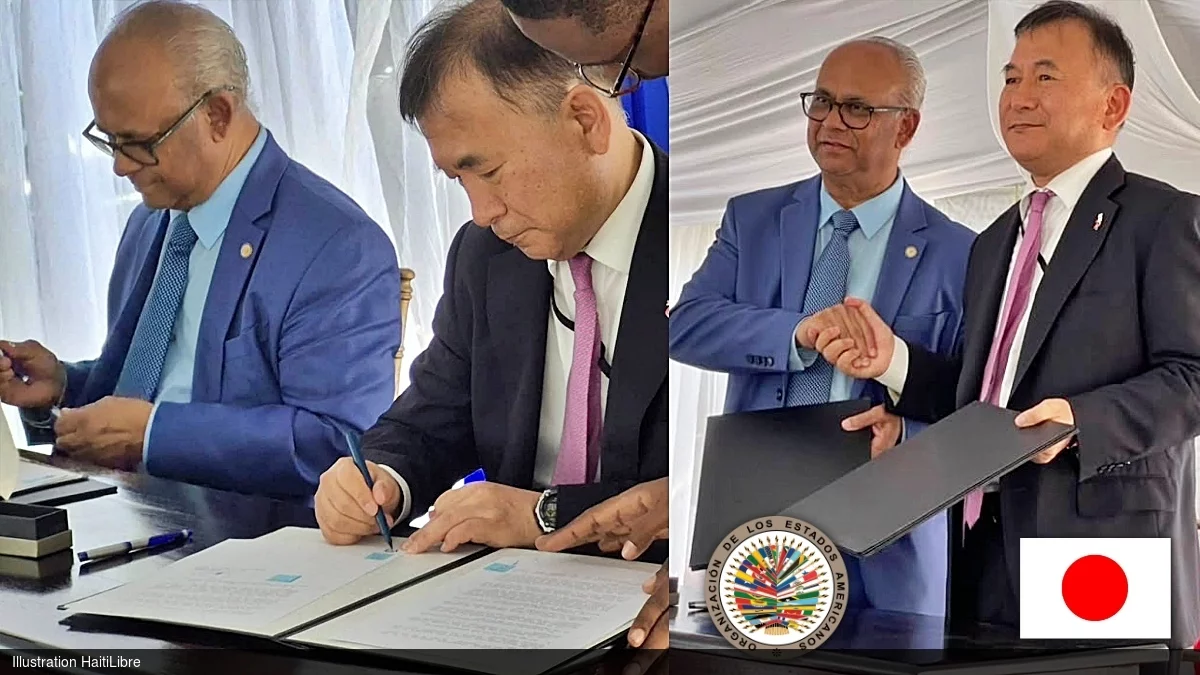
On August 18, 2026, a landmark new cooperation agreement was signed at the headquarters of Haiti’s National Identification Office (ONI) between top representatives of the Organization of American States (OAS) and Japan, marking a critical step forward in efforts to stabilize the Caribbean nation’s democratic process.
The signing ceremony was attended by key Haitian government stakeholders, including Minister of Justice and Public Security Patrick Pélissier, Minister of Foreign Affairs Raina Forbin, and ONI Director General Reynold Guerrier. OAS Secretary General Albert R. Ramdin signed on behalf of the hemispheric body, while Japanese Ambassador to Haiti Kazuhiko Nishiuchi represented Tokyo in the agreement.
Backed by a $3 million grant from the Japanese government, the initiative centers on updating Haiti’s national voter rolls by streamlining and expanding citizen registration operations and the production of official National Identification Cards (CINs). Beyond electoral preparations, the project targets longstanding gaps in national identification access: it will cut backlogs of citizens waiting for critical identity documentation, extend mobile registration services to hard-to-reach remote and marginalized communities, and tighten institutional coordination between the ONI and Haiti’s Provisional Electoral Council.
The allocated funding will cover a wide range of operational and infrastructure needs, including the procurement of 350,000 blank biometric identification cards, sustained deployment of ONI mobile registration units, public outreach campaigns to educate Haitians on the importance of legal identity and electoral participation, upgrades to shared facilities for the ONI and national electoral body, transportation support for field operations, and other day-to-day operational costs. The project also includes upgrades to decentralized local offices, improving access to electricity and internet connectivity to expand service reach, ultimately expanding access to critical identification services for underserved populations across the country.
In remarks following the signing, OAS Secretary General Ramdin emphasized the shared foundational principle guiding the partnership: Haiti’s long-term stability must be driven from within by Haitian citizens, built incrementally through guaranteeing every citizen a legal identity and the ability to participate in elections. Ramdin noted that Japan’s consistent diplomatic stance on Haiti prioritizes this Haitian-led approach, and the $3 million commitment translates that vision into tangible action. He added that the agreement reinforces the OAS’s longstanding commitment to supporting Haiti and advancing homegrown initiatives that foster stability and inclusive development.
Ambassador Nishiuchi echoed this framing, stating that Japan is proud to support Haiti’s work to solidify a national system of legal identity, expand access to essential public services, and boost the operational capacity of Haitian national institutions. Through collaboration with the OAS and local Haitian authorities, the partnership aims to ensure all citizens — especially those in isolated and vulnerable communities — can secure the identity documentation required to fully participate in Haitian society and exercise their fundamental civic rights.
The agreement formalizes the framework for this Japanese funding initiative, which will be executed by the OAS to advance Haiti’s broader social and economic development goals tied to democratic governance.