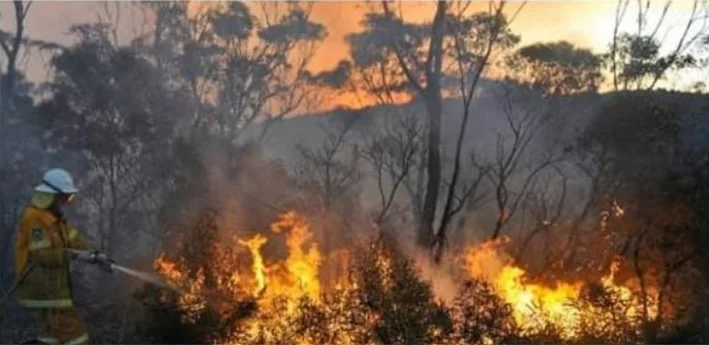
As Suriname prepares to enter its annual severe dry season, the Korps Brandweer Suriname (KBS), the country’s national fire service, has upgraded its operational readiness to counter elevated wildfire risks and is proactively planning for extended periods of extreme drought. The agency has deployed additional personnel to high-risk areas and activated its specialized biker unit for both preventive and response operations, amid growing concern over an unexpected early jump in grass and waste fires.
In an interview with Suriname’s Communication Service, KBS spokesperson Olton Pinas explained that the fire service has spent the past two to three months implementing targeted preparations for the dry season, after early data showed an alarming rise in fire incidents. “If we look at current statistics, we have already recorded almost the same number of grass and waste fires that we saw in December of last year, and the full dry season has not even officially begun,” Pinas noted.
High-density residential neighborhoods and districts with large expanses of unmaintained grass are marked as the highest risk zones. Parched dry vegetation ignites easily, and fires can spread rapidly to threaten nearby homes, putting lives and property at risk.
The KBS’s biker unit is set to play a central role in the agency’s dry season strategy. Team members will patrol neighborhoods door-to-door to distribute public safety educational materials, host awareness sessions, and respond immediately to small grass and waste fires. This setup eliminates the need to deploy large, resource-heavy fire trucks for every minor blaze, cutting operational costs while reducing response times. Public outreach efforts will also extend to vacation schools and rural regions across all four corners of the country, ensuring remote communities receive critical safety guidance.
Pinas emphasized that unauthorized waste burning remains the single leading cause of preventable fire incidents across Suriname, despite repeated public warnings. Many residents continue to burn household and yard waste illegally, a practice that has been banned nationwide in all settings, from roadside berms to backyard pits and containers. “There is a total ban on burning any waste, anywhere,” Pinas stressed. For households dealing with large volumes of accumulated waste, he recommended community collective funding to arrange for official transport to authorized public landfills, rather than illegal burning.
Beyond wildfire prevention, the KBS is issuing a series of public safety reminders for the upcoming vacation and dry season. The agency is calling on parents to prioritize child fire safety, urging caregivers to keep lighters and matches stored out of reach of young children, educate kids on the dangers of unregulated fire, and never leave minors unsupervised at home. “Children cannot supervise other children,” Pinas said. “If you need to leave, arrange for a trusted caregiver or enroll your children in a vacation school program.” The KBS also recommends all households install working smoke detectors, and advises that if a wildfire approaches a residential property, residents should first evacuate all household members to a safe location, call the emergency line 112 immediately, and only attempt to extinguish small fires if it can be done without putting themselves at risk.
The fire service also drew attention to health risks linked to extreme drought and heat, advising the public to stay hydrated, protect eyes from harmful UV radiation, and wear sun-protective head coverings when outdoors. For residents planning vacation outings, Pinas reminded parents to maintain constant supervision of children during swimming activities, and repeated a warning against the dangerous combination of alcohol consumption and driving: “If you have been drinking, don’t get behind the wheel – arrange for a designated driver instead.”
Across all its dry season initiatives, the KBS reiterated that proactive public prevention remains the most effective tool to minimize fire incidents and keep communities safe through the extreme weather period.