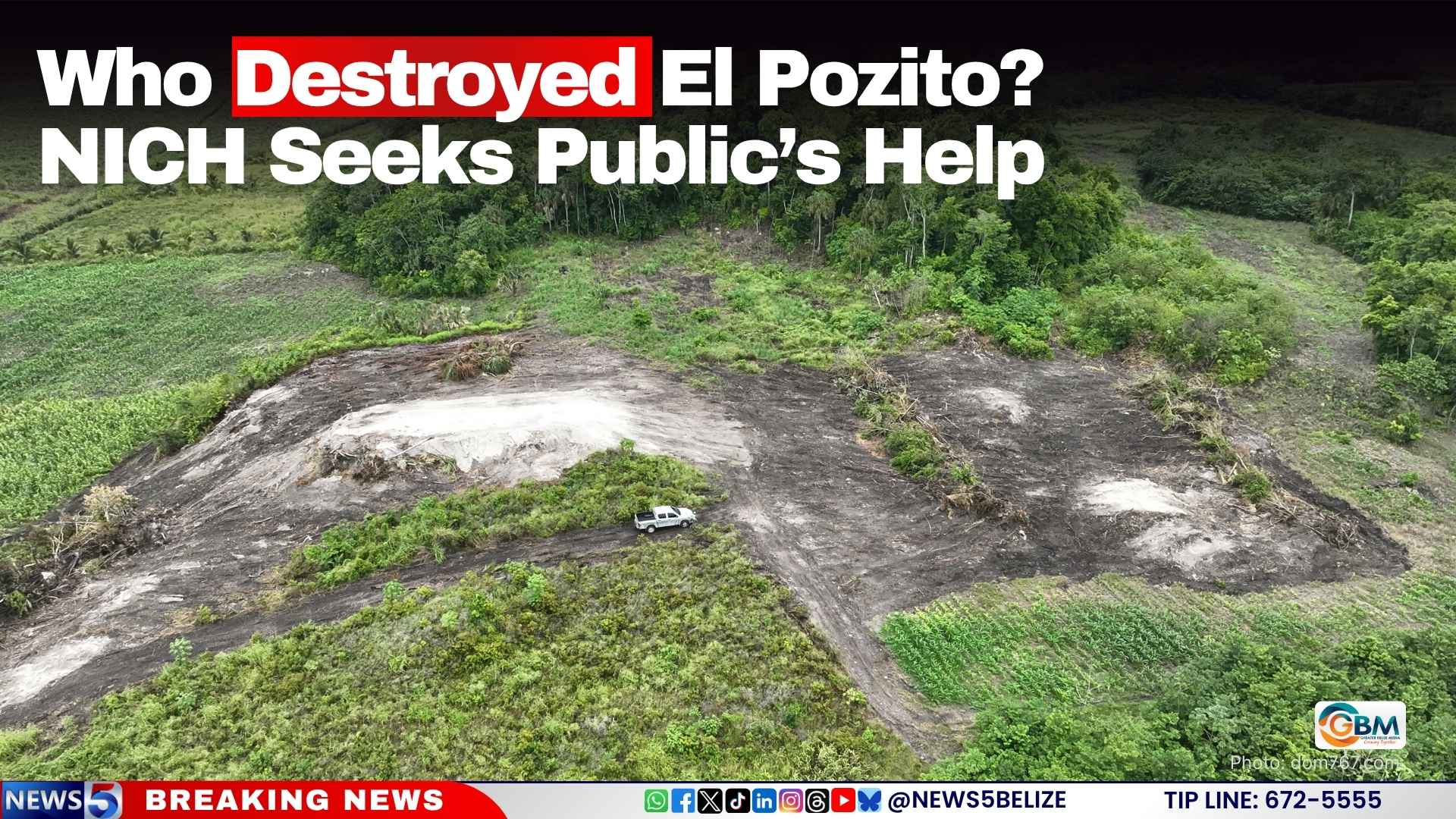
In a disturbing development that has shaken Belize’s cultural heritage community, the National Institute of Culture and History (NICH) has issued a public appeal for information to track down those responsible for the complete destruction of an ancient pre-Columbian archaeological complex at El Pozito. Located near Guinea Grass Village in northern Belize’s Orange Walk District, the site represents one of the region’s most valuable windows into the ancient Maya civilization that once dominated the area.
The scale of the damage was first uncovered by NICH’s Institute of Archaeology (IA) during a routine site monitoring inspection carried out on Monday, August 17, 2026. Inspectors confirmed that Complex D, a core structural grouping at the site, along with all its associated smaller ceremonial and residential structures, had been completely destroyed.
In an official public statement released following the inspection, NICH officials described the discovery of the site’s destruction as deeply disheartening for the nation’s cultural stewards. The organization emphasized that protected archaeological sites like El Pozito are not just isolated ruins—they are irreplaceable pieces of Belize’s national identity, connecting modern Belizeans to the deep history of the land they call home. “These sites form an integral part of our national cultural heritage, and it is only through joint effort, built on national pride, that we can ensure their protection,” the statement read, underscoring the critical need for public partnership in safeguarding these non-renewable cultural resources.
Long a site of concern for heritage managers, El Pozito had already been flagged for increased monitoring in recent months after preliminary land clearing activity near the site’s core caused partial damage to a number of structures. Prior to the destruction, the site was the focus of a new collaborative archaeological research initiative between the IA and the College of East Texas, led by principal investigator Dr. Keith Eppich. The first phase of fieldwork, completed earlier in the summer of 2026, was dedicated to updating the site’s original 1976 archaeological map and laying the groundwork for years of future research into the site’s role in ancient Maya regional politics and economy.
In its appeal, NICH reminded the general public that the deliberate damage, destruction, or disturbance of any ancient archaeological monument is classified as a criminal offense under the National Institute of Culture and History Act. Individuals convicted of violating this act face severe legal penalties, including fines that can reach as high as BZ$75,000, custodial sentences of up to five years, or both penalties for aggravated offenses.
NICH is urging any member of the public who has information about recent activity at the site, or who can identify parties responsible for the destruction, to come forward immediately. Tips can be submitted to the nearest Belizean police station, sent via email to NICH’s Senior Archaeologist, or shared anonymously through the dedicated WhatsApp hotlines at 601-7292 and 672-4190.