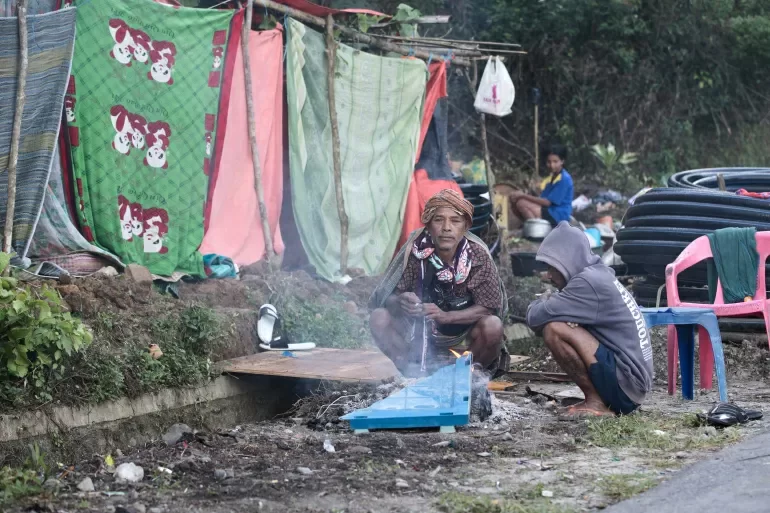
Just days after a powerful 7.7-magnitude earthquake rattled Indonesia’s eastern province of East Nusa Tenggara, thousands of displaced survivors remain stranded without critical assistance, as authorities confirmed the death toll has climbed to 68, up from an earlier count of 54. More than 200 people have been injured in the quake, which hit the region last Saturday, according to Berton SP Panjaitan, a spokesperson for Indonesia’s national disaster management agency.
The island of Flores, one of the disaster zone’s hardest-hit areas, remains partially cut off, with isolated communities still searching for missing relatives and waiting for life-saving supplies. Preliminary damage assessments show more than 1,300 residential properties have been damaged, including nearly 250 that were completely reduced to rubble. Dozens of public infrastructure facilities, including local schools, community health centers and government administrative offices, also sustained severe structural damage.
On Sunday, the provincial governor declared a 14-day state of emergency to coordinate response efforts. Approximately 12,800 residents have been unable to return to their damaged or destroyed homes, and are currently sheltering in temporary evacuation sites scattered across Flores. Many survivors have chosen to camp outside in makeshift tents rather than stay in formal buildings, driven by widespread fear of powerful aftershocks that could further collapse damaged structures.
For many locals, the delay in aid has deepened the crisis. Junaidin, a 32-year-old resident of Mbay, told reporters his home became uninhabitable after the quake left major cracks and partial structural collapse. Frustrated by the slow response, he said, “We have received no assistance from the government: no tents, no medicine, no food, no clean drinking water.”
National authorities have begun deploying emergency resources to the region. The Indonesian Air Force has delivered 13 tons of relief supplies via cargo planes, including ready-to-eat meals, clothing, clean water and essential medical equipment. Military helicopters have been assigned to reach cut-off remote communities that are inaccessible by road, and uniformed personnel have been deployed to help distribute aid across the disaster zone.
Rescue teams are still conducting search operations to locate any potential survivors trapped under rubble, though as of Monday there have been no official reports of people listed as missing. Temporary field hospitals have been set up to treat injured survivors, after most local medical facilities sustained damage. Many survivors are even receiving care outdoors in open-air medical tents, out of concern that damaged hospital buildings could collapse during aftershocks. Medical teams, however, are grappling with shortages of essential equipment and supplies, forcing them to deliver care under extremely challenging conditions.
Geographically, Indonesia sits along the Pacific “Ring of Fire”, a horseshoe-shaped zone of intense seismic activity that circles the Pacific basin, making the country extremely prone to strong earthquakes. One of the deadliest natural disasters in modern history struck the nation in 2004, when a 9.1-magnitude earthquake off the coast of Sumatra triggered a massive Indian Ocean tsunami that killed more than 220,000 people across 14 countries.
The recent earthquake in East Nusa Tenggara has once again highlighted the ongoing vulnerability of Indonesia’s seismically active regions to catastrophic natural disasters, and underscored the urgent need for robust, rapid disaster response systems and resilient infrastructure. As of Monday, the situation in affected areas remains critical, and relief and recovery operations are continuing around the clock.