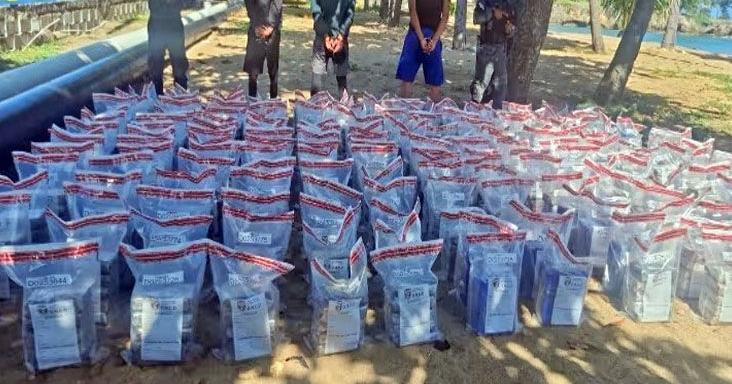
A four-week coordinated maritime security operation led by CARICOM Implementation Agency for Crime and Security (IMPACS) has delivered a major blow to transnational smuggling networks operating across the Caribbean, resulting in the seizure of an estimated $54.5 million in illegal contraband and criminal assets. Codenamed Operation Eclipse, the sweeping enforcement initiative unfolded throughout the month of May, bringing together an unprecedented coalition of 14 CARICOM member states, seven associate members, and key international partners including the governments of Canada, Colombia, France, the United Kingdom, the United States, and global law enforcement body Interpol.
The entire operation was coordinated through a central integrated fusion cell based at IMPACS’ Joint Regional Communications Centre in Port of Spain, with critical financial and operational backing from the U.S. Bureau of International Narcotics and Law Enforcement Affairs (INL). During the active interdiction phase of the mission, law enforcement teams opened 82 active investigations based on developed intelligence, tracked 59 high-priority vessels of interest, vetted 17 time-sensitive intelligence leads, and successfully carried out 24 targeted seizure operations.
By total value, the largest share of contraband seized consisted of illegal narcotics. Authorities recovered 5,222.59 kilograms of cocaine, which carries an estimated street value of more than $44 million, alongside 1,848 kilograms of marijuana valued at over $6.84 million. All narcotics were seized from a range of smuggling vessels, including high-speed go-fast boats, private yachts, and inter-island cargo ships that criminal networks have long used to move illicit goods across porous regional maritime borders.
Beyond illegal drugs, enforcement teams confiscated more than 6,100 cases of untaxed, contraband alcohol, 191 cartons of unregulated cigarettes, and 22 cylinders of banned ozone-depleting refrigerant gas. These additional seizures have a combined estimated value of more than $1.58 million. Authorities also took two unregistered firearms, 65 rounds of ammunition, 13 smuggling vessels and three land vehicles that were linked to transnational criminal groups. As part of the operation, teams also intercepted 59 irregular migrants who were being moved through multi-stop transit routes that span Caribbean air and sea corridors.
When broken down by case type, contraband smuggling made up 32.9% of all active maritime cases investigated during Operation Eclipse, followed by cocaine trafficking at 23.2%. Most enforcement activity was concentrated in high-risk smuggling zones: the Eastern Caribbean, territorial waters off Guyana, and key transatlantic trafficking routes connecting South America to Caribbean and North American markets.
Intelligence gathered over the course of the operation uncovered a newly emerging smuggling tactic used by transnational networks: clandestine fixed-wing aircraft dropping narcotics packages near national maritime borders, which are later retrieved by small boat crews operating at sea. Partner-provided surveillance technology allowed teams to track and disrupt this activity before the contraband could be moved to end markets. Biometric and document checks of 99 individuals intercepted on suspicious vessels also confirmed the existence of a deeply interconnected global smuggling network, with detained individuals tracing their origins to Canada, China, Cuba and Syria, per official releases.
Beyond immediate seizures, Operation Eclipse also served as a critical test and refinement of existing regional maritime security governance frameworks, including the Treaty of San José and bilateral Shiprider agreements that allow cross-border law enforcement boarding and intervention on the high seas. For IMPACS, the successful operation confirmed the agency’s core role as the Caribbean’s central hub for maritime domain awareness, laying a foundational framework for future joint regional security operations.
In the post-operation phase, participating nations are now analyzing the full body of intelligence gathered to update long-term border management policies and design sustained targeting campaigns to dismantle the remaining transnational smuggling infrastructure embedded in the region. Lt Col Michael Jones, executive director of CARICOM IMPACS, emphasized that deep regional collaboration is the most effective tool to counter powerful transnational criminal organizations.
“Operation Eclipse proves that when our countries and partners pool their intelligence and operational capabilities, we can effectively dismantle the financial engines driving transnational crime,” Jones stated in the official release. A senior U.S. State Department official echoed that sentiment, noting the operation underscores the critical importance of real-time information sharing and coordinated cross-border enforcement. “INL recognises that our shared security challenges mean that Caribbean security is American security,” the official said, adding that collaborative regional operations like Eclipse demonstrate just how effective coordinated intelligence sharing can be to support interdiction and enforcement actions targeting transnational criminal groups.