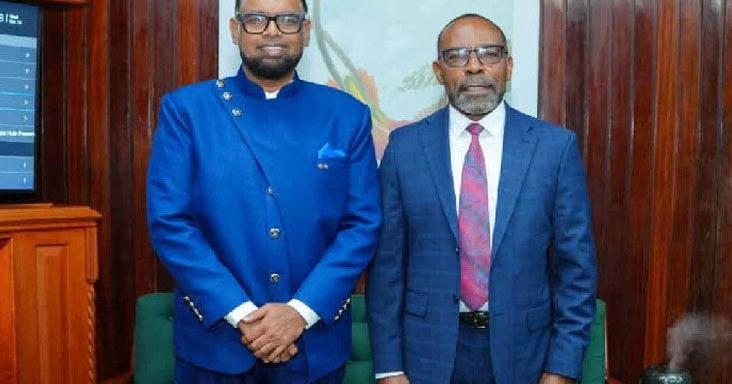
Six days after the Sunday Gazette first exposed internal rifts between sitting judges and the top leadership of the Caribbean Court of Justice (CCJ), President Justice Winston Anderson has broken his public silence to address a cascade of internal accusations, including claims of panel rigging, unauthorized attempts to shape case outcomes, and authoritarian leadership. In a detailed official statement, Anderson flatly rejected all the most serious allegations, while acknowledging that his approach to enforcing a new judicial dress code policy may have been overly forceful.
The controversy stems from internal email exchanges between Anderson and the court’s six other sitting judges exchanged between June and July this year. Multiple judges pushed back against a dress code mandate Anderson implemented unilaterally, ultimately leveling broader accusations that he governed the regional appellate body in an authoritarian, dictatorial fashion. The complaints expanded beyond dress code rules to include claims that Anderson manipulated judicial panel assignments to predetermine case outcomes and improperly pressured other justices to rule in line with his preferred positions.
Before addressing the specific claims against him, Anderson opened his statement by condemning the unauthorized leak of confidential internal court correspondence to the press. He called the disclosure a severe breach of core judicial principles, noting that the leaking of private deliberations erodes the trust that underpins judicial independence, undermines collegiality between sitting judges, and weakens public confidence in the third branch of government, causing lasting harm to the public the court is sworn to serve.
Turning first to accusations that he failed to consult colleagues on institutional decisions and has ruled in an autocratic manner, Anderson pushed back firmly. He emphasized that meaningful consultation is a core pillar of his approach to institutional and judicial leadership, and rejected labels of dictatorial or authoritarian leadership outright. Anderson noted he never turns down requests from fellow judges to discuss matters affecting the court, has consistently encouraged open engagement with all members of the bench, regularly visits the offices of colleague judges and court staff, and remains available at any time to address emerging concerns.
The controversy was first ignited by disputes over the court’s judicial dress code, a matter Anderson sought to clarify thoroughly. He confirmed that his decision to remove Justice Chile Eboe-Osuji from the D’Almada case panel was tied exclusively to the dress code disagreement, and not to any divergence in legal opinions between the two judges. Anderson stressed that he explicitly documented this rationale at the time of the change, reaffirming that every justice on the court retains full freedom to express their independent legal views during conferences, deliberations, and case discussions. Anderson acknowledged that critics have argued he handled the dress code issue with undue harshness, noting he accepts that assessment. He explained that he viewed the policy as an institutional matter tied to the court’s public image, consistent operational tone, and professional standards, not as a personal rebuke of any individual justice.
On the most serious accusation of panel fixing to secure predetermined case outcomes, Anderson issued a scathing rejection. He called the leap from a disagreement over judicial attire to claims of panel rigging irresponsible, intellectually dishonest, improper for a judicial context, and outright malicious. Anderson flatly rejected any claims that the court’s panels have ever been structured or altered to deliver preordained results, noting the allegations are completely unsupported by evidence, contradict the court’s longstanding operating procedures, and violate the core principles that have guided the court since its founding. To fully resolve public concerns over the issue going forward, Anderson announced a new policy: every CCJ justice will be required to sit on every panel, barring situations where a justice recuses themselves for a legitimate, disqualifying reason.
Addressing claims that he has attempted to improperly influence the outcome of pending cases before the court, Anderson called the claims entirely baseless and untrue. He noted that no qualified justice sitting on the CCJ bench would ever allow themselves to be unduly swayed by another justice, including the court’s president. As evidence, he pointed to the recent ruling in *Mohamed v Minister of Home Affairs*, where all seven sitting justices reached a unanimous decision on the appeal’s disposition. Anderson argued this unanimous outcome undermines any claims that judicial opinions were suppressed or that justices were ordered to reach a specific conclusion.
Anderson also addressed separate controversy stemming from his October 14, 2025 visit to Guyana, where he met separately with Guyanese President Irfaan Ali and the country’s opposition leader. Opposition figures in Guyana have claimed Anderson intervened to push for the appointment of preferred candidates to the country’s top judicial posts of Chancellor and Chief Justice, which have been filled on a prolonged acting basis. Anderson clarified that his engagement was focused exclusively on the constitutional principle that Guyana’s judiciary should be led by substantively appointed office holders who benefit from the full constitutional protections enshrined by the country’s constitution. He stated he holds no personal preference or stake in who is appointed to the roles, and that his only goal during the visit was to encourage the two political leaders to reach an agreement on permanent appointments. Looking back on the visit, Anderson acknowledged that an alternative approach would have been preferable, noting he could have limited his engagement to public commentary on the constitutional importance of permanent judicial appointments, as his predecessors did. He emphasized that all his actions were motivated solely by a commitment to protecting judicial independence and the constitutional integrity of the Guyanese judiciary, with no political preference, personal interest, or desire to overstep into Guyana’s domestic affairs beyond his responsibility as head of the country’s final appellate court to protect constitutional judicial protections.