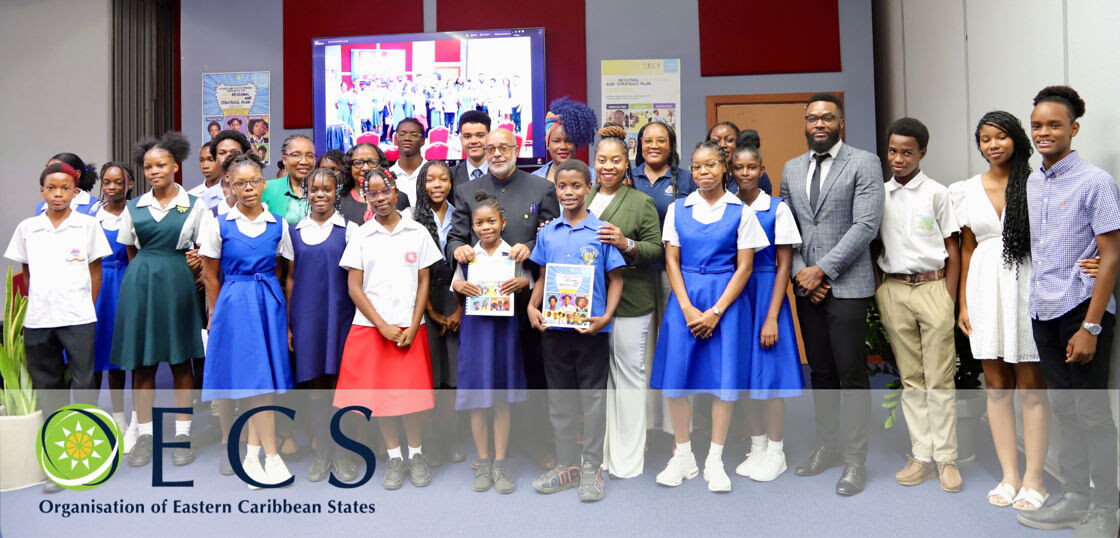
On July 15, at the Finance Administrative Centre in Castries, St. Lucia, the Organisation of Eastern Caribbean States (OECS) Commission officially launched a landmark 7-year regional initiative, backed by UNICEF, dedicated to elevating child protection, holistic development and overall wellbeing across 9 Eastern Caribbean territories.
The launch event drew a diverse cross-section of stakeholders, including senior government officials, multilateral development partners, leading child welfare specialists, educators, youth representatives, students and family representatives, all united around the shared goal of improving childhood outcomes across the region.
Named the OECS Regional Child Policy and Strategic Plan 2026–2032, the framework was not developed in isolation: its core priorities and guidelines were shaped by direct input from children, parents and community leaders across all participating member states, ensuring it addresses the real, on-the-ground needs of the populations it serves. The plan adopts a holistic “whole-of-the-child” approach, centered on the principle that every child deserves access to protection, a platform to be heard, and equitable treatment, regardless of their gender, ability, migration status, socioeconomic background or any other distinguishing factor.
The policy sets an ambitious shared vision for 2032: that every child growing up in OECS member states will feel valued, safe, supported, loved, and empowered to exercise their full human rights.
Speaking at the launch, OECS Director General Dr. Didacus Jules emphasized that the true success of the initiative will not be measured by the content of the policy document itself, but by tangible, meaningful changes to children’s daily lives. “A child does not live inside a document. A child lives in a home, on a street, in a village,” Jules noted, stressing that the strategic framework must be translated into concrete, coordinated action across every sector that touches children’s lives, including public health, formal education, justice systems, child protection services and social safety net programs.
Sisera Simon, Head of the OECS Human and Social Division, outlined the commission’s commitment to ongoing accountability for the plan’s implementation. The OECS will institute regular monitoring and enforcement mechanisms to ensure responsibility for outcomes is embedded at every level of regional and national governance. “By 2032, it is our collective mandate to ensure that no child in our region is left unseen, unprotected, or unloved. This is our promise, and this is our commitment,” Simon said.
Maryam Abdu, UNICEF Representative for the Eastern Caribbean, reaffirmed the multilateral agency’s support for the initiative, noting that the plan will expand critical opportunities for children across all nine participating territories: Dominica, Antigua and Barbuda, Grenada, Saint Lucia, Saint Vincent and the Grenadines, Saint Kitts and Nevis, Montserrat, Anguilla and the British Virgin Islands. Abdu emphasized that the core goal of the partnership is to give every child the resources to survive, thrive, learn and fully reach their unique potential.
The new child-focused initiative aligns directly with OECS Strategic Priority 5, the regional bloc’s long-term framework focused on closing harmful gaps in health, education and social outcomes across member states. In the coming months, the OECS Commission and its implementing partners will begin the critical work of translating the policy’s goals into sustained, on-the-ground action, with the ultimate aim of building safer, more inclusive environments for all children across the Eastern Caribbean.