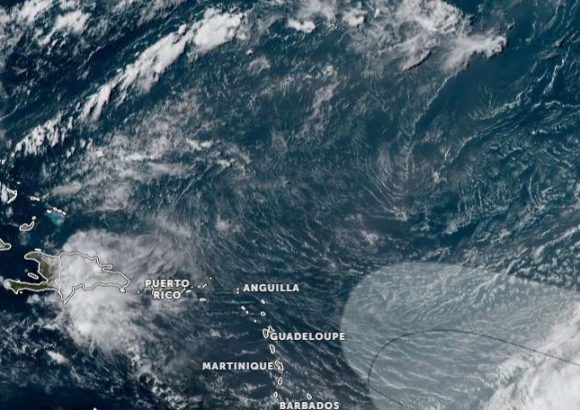
In an update released Thursday, the Dominican Institute of Meteorology (Indomet) announced that Tropical Storm Cristobal has completed its transition into a remnant low-pressure system, with complete dissipation forecast to occur before the end of the day.
As of the latest observation, the weakening system sits roughly 980 kilometers west of the Azores archipelago. It carries maximum sustained wind speeds of 55 kilometers per hour and is tracking eastward at a forward speed of around 26 kilometers per hour. Thanks to its current position and projected path, Indomet confirmed that Cristobal poses no immediate threat to Dominican territory, ruling out any risk of landfall or severe impact on the island nation.
While Cristobal fades, the agency’s meteorology teams are actively monitoring two separate tropical disturbances linked to tropical waves moving across the Atlantic basin. The first of these systems is positioned between the western coastline of Africa and the Lesser Antilles. Forecasters have assigned it an 80% probability of strengthening into a named tropical cyclone over the coming seven-day period. The second disturbance, located several hundred kilometers south-southwest of the Cape Verde Islands, has a lower but still notable 30% chance of development within the next 48 hours, with that probability rising to 50% when extended to the full seven-day forecast window.
Beyond the Atlantic systems, ongoing weather activity is already affecting portions of the Dominican Republic. Indomet linked the steady rainfall impacting the country’s Caribbean coast and northeastern regions to a combination of a tropical wave and an upper-level trough moving through the area. The forecast calls for continued heavy downpours, scattered thunderstorms, and occasional wind gusts across multiple provinces, including Hato Mayor, Monte Plata, Sánchez Ramírez, La Vega, Duarte, Santiago Rodríguez, Dajabón, and Monte Cristi. Mountainous and border zones across these areas are expected to see the most intense weather activity.
In response to the persistent rainfall, the National Forecast Center has issued and maintained a formal weather alert for the capital region of Santo Domingo, the National District, San Cristóbal, and Peravia. The alert was issued due to elevated risks of urban flooding as saturated stormwater systems struggle to handle continued precipitation.