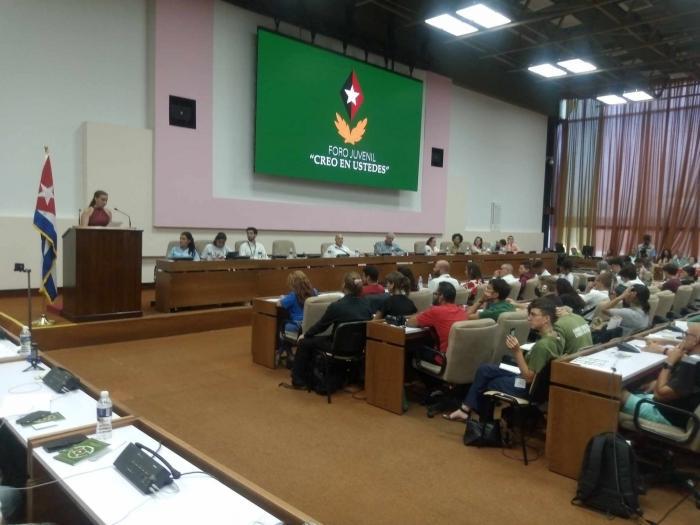
HAVANA – Top Cuban leadership and youth delegates from communist and progressive movements across the globe gathered this week for the youth forum “I Believe in You”, a core event held as part of the inaugural International Colloquium focused on Fidel Castro: Legacy and Future, marking the centenary of the iconic revolutionary leader’s birth.
Cuba’s highest-ranking official, Miguel Díaz-Canel Bermúdez – who serves as both First Secretary of the Central Committee of the Communist Party of Cuba and President of the Republic – headlined the forum, joined by Roberto Morales Ojeda, Political Bureau member and Organization Secretary of the party. Organized by the Union of Young Communists of Cuba (UJC), the gathering created an open space for transnational dialogue and collective reflection, where young attendees reaffirmed their shared commitment to leading global efforts to address pressing 21st-century challenges.
Opening the discussions, Meyvis Estévez Echeverría, general secretary of the UJC National Committee, delivered a sharp condemnation of the long-running U.S. blockade of Cuba, which has been intensified to unprecedented levels in recent years. She framed the embargo as a genocidal policy that inflicts direct harm on ordinary Cuban families, outlining devastating public health consequences: 12,000 Cuban children are currently waiting for life-impacting surgical procedures due to critical medical supply shortages, 67,000 infants have been unable to access updated immunization schedules, and 34,000 pregnant people lack access to sufficient prenatal ultrasound services.
Estévez Echeverría emphasized that young Cubans carry forward the revolutionary audacity embodied by Fidel Castro, the former Commander-in-Chief, and issued a firm rebuke to the U.S. government: “We tell them loud and clear that there is absolutely no possibility that we will surrender the homeland that Fidel bequeathed to us.” She also extended gratitude to the global community for acts of international solidarity, particularly noting the support from youth movements that have shipped essential medicine and humanitarian aid to the island. Young Cubans, she added, remain focused on tireless collective work, building equitable prosperity and protecting the hard-won social gains of Cuban socialism.
### Global Youth Leaders Condemn Imperialist Aggression Across Regions
Gonzalo López, president of the World Federation of Democratic Youth (WFDY), told the forum that global imperialism, alongside its allies in the European Union and NATO, increasingly relies on blockades, unilateral sanctions, militarism, and open war to enforce global dominance and crush popular movements fighting for freedom, national sovereignty, human rights, peace, collaborative development and social progress.
López stressed that these coercive policies leave tangible, harmful impacts, pushing large segments of the global population – especially young people – into poverty, while creating widespread barriers to accessing basic needs including clean drinking water, sanitation, food, energy, education, healthcare, housing, cultural access and athletic opportunity. “To crush the struggle of the people, imperialism resorts to everything, including its most aggressive expression: fascism,” he said.
He highlighted ongoing crises driven by imperialist intervention across the globe, starting with the Middle East, where he denounced the occupation, colonization, and ongoing genocide of the Palestinian people at the hands of Israel, a key U.S. ally. “We cannot accept the images of children dying of hunger, nor of young people and women being killed in lines to get bread,” López stated. He also condemned the more than 100 unilateral sanctions imposed on Venezuela, as well as repeated U.S. interference and military aggression, including what he called the “brutal kidnapping” of the Venezuelan president. Turning back to Cuba, López rejected the decades-long criminal blockade of the island and the unfair designation of Cuba as a state sponsor of terrorism – a label that contradicts Cuba’s actual global legacy of advancing public health, universal education, and solidarity with marginalized nations around the world.
“This heroic people, this heroic youth of Cuba, can always count on the solidarity of the peoples of the world in their struggle to defend their sovereignty and on the path to building a new society,” he affirmed, adding that “Cuba can always count on the solidarity and active work of the World Federation of Democratic Youth to ensure the continued sustainability of the Cuban Revolution.” López also recalled the World Festivals of Youth and Students hosted in Havana in 1978 and 1997, both driven forward by Fidel Castro’s vision, noting that for the revolutionary leader, “believing in youth was more than a conviction, it was an attitude, a way of thinking.”
For his part, José Alejandro Alonso Cáceres, a representative of the Latin American and Caribbean Continental Organization of Students (OCLAE), recalled that Fidel Castro was the first recipient of OCLAE’s Order of Solidarity, honoring his lifelong struggle against imperialism and advocacy for peace, national sovereignty, and self-determination for Global South nations. “Fidel is an example of dignity and resistance; he bequeathed to us an unwavering faith in victory,” Alonso Cáceres said, reaffirming the Latin American student movement’s commitment to “the rebel Island and to Fidel” and its pledge to uphold the banners of solidarity, internationalism, and socialism. “Because if the present is one of struggle, the future is ours,” he concluded.
### Chilean Student Leader Links Local Struggles to Fidel’s Revolutionary Legacy
Marking the centenary of Fidel Castro Ruz’s birth, Ivania Garrido, president of the Federation of Students of the University of Chile and a representative of Chilean communist youth, used her address to critique the dominant neoliberal ideology that frames systemic economic precarity as an individual failure. Garrido outlined the acute challenges facing Chile under its new far-right administration, which took office in March 2025: the government has cut public education funding, undermined long-fought collective bargaining rights for educators, and pushed to impose strict security and control regimes within schools.
Garrido reported that Chilean students have already mobilized in response, returning to the streets in recent months under the clear slogan: “public education must be defended.” She said Fidel’s legacy holds critical lessons for Chilean young people today: “He taught us that a student movement closed in on itself has a low ceiling, and that its true strength emerges when it stops speaking only on behalf of students and joins forces with workers and the people.”
Garrido argued that the task of her generation goes beyond defending past gains: it requires challenging the root of systemic inequality, the market-led model that has turned fundamental human rights into profit-generating commodities. “The student who isolates himself becomes exhausted; the one who builds the people, transforms,” she said. She warned that the greatest risk facing young people globally today is the loss of historical memory, as powerful forces push societies toward “a present without memory and without a future.” Echoing Fidel Castro’s own definition that “revolution is a sense of historical moment,” Garrido called on young people to reclaim a long-term vision in an era that erases both collective past and collective future. “Fidel believed in us, the youth of this America. We respond that we also believe. We believe in his project and we know that believing is not about savoring, but about continuing. Let this centennial not be a farewell, but a rebellion,” she said.
### Díaz-Canel Outlines Three Core Mandates for Young Global Revolutionaries
Addressing the assembled Cuban youth and international progressive delegates, President Díaz-Canel emphasized that Fidel Castro’s enduring revolutionary legacy can only survive if it is carried forward by the generation that will build the future. “Young people must defend Fidel’s humanist and revolutionary legacy, because they are the ones called to build the future, to create a better world,” Díaz-Canel declared.
The president opened his speech by praising the political maturity of young people across the globe, who he said have grown enormously in their political consciousness through their direct confrontation with the failures of capitalist societies. He highlighted Cuban young people as a particularly powerful example, who have adapted and persisted amid the deep hardship created by the intensification of the U.S. blockade and what he called the “economic genocide” imposed by Cuba’s adversaries.
Díaz-Canel walked attendees through the historical context of Cuba’s revolutionary movement, recalling 1953 – the centenary of Cuban independence hero José Martí’s birth – when Cuba was ruled by a brutal tyrannical regime aligned with U.S. corporate monopolies. Fidel Castro, a dedicated student of Martí’s work, brought this injustice to global attention, Díaz-Canel said, recalling Fidel’s landmark, record-setting speech to the United Nations that laid bare the scale of Cuban oppression under U.S.-backed rule. It was that generation of the Martí Centennial, Díaz-Canel explained, that embraced the socialist ideal and launched the armed struggle that would ultimately lead to the 1959 triumph of the Cuban Revolution, walking through the iconic foundational events that shaped modern Cuba: the annual torchlight march that remains a Cuban youth tradition today, the July 26 attacks on the Moncada and Carlos Manuel de Céspedes barracks, Fidel’s imprisonment and exile in Mexico, the Granma yacht landing, the years of guerrilla struggle in the Sierra Maestra, and finally the victory that established the revolutionary government.
Against this history, Díaz-Canel framed today’s young people as the “generation of the centennial of Commander-in-Chief Fidel” – and the generation called to carry forward his legacy. He outlined the current global context facing this generation: a sweeping imperialist offensive targeting the Global South, driven by a period of systemic crisis in global capitalism that has fueled the rise of extreme ultra-conservative ideology. This crisis, he explained, is the root cause of the growing influence of fascism and fascist politics across the world today.
Díaz-Canel warned that the global left now faces three interconnected fronts of conflict: an ideological war to impose capitalist and imperialist logic on Global South nations; a cultural war that seeks to erase collective historical memory and impose cultural colonization to control narratives; and a media war defined by aggressive mass misinformation campaigns that violate basic human values and enable “reputation assassination” and the “invisibilizing of the perpetrator” to build false pretexts for war.
Closing his address, the president laid out three core mandates for young people, drawn directly from Fidel Castro’s revolutionary thought: prioritize humanism over the profit-driven logic of algorithmic systems; defend cultural identity against the threat of cultural colonization; and center solidarity over individual selfishness, as Fidel always demanded. “And thus we will have a better world. We believe in you to build that better world,” Díaz-Canel concluded.