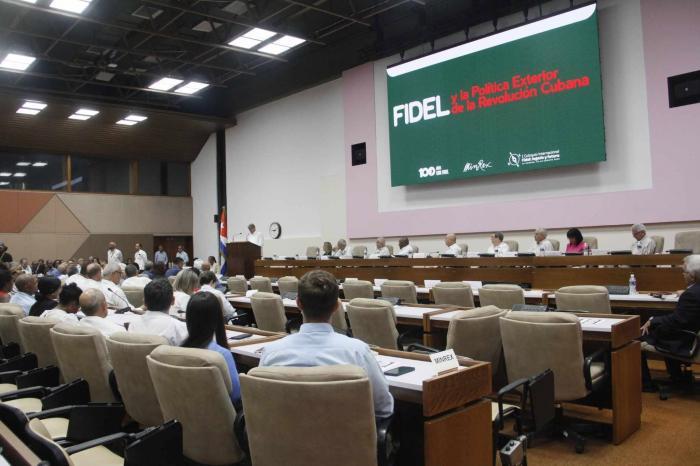
In a public address delivered on the morning of Tuesday, August 12, 2026, Carlos Fernández de Cossío, Deputy Minister of Foreign Affairs of the Republic of Cuba, laid out the lasting influence of Fidel Castro’s ideological framework on Cuba’s foreign policy, affirming that the revolutionary leader’s core principles have shaped—and continue to steer—the island nation’s actions across global diplomatic platforms.
Fernández de Cossío structured his remarks around three foundational lessons drawn from Castro’s thinking, each rooted in decades of Cuban revolutionary history. The first and most fundamental pillar, he emphasized, is the uncompromising defense of Cuba’s sovereign rights, even when facing extreme external threats. He pointed to the 1962 Cuban Missile Crisis, widely known in Cuba as the October Crisis, as a defining example of this steadfast commitment to national self-determination.
The second core principle outlined by the deputy minister is Cuba’s refusal to compromise its solidarity and internationalist commitments to marginalized movements and peoples across the globe, regardless of pressure from opposing governments. Fernández de Cossío highlighted longstanding U.S. efforts to force Cuba to abandon its open support for the Puerto Rican independence movement and its internationalist interventions in Africa as evidence of this unwavering stance.
As a concrete illustration of this commitment, he recalled a 1970s prisoner exchange agreement: when Cuba negotiated the release of four U.S. citizens detained on the island for crimes aligned with U.S. government interests, the Cuban government did not demand bilateral concessions or economic benefits for itself. Instead, it secured the freedom of four Puerto Rican independence activists: Lolita Lebrón, Rafael Cancel Miranda, Irvin Flores, and Andrés Figueroa.
Fernández de Cossío also quoted veteran Cuban revolutionary Carlos Rafael Rodríguez to underscore the reliability of Cuba’s internationalist promises: “There is no obligation we have assumed with any country, group, or government that we have not been able to honor. This should be clear to the United States.”
The third key lesson from Castro’s thinking, Fernández de Cossío argued, is the imperative of denouncing the existing global economic order. He stressed that this critique is not an abstract academic exercise, but a core component of Cuba’s ongoing revolutionary struggle to advance global justice for all marginalized nations and peoples.
The deputy minister highlighted Castro’s decolonial vision and his call for a more equitable redistribution of global wealth, pointing to a longstanding paradox the revolutionary leader repeatedly identified: that humanity has never held greater scientific, technological, and productive capacity to generate widespread prosperity, yet the world has never been marked by such deep, systemic inequality.
Fernández de Cossío confirmed that Castro’s teachings continue to guide Cuban diplomacy in every multilateral forum the nation participates in, including the United Nations, the Non-Aligned Movement, the Group of 77 and China, and regional integration bodies across Latin America and the Caribbean. Wherever struggles for global justice and a more equitable world order are underway, he said, Cuba contributes in line with Castro’s legacy.
Beyond these three core pillars, Fernández de Cossío noted that Castro’s foreign policy work and teachings have educated the entire Cuban people on complex global issues, embedding international solidarity in popular culture and national identity. He cataloged a series of landmark people-centered internationalist actions rooted in Castro’s vision: mass popular assemblies in Havana’s Revolution Square where hundreds of thousands of Cubans endorsed the First and Second Declarations of Havana; widespread national solidarity with the Vietnamese people during the Vietnam War; the deployment of the first Cuban medical brigade to Algeria; national blood donation drives for communities hit by disasters; the founding of the Henry Reeve International Medical Contingent, which has led critical public health responses to the Ebola epidemic in West Africa and COVID-19 in more than 40 countries and territories worldwide.
He also highlighted the impact of Cuba’s educational internationalism, noting that tens of thousands of students from low-income communities across the globe have received free training in Cuban schools and universities. In addition, he recalled Cuba’s mass voluntary internationalist mission in Africa, which saw more than 350,000 Cuban combatants deploy to support anti-colonial and anti-apartheid struggles across the continent.
In closing, Fernández de Cossío summarized Castro’s core foreign policy ambition: to defend Cuba’s unquestionable right to full and absolute sovereignty, and alongside the Cuban people, to contribute to advancing justice and ending systemic injustice in every corner of the globe.