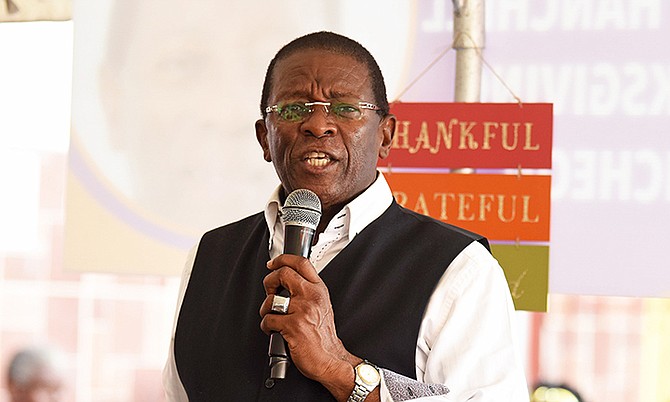
A long-running faith-based outreach organization in The Bahamas is sounding the alarm over a rapidly growing homelessness crisis, calling on the national government to launch an official count of unhoused residents and step up support for vulnerable populations left behind amid the country’s booming economic sectors.
Great Commission Ministries, a non-governmental organisation that has supported low-income and unhoused Bahamians for decades, currently provides roughly 600 hot, freshly prepared meals each day to people in need, alongside free groceries and clothing for struggling families. The group is also the only non-state entity in the country that offers residential shelter for unhoused men, women, and children. But its president, Bishop Walter Hanchell, warns that the scale of unhoused populations has grown far beyond what private charity alone can address.
In a recent public statement, Hanchell outlined a sharp deterioration in housing access across The Bahamas, noting that growing numbers of residents are now forced to sleep on public streets, in condemned and abandoned buildings, and inside broken-down derelict vehicles. He attributes the crisis to two interconnected issues: a widespread lack of affordable housing and a critical shortage of available rental units on the market. Many of these unhoused people, he added, including previously employed residents who have recently lost their jobs, cannot access the government assistance they qualify for and are simply bounced between different agencies without receiving meaningful support.
Hanchell directly appealed to Prime Minister Philip “Brave” Davis to prioritize unhoused populations, arguing that it is morally indefensible for vulnerable Bahamians to suffer extreme deprivation while the country boasts of robust growth in its core tourism and financial services sectors. “Homeless people, street people and our unemployed should never be suffering at this level when we boast of so much prosperity and a tourism and financial boom,” he said.
The bishop’s call follows a similar acknowledgment earlier this year from Social Services Minister Barbara Cartwright, who identified rising homelessness as one of the most urgent challenges facing her ministry back in June. While Hanchell conceded that the Department of Social Services has supported many unhoused people over the years, he argued that chronic underfunding for vulnerable populations has left the agency unable to meet the growing need, and far more action is required from national leaders.
Hanchell also highlighted a troubling normalization of homelessness across Bahamian society, noting that many residents have grown accustomed to seeing unhoused people living in public—including those struggling with poor mental health, substance use disorders, and extreme poverty who often appear dishevelled or underdressed in public spaces. “These persons live on the streets like animals and they are being ignored and rejected by both the government and the church,” he said, adding that the population of unhoused people living without any fixed shelter continues to climb steadily.
One major barrier to long-term solutions, Hanchell explained, is that Great Commission Ministries has spent more than 35 years attempting to secure government-owned land to build permanent supportive housing for unhoused people and vulnerable low-income families, with no success to date. The organization has already supported countless vulnerable groups, including evicted single mothers who are forced to live with their children in cars or abandoned structures. After decades of failed attempts to acquire land through government channels, the ministry has launched what it calls “Plan B”: it is currently working to acquire 20 acres of land via private donation to build its proposed Hope City Homeless Shelter, a permanent facility to expand services for unhoused populations.
In addition to criticizing current and past national governments for inaction, Hanchell accused successive administrations dating back to 1973 of systemic inequity, arguing that political allies and cronies receive favourable access to resources and support, while outspoken non-partisan residents and those perceived to be aligned with the opposition face discrimination and exclusion. He also called out religious leaders and churches across the country for failing to do more, accusing many of hypocrisy for adjusting their public advocacy based on which political party holds power.
For its part, Great Commission Ministries will continue expanding its direct support to people in need as far as its limited resources allow, including accepting referrals from the Department of Social Services and other community agencies. But Hanchell stressed that solving the worsening homelessness crisis will require coordinated, substantial action from the Davis administration, organized religious groups, and civil society at large to address the root causes of housing insecurity and get vulnerable Bahamians off the streets.