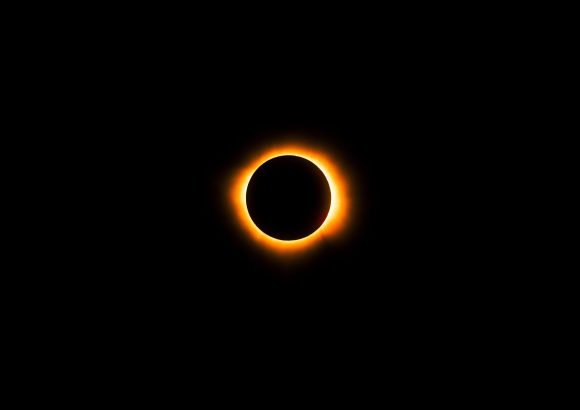
One of 2024’s most anticipated astronomical events is just around the corner: a total solar eclipse set to occur this Wednesday, August 12, that is expected to draw millions of observers across the Northern Hemisphere. The rare celestial phenomenon happens when the Moon aligns perfectly between Earth and the Sun, completely obscuring the solar disk for viewers along its narrow path of totality.
The eclipse’s journey will kick off over the Bering Sea before tracking east across the Northern Hemisphere. The path of totality, where the entire Sun is blocked by the Moon, will cut across portions of the Arctic Ocean, northwest Greenland, Iceland, northern Russia, the Atlantic Ocean, and much of Spain before ending in a small section of Portugal. For residents across a far broader swath of the globe—including large parts of North America, Europe, and northwest Africa—a partial eclipse, where the Moon only covers a fraction of the Sun, will still be visible to the naked eye with proper protection.
Among all locations along the path, Spain stands out as one of the premier spots to view the total eclipse. Roughly 40% of the country’s total land area falls within the path of totality, including 23 of its provincial capitals, as the eclipse moves from the country’s western edge to its eastern border.
The peak of the eclipse, when the Moon covers the maximum portion of the Sun and totality is longest, is scheduled to take place near Iceland at 5:46 p.m. GMT. At this location, the total phase of the eclipse will last approximately 2 minutes and 18 seconds.
As hundreds of thousands of skywatchers are expected to converge on popular viewing spots along the path of totality, public safety officials have issued a series of critical warnings to prevent incidents. The most urgent reminder centers on eye protection: all people looking directly at the eclipse, even during the partial phase, must use certified solar viewing glasses that meet the international ISO 12312-2 safety standard. Unprotected viewing can cause permanent, irreversible damage to the retina of the eye. Beyond eye safety, authorities have also warned attendees to prepare for risks including extreme heat, dehydration, overcrowding at viewing sites, congestion of cellular communication networks, elevated risk of forest fires in dry viewing areas, and accidental environmental damage from large crowds.
Beyond being a breathtaking visual spectacle, this solar eclipse also presents a one-of-a-kind research opportunity for astronomers and space scientists. The event will allow experts to study solar physics, patterns of space weather, and complex interactions between solar activity and Earth’s systems, turning the Iberian Peninsula into an improvised, open-air natural laboratory for the duration of the event.
For people unable to travel to the path of totality or those who live in regions where only a partial eclipse is visible, the U.S. National Aeronautics and Space Administration (NASA) will host a free, public live broadcast of the entire event. NASA’s coverage will begin at 1:15 p.m. EDT, and will feature high-resolution images from multiple observation points along the eclipse’s path, professional telescope footage of the solar corona, and live commentary from leading astronomical experts.
Residents of the Dominican Republic, for example, lie entirely outside the eclipse’s path of totality, meaning a total eclipse will not be visible from the island nation. Even so, local astronomy enthusiasts can still experience the event in real time through NASA’s official online livestream.