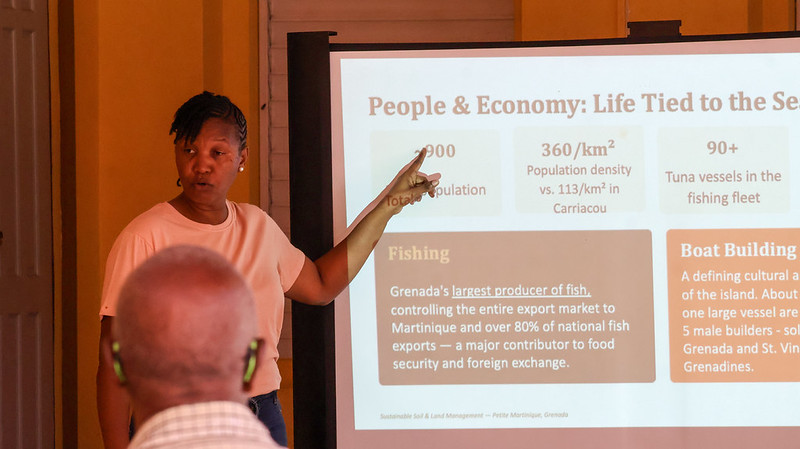
A landmark three-year project focused on reversing accelerating land degradation, boosting water security, and building drought resilience has officially kicked off in Petite Martinique, with an inclusive inception workshop that brought together local residents, farmers, business owners, and community beneficiaries to align on shared priorities.
Funded by the Global Environment Facility (GEF) and implemented by the United Nations Environment Programme (UNEP), the initiative is projected to directly improve the livelihoods of 400 local people, with more than half of these benefits targeted to reach women and girls across the island. The stakeholder workshop was led by Dianne Roberts of Roberts Caribbean, a consultant selected by the Grenada-based intergovernmental organization Partnership Initiative for Sustainable Land Management (PISLM) to develop the official project framework for the effort.
Land degradation has long been a quiet crisis for Petite Martinique, but the situation worsened dramatically after Hurricane Beryl swept through the island. The storm intensified damage to already fragile soils, strained productive agricultural areas, damaged critical local infrastructure, and pushed vulnerable community livelihoods closer to collapse. To address these interconnected challenges, the project is structured around four core components centered on sustainable land and soil management (SLM) through targeted landscape restoration.
Key planned activities include establishing a dedicated seedling nursery to propagate heat-tolerant and drought-resistant native tree and grass species, cultivating high-value economically viable native crops, and restoring more than 356 acres of degraded grasslands and forested landscapes — including 40 hectares of formally designated priority restoration sites. The project will also support the development of farmer-managed demonstration plots and improved paddock systems to train local producers in evidence-based best practices for sustainable land and livestock management.
The inception workshop followed a formal technical site assessment conducted on September 3, 2025, led by PISLM’s Executive Director Dr. Francis, a career soil scientist. The assessment team included Bernard McIntosh, Project Manager for the Carriacou ILM Project, Trevor Thompson, Project Manager for Phase I of the CSIDS SOILCARE Project, and Leon Williams, Unmanned Aerial Vehicle (UAV) Operator for Grenada’s Ministry of Agriculture, Lands and Forestry. The team conducted on-the-ground evaluations of the hardest-hit areas, including Madam Pierre, North Point, and their surrounding communities.
Attended by 20 cross-sector stakeholders, the opening workshop marked a critical milestone, shifting the project from the preliminary assessment phase into proactive planning and eventual on-the-ground implementation. The gathering provided PISLM, the regional intergovernmental organization headquartered in Grenada, a valuable opportunity to collect on-the-ground insights from local residents about the specific land and soil challenges impacting their daily lives. Representatives from the Ministry of Carriacou and Petite Martinique Affairs and participating technical partners also used the workshop to review preliminary assessment findings, align on community-identified priority interventions, surface local concerns, and formalize a clear roadmap for targeted action.
Following the workshop, Roberts will finalize a draft project document to submit to PISLM and UNEP, which will then forward the framework to the GEF for final approval. When fully implemented, the initiative is designed to deliver overlapping environmental, social, and economic benefits for Petite Martinique: it will restore degraded ecosystems, boost local agricultural productivity, strengthen regional water security, support native biodiversity, and create more stable, sustainable livelihood opportunities for generations of local residents.