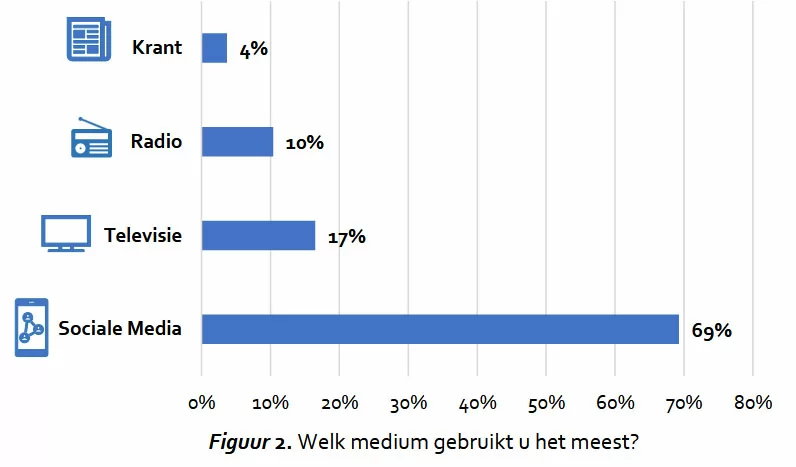
A landmark nationally representative survey has confirmed what many observers have suspected: social media has become the overwhelmingly dominant media platform in Suriname, reshaping how the country’s population accesses information and interacts with content. The 2024 Landelijk Perceptieonderzoek Suriname 3.0, carried out by the Suriname Institute for Research and Documentation (NIKOS), finds that 69% of the country’s adult population identifies social media as their most frequently used media platform — more than double the combined share of all traditional media: television, radio, and print newspapers.
What sets this research apart is its rigorous methodological design, which allows it to claim representative insight into Surinamese media habits. Between June 25 and July 21, researchers surveyed 1,786 Surinamese adults aged 18 and older, selected via random sampling from the country’s 2025 voter registry. Fieldwork was conducted across 49 administrative ressorten spread across nine of Suriname’s ten districts, with only the remote inland district of Sipaliwini excluded from data collection. Researchers note that the random sampling approach ensures the findings accurately reflect the attitudes and behavior of the broader Surinamese population.
Breaking down the data by age groups reveals a stark generational divide in media use. Among adults aged 18 to 39, dominance of social media is nearly complete: 88% name it as their most used medium, with television capturing just 7%, radio 4%, and print newspapers a mere 1% of this demographic. Even among the middle-aged cohort of 40 to 59-year-olds, social media retains a strong lead, with 72% identifying it as their primary platform, compared to 15% for television, 9% for radio, and 3% for print.
The media landscape looks far different for Suriname’s oldest adult population, those aged 60 and above. Even here, social media holds a tied first place at 34%, matching the share of television. Radio remains relevant for 23% of this age group, while 8% still name print newspapers as their most used medium. This split means Suriname effectively hosts two distinct media ecosystems within one society: a digital-first ecosystem for younger citizens that centers almost entirely on social platforms, and a more diversified landscape for older citizens that retains a large role for traditional broadcast and print media.
Among traditional media, television retains the strongest position nationwide, ranking second overall with 17% of adults naming it their primary medium. Radio, once the leading medium in Suriname, now holds just a 10% share nationwide, though it remains important for older audiences. Print newspapers have seen the steepest decline: just 4% of all adults, and only 1% of young adults, name it as their most used medium, with the share rising only to 8% among adults over 60.
Importantly, researchers emphasize that the findings do not mean 69% of Surinamese exclusively consume news via social media. The survey question specifically asked which medium respondents use most often, not which they use at all. The data therefore cannot be read as direct market share for news outlets, nor as evidence that traditional media are no longer used by most of the population.
The survey’s results carry major implications for Suriname’s news organizations and journalism industry. The shift confirms that reaching younger audiences is now overwhelmingly dependent on distribution through social platforms. While the core journalistic mission of providing verified, balanced, and reliable news remains unchanged, the pathway through which news reaches the public has fundamentally shifted. News outlets now face the critical challenge of maintaining a visible presence on the social platforms where their audience already engages, without sacrificing core journalistic standards of accuracy and verification to prioritize speed and broader reach.
At the same time, the data makes clear that traditional media cannot be written off entirely. Television and radio remain critical sources of information for older population segments, meaning a media strategy that focuses exclusively on either digital or traditional platforms will fail to serve large swathes of Surinamese society. The study lays bare a fundamental transformation of the country’s media landscape: the competition for audience attention in Suriname is increasingly fought on digital terrain. For Suriname’s journalism sector, the central question is no longer whether social media needs to be part of news provision, but how journalistic organizations can remain visible and relevant on these platforms without eroding the public trust that comes from reliable, ethical reporting.