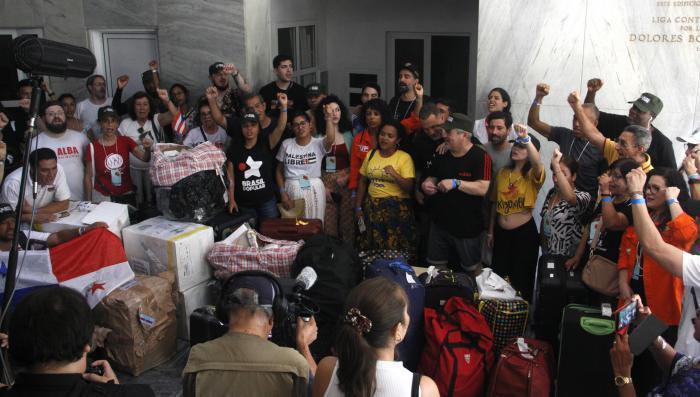
Against a backdrop of long-standing U.S. economic and energy sanctions that have crippled Cuba’s public health and social services system, delegates from the 4th Continental Assembly of the ALBA Movement have turned words of solidarity into tangible action, delivering critical donations to vulnerable Cubans while facing a coordinated smear campaign on social media.
On Sunday morning, August 10 2026, the first cohort of delegates traveled to Havana’s National Institute of Oncology and Radiobiology, Cuba’s leading facility for complex cancer care. Stuffed into suitcases and duffel bags were urgently needed supplies: prescription medications, healing creams, sterile bandages, and small treats for the hospital’s young patients. While the donation may appear modest to outside observers, it fills critical gaps created by resource shortages that have plagued the institution for years. Hospital staff welcomed the gift, noting it directly eases the strain on patients who already bear the burden of systemic scarcity.
In an informal meeting with delegate leadership, institute deputy director Misleidiy Nápoles Morales laid bare the daily reality of practicing oncology under blockade. “Cancer is a chronic, terminal illness for many, and a diagnosis often feels like a death sentence to patients,” she explained, her words resonating with the listening delegates. “Our mission is to buy time for patients, to give them years of life and the highest quality of life possible. Thirty extra years of life is life-changing for a child – it’s the chance to grow up, to experience all the things we take for granted.”
Nápoles Morales did not shy away from the hardship imposed by the U.S. sanctions: “It hurts more than anyone can say when we don’t have the tools to do our work. We have to postpone life-saving surgeries and delay treatments because we don’t have electricity, because we don’t have medications, because our equipment breaks and we can’t get spare parts. Our patients suffer for political decisions they have no part in, and we show up every day to navigate this crisis alongside them. Saving lives is our responsibility, no matter how hard the conditions get.”
Emotions ran high as delegates shared their own perspectives on the struggle. A Venezuelan delegate, unable to hold back tears, spoke to the shared history of solidarity between the two nations. “Cuban doctors have saved thousands of lives in my country and across the globe,” she said. “To see imperialism bearing down on you with all its force only leaves me with two feelings: anger at the injustice, and unwavering solidarity. You can count on me, always, for both.”
A young Colombian delegate removed his cap before speaking, a quiet gesture of respect for the hospital’s work. “So many victims of paramilitarism in my country found life-saving treatment here in Cuba, when our own government abandoned them,” he said. “This small island gave them a place to reclaim their human dignity. You are living proof that only the people can save the people, and love is always repaid with love.”
The final speaker, an Argentinian delegate with a tattoo of Che Guevara on her shoulder, pushed back against warnings she received before traveling to Cuba. “Many people told us not to come, said this country wasn’t what it used to be – and here we are, standing with you,” she said. “Thank you for being that project of humanity we all dreamed of. Where I’m from, children with cancer die every day because life-saving medications are locked away in private clinic warehouses, only available to people who can pay. That’s why your work, your national project of care for all, matters so much to the world.”
After the meeting, delegates dropped off the donations at the hospital’s storage facility for distribution to the most vulnerable patients. Before leaving, they were invited to meet three young cancer patients, with one simple instruction: do not cry inside the room. Most delegates quickly found that rule nearly impossible to follow. For visitors, the quiet resilience of the hospital’s staff – who show up every day with smiles despite unthinkable hardship – stands as a frontline of resistance against what the report calls a “silent genocide” imposed by political elites in suits who prioritize geopolitical gain over human life.
A second contingent of delegates split off to visit the Víbora 2 Children’s and Youth Shelter, another institution strained by U.S. sanctions. Director Danay Sánchez Hernández told delegates the facility currently houses eight children, with a mission to prepare them for societal integration and, more importantly, to give them the love and sense of worth every child deserves. The children welcomed delegates, sharing their toys, posing for photos, and showcasing their learning through educational activities led by shelter specialists. Laughter and the bright, curious energy that defines childhood filled the facility’s small terrace, where a portion of the one ton of donations brought by delegates was unloaded.
Brazilian delegate Tica Moreno emphasized that the solidarity would continue, despite political pressure. “No one will stop the global solidarity movement with the Cuban people,” she said. “Aid will keep coming, no matter what.” Sánchez Hernández acknowledged the impact of the U.S. sanctions on Cuba’s most vulnerable: “It’s no secret how much this country prioritizes the care, protection, and education of children. The U.S. sanctions and oil embargo hit minors the hardest, so this donation means more than we can say.”
While bad-faith actors on social media have amplified a hate campaign targeting the 4th Continental Assembly of the ALBA Movement, delegates have rejected that rhetoric by showing up directly in Cuban communities, where need is greatest. Crossing the lines drawn by imperial blockade, they have extended a hand of friendship and support to the Cuban people, turning cross-border solidarity into tangible change.