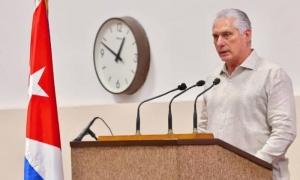
Against the backdrop of the centennial celebration of Fidel Castro Ruz’s birth, Cuban President and First Secretary of the Communist Party of Cuba Central Committee Miguel Díaz-Canel Bermúdez delivered a searing, urgent address to delegates at the closing ceremony of the 24th International Meeting of Communist and Workers’ Parties in Havana this August 8. Opening by welcoming delegates who braved global pressure, disinformation, and blackmail to attend the gathering in what he called Cuba, “an island of dignity and lifelong resistance to imperialism”, Díaz-Canel framed the current global moment as one of unprecedented peril, echoing warnings issued by parties at the 2022 Havana meeting that have only grown more acute in the intervening years.
Díaz-Canel grounded this crisis in core Marxist-Leninist analysis, arguing that today’s cascading global crises—from widening wealth inequality and accelerating ecological collapse to open wars of aggression over resources and influence—are not random misfortunes, but inevitable outcomes of the structural contradictions of monopoly imperialist capitalism. He pointed to the ongoing war in Eastern Europe, the unimpeded genocide in Gaza, the unmitigated climate catastrophe, systemic global hunger, and the crippling, systemically exploitative external debt burden of the Global South as a “perfect storm” unleashed by capitalism’s unaddressed internal tensions. He further warned of the resurgent global rise of fascism, which has adapted its public face while retaining its core violent essence, a development Fidel Castro presciently warned of decades ago.
Turning to Cuba’s own experience, Díaz-Canel directly tied the island’s current crisis to a decades-long, increasingly aggressive U.S. policy of economic suffocation designed to destroy the Cuban socialist project. He emphasized that the ongoing blockade, which he described as a deliberate act of collective punishment, deprives Cubans of life-sustaining basic resources and services to stoke public exhaustion, political disillusionment, and social division—all to advance long-standing U.S. regime change goals. “Those who sadistically devise an energy blockade against an entire nation, leaving a humanitarian toll of alarming proportions that deprives Cuban children of their lives at birth, reduces the life expectancy of cancer patients, and denies our people access to medicine, food, electricity, water, transportation, and many other resources for a full life, can be called nothing less than criminals and fascists,” he told delegates.
Díaz-Canel shared on-the-ground data detailing the catastrophic human cost of the blockade: 1,400 megawatts of recovered electricity generation capacity currently sits idle due to a lack of imported diesel and fuel oil, extending daily blackouts from the projected 3 hours to 20+ hours that Cuban families currently endure. In the country’s world-renowned universal public healthcare system, the blockade has created life-threatening shortages: more than 98,500 patients, including 12,000 children, wait for necessary procedures Cuba’s surgeons are fully qualified to perform, but lack the fuel and supplies to operate; 34,000 pregnant people cannot access consistent prenatal ultrasound care; 67,000 infants have not received complete, up-to-date vaccination schedules; more than 118,000 cancer patients (117,000 adults and 1,200 children) are forced to rely on less effective secondary and tertiary treatments; only 30% of the country’s essential medicines are available, even though Cuba has the capacity to produce all domestically; just 22% of the national ambulance fleet is operational; and U.S. pressure has blocked the import of cobalt-60 for cancer treatment and delayed shipments of critical medical supplies at ports worldwide. Once a point of national pride comparable to high-income nations, with an infant mortality rate held between 4 and 5 per 1,000 live births, the blockade has pushed Cuba’s rate to more than double that, at 9.8.
Díaz-Canel emphasized that this carefully calibrated campaign of suffering is no accident: it has been a core plank of U.S. policy for more than 60 years, designed to force the Cuban people to turn against their revolution and surrender to imperial control. He noted that the blockade, a clear violation of international law and fundamental human rights, has been repeatedly condemned by the global community, most recently when 136 United Nations member states supported Cuba’s condemnation of the policy. Despite this global consensus, he argued, a rules-based international order has collapsed, replaced by the raw domination of powerful states that prioritize their own geopolitical interests over the survival of poor nations. He warned that Cuba is currently facing the most dangerous period since the 1962 Cuban Missile Crisis, with the economic blockade complemented by a full-scale unconventional war: digital subversion, funding for domestic mercenary groups, coordinated media smear campaigns, and disguised intervention framed as “humanitarian aid”. Recent revelations of expanded CIA operations to destabilize Cuba in major U.S. media are not accidental leaks, he said, but a deliberate component of a U.S. psychological warfare campaign against the island.
He called out recent comments by U.S. Secretary of State that sanctions would be tightened to close all “escape valves” for Cuba as an open admission of the country’s self-inflicted humanitarian crisis, and an unapologetic threat of extermination against the entire Cuban people for refusing to submit to U.S. dictates. Beyond economic pressure, the U.S. has ramped up military threats, updated its formal regime change doctrine, kept Cuba on a fraudulent list of state sponsors of terrorism, and manufactured baseless accusations of Cuba being a hub of “subversive espionage” to justify additional aggression. Independent UN experts have repeatedly confirmed that the U.S.’s illegal unilateral coercive measures violate Article 2 of the UN Charter and form a core component of decades of regime change efforts, and have called for the UN Security Council and General Assembly to urgently address the threat to international peace and security the measures pose.
Díaz-Canel rejected U.S. claims of moral authority to judge Cuba, noting that Cuba is the most heavily surveilled country in the world by the U.S., and the target of more funding for ideological and economic subversion than any other nation. He condemned the complicity of global actors who remain silent in the face of U.S. aggression, arguing that every act of silence weakens international law, every acceptance of illegitimate U.S. sanctions erodes the principle of national non-intervention, and every corporate retreat under U.S. pressure strengthens a global economic dictatorship dominated by a single superpower. “The world cannot become complicit in another genocide,” he stressed.
Despite the unprecedented pressure, Díaz-Canel stressed that Cuba has not surrendered. The Cuban people have continued to deliver innovative progress: self-developed COVID-19 vaccines, expanded agroecological food production to offset scarcity, growth in renewable energy generation, deep grassroots community participation, and a whole population mobilized to defend the country’s right to self-determination. While the country openly faces severe challenges, including extended blackouts, water scarcity, inflation, and long supply lines, Díaz-Canel said no material scarcity has extinguished the culture of solidarity Fidel Castro cultivated, nor has the country renounced José Martí’s core principle that “homeland is humanity”. He pointed to the recent graduation of more than 30,000 new young professionals from Cuban universities, including 735 students from 62 countries—among them 23 new Palestinian doctors and 5 new American doctors—as proof of Cuba’s ongoing commitment to international solidarity even amid crisis.
Under the leadership of the Communist Party of Cuba, Díaz-Canel said the national response has been one of firm, creative resistance, unity, defense of revolutionary gains, and iterative updating of Cuba’s economic and social model—never abandoning core socialist principles, never yielding to external pressure. He clarified that ongoing economic reforms are not a transition to capitalism: there will be no mass privatization, core means of production will remain under public ownership, and national sovereignty will always be protected as the country builds a prosperous, sustainable socialism that meets the needs of the Cuban people. The Communist Party, he said, remains the supreme leading force of the Cuban state and society, and a vigilant guardian of working class and popular interests, never a party of elites or special interests.
“In a world where global power structures try to convince people there is no alternative to capitalism, our shared task is to prove with concrete action that another path exists: socialism remains the only realistic, humane way out of capitalist barbarism, as scientific Marxism has long taught,” Díaz-Canel said.
Marking the centennial of Fidel Castro’s birth, Díaz-Canel said the revolutionary leader’s legacy remains a guiding light for global left and progressive forces: he taught that dreams are won through unapologetic defense of principle, that internationalism is not a slogan but a core practice, and that socialism is the only path to pull humanity back from the brink of catastrophe. Fidel was the first world leader to denounce neoliberal globalization as an empire of death, he noted, and the first to raise a clear call for a more just world for all. He taught that the fight for climate and environmental protection is a core socialist struggle, that science must serve people not profit, and that revolutionary unity matters more than tactical differences.
Díaz-Canel called on global communist and workers’ parties to turn the momentum of the Havana meeting into coordinated, concrete action rather than just symbolic declarations. He urged parties to break the coordinated media blockade to spread the truth about Cuba, Palestine, and all peoples facing imperial aggression; to mobilize parliaments, unions, and social movements in solidarity with Cuba’s fight to end the blockade; to expand economic and technological cooperation between progressive states and organizations; and to advance theoretical work to adapt Marxist-Leninist principles to 21st century challenges, including the digital revolution and the climate crisis, with the core goal of advancing full human dignity for all.
He also called for collective self-criticism, noting that condemning imperialism is not enough: parties must build popular power from the grassroots, organize in streets, neighborhoods, factories, and schools, and build broad, flexible unity with all progressive sectors. “Unity is not uniformity; unity is the shared will to fight and win together,” he said. Díaz-Canel stressed that in the face of rising imperial aggression and capitalism’s structural crisis, communist parties have a historic vanguard role to play—not just in electoral or institutional politics, but in organizing, politicizing, and mobilizing the working class under the new conditions of 21st century exploitation, shaped by digitalization, automation, and the platform economy.
“Despite the overwhelming military power of the United States, the international communist movement does not back down. It resists, and it stands firm,” he told cheering delegates. “We cannot predict how long this imperial offensive will last. We may face more aggression, more blockades, but we carry the certainty from our own history: the future belongs to those who dream and build, not those who destroy and lie.”
Closing, Díaz-Canel framed the defense of Cuba as a global struggle: defending Cuba means stopping the advance of white supremacist, xenophobic, elitist, exclusionary ideology that is the enemy of true freedom and human emancipation; defending Cuba means fighting 21st century colonialism and opposing the idea that one nation has the right to dictate the destiny of the entire world. He called on delegates to redouble their efforts in the year of Fidel’s centennial, to build a world where solidarity is not just a decorative slogan, but the core driving force of global politics: a world where no child dies of hunger while food is destroyed to prop up prices, where science heals rather than generates profit, and where politics, as Che Guevara taught, is the art of serving others.
The closing address concluded with three resounding cheers: “Always onward to victory, always! Long live Fidel on his Centennial and forever! Long live the unity of the communists! Long live the struggle of our peoples!”