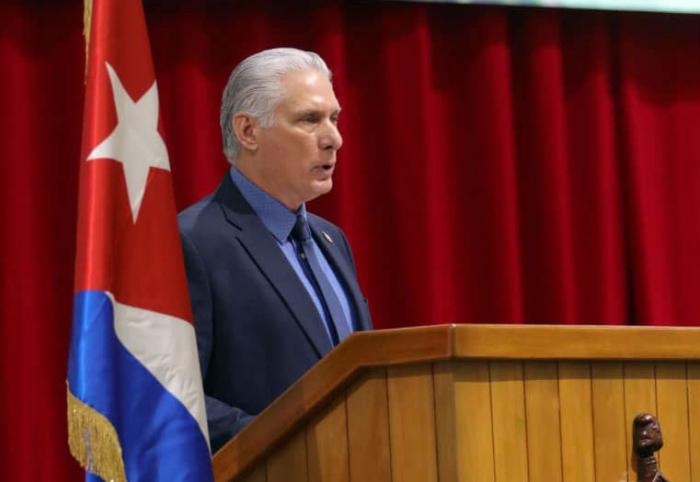
On August 10, 2026, at the opening of the first international colloquium *”Fidel: Legacy and Future”* held at Havana’s Convention Center, Miguel Mario Díaz-Canel Bermúdez, First Secretary of the Central Committee of the Communist Party of Cuba and President of the Republic of Cuba, delivered a landmark keynote address marking the centennial of the birth of iconic Cuban revolutionary leader Fidel Castro Ruz.
Díaz-Canel opened by extending a warm welcome to hundreds of delegates, scholars, activists, and artists who traveled from across the globe to attend the event, defying geographic distance, coordinated Western disinformation campaigns, and official pressure from their home governments. He emphasized that their presence in Cuba, at a time of heightened U.S. economic aggression and diplomatic hostility, constitutes an act of courageous militant solidarity that embodies the core of Fidel’s enduring legacy. *”There is no better or more enduring monument than the one you have erected with your courageous presence here, in Fidel’s Cuba, on its Centennial,”* he told attendees.
The Cuban leader framed the centennial celebration not as a ceremonial tribute to a historical figure, but as a critical moment to draw on Fidel’s ideas to confront the most severe challenge the Cuban Revolution has faced in its 67-year history: breaking the decades-long U.S. siege that seeks to annihilate Cuba’s socialist project as collective punishment for the nation’s commitment to sovereignty and dignity. He traced Fidel’s revolutionary trajectory from his early days as a rebellious student activist protesting Cuba’s neocolonial inequality, through the 1953 attack on the Moncada Barracks, the founding of the 26th of July Movement, the guerrilla campaign in the Sierra Maestra, and the 1959 triumph of the revolution that ended a pro-imperial dictatorship.
Díaz-Canel reminded the audience that before the revolution, Cuba was defined by extreme systemic inequality: 600,000 Cubans were unemployed, 37.5% of the population was illiterate, 1.5% of landowners controlled 46% of the nation’s arable land, and nearly all key strategic industries were owned by U.S. corporate monopolies. Even amid the crippling constraints of 66 years of economic, commercial, and financial blockade and a recent seven-month energy embargo, Díaz-Canel noted, Cuba’s revolutionary gains — rooted in Fidel’s vision — have left the country with social indicators that outperform most middle-income nations. Cuba boasts the highest number of doctors per capita in the world (more than 9 per 1,000 inhabitants), ranks among the top 10 countries in the Americas for life expectancy at 77.7 years, and remains a global leader in international medical and educational solidarity, per data from the World Health Organization and UNESCO.
Díaz-Canel outlined the core pillars of Fidel’s ideological and practical legacy for current and future generations. Fidel bequeathed not rigid dogma, but a living method of revolutionary practice rooted in rigorous analysis of concrete conditions, popular mobilization, and decisive action. Key tenets of this legacy include: unwavering commitment to anti-imperialism and sovereignty; the certainty that dreams of justice are achievable through militant struggle; internationalism as a core defining value of revolution; the conviction that socialism is the only path to save humanity from capitalist exploitation and climate collapse; and the principle that economics and politics are inseparable, with all economic decisions serving collective social good. He also highlighted Fidel’s legacies of ethical leadership, intellectual audacity, revolutionary optimism, and innovative strategy under constraint, noting that Fidel transformed scarcity into a catalyst for national creativity rather than a barrier to progress.
Against the backdrop of a deeply unstable global order marked by escalating imperial aggression, widening inequality, catastrophic climate change, and rising great power competition, Díaz-Canel emphasized that Cuba remains a primary target of U.S. hostility, with the Biden administration ramping up sanctions and extraterritorial blockade measures in this centennial year. He detailed the devastating human cost of the intensified blockade, which has created unprecedented hardship for the Cuban people: more than 1,400 megawatts of idle electricity generation capacity due to fuel shortages, leaving much of the country coping with 20+ hour daily blackouts; 98,500 patients waiting for urgently needed surgeries, including 12,000 children, due to lack of medical supplies and energy to power operating rooms; 67,000 infants under the age of one missing up-to-date routine vaccinations; 118,200 cancer patients unable to access adequate primary treatment; and only 30% of essential medicines available in the national health system, all as a direct result of U.S. sanctions. The infant mortality rate, once comparable to developed nations at 4-5 per 1,000 live births, has more than doubled to over 9.8 due to blockade-related shortages, he confirmed.
Díaz-Canel called the intensified blockade an undeclared act of genocidal aggression, noting that United Nations human rights experts have repeatedly confirmed that U.S. unilateral coercive measures against Cuba violate the UN Charter and constitute a crime against humanity. He rejected U.S. claims that Cuba is a “state sponsor of terrorism” or a hub for subversion, pointing out that Cuba has been the victim of decades of U.S.-sponsored state terrorism and covert regime change operations, with recent confirmed increases in CIA subversion activity on the island.
Despite the unprecedented hardship, Díaz-Canel stressed that Cuba has followed Fidel’s teaching of creative, not passive, resistance. In recent years, Cuba has developed sovereign COVID-19 vaccines, expanded urban and agroecological agriculture to offset fertilizer and fuel shortages, maintained its longstanding commitment to international solidarity, and continues to train thousands of medical professionals from low-income countries at no cost. Just weeks before the colloquium, 30,185 young professionals graduated from Cuban universities, including 735 from 62 foreign nations — among them 20 new Palestinian doctors and five U.S. doctors trained in Cuban institutions.
Díaz-Canel outlined that Cuba’s ongoing economic and social transformation process is rooted in Fidel’s principles, aimed at building prosperous, sustainable socialism without abandoning core commitments: the fundamental means of production remain under collective ownership, no widespread privatization will be implemented, and national sovereignty and independence will remain non-negotiable. The Communist Party of Cuba retains its role as the leading force guiding the process and safeguarding the social gains won by the revolution over decades.
Fidel’s legacy, Díaz-Canel argued, belongs not only to Cuba but to all people fighting for justice and sovereignty across the globe. He called on international delegates to take up three core tasks: countering the massive disinformation campaign about Cuba by spreading factual accounts of the nation’s reality — a reality of hardship, but also of resilience, solidarity, and unwavering hope; building concrete solidarity networks to campaign for an end to the blockade, advance scientific and cultural cooperation, and hold imperial powers accountable at international bodies; and deepening critical thinking about 21st-century socialism to answer open questions left by Fidel, from building popular power in the digital age to confronting climate change from a socialist perspective.
Díaz-Canel closed by reaffirming Cuba’s unwavering commitment to carrying forward Fidel’s vision, emphasizing that the centennial is a starting point, not a conclusion. *”It is not enough to remember him; we must study him! It is not enough to admire him; we must emulate him!”* he declared. Echoing Fidel’s iconic words, he concluded: *”If others compromise, if others allow themselves to be bribed, if others betray, Cuba will know how to remain an example of a revolution that does not surrender… Fidel is a country, Fidel is Cuba! For Cuba, with Fidel, until victory, always! Long live Fidel forever! Socialism or Death! Homeland or Death! We shall overcome!”*