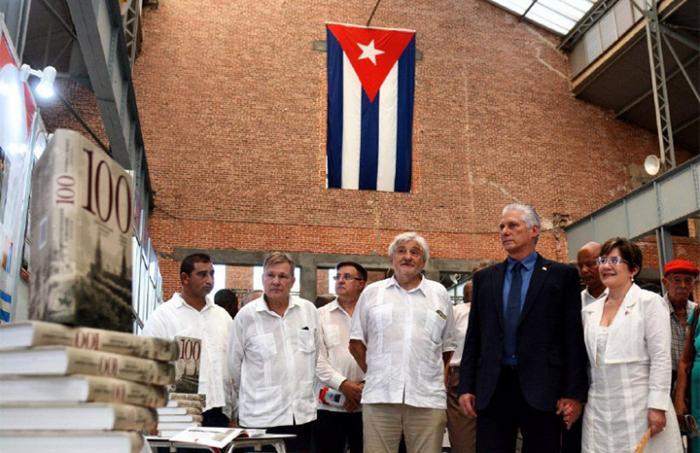
The 34th iteration of the Havana International Book Fair officially opened its doors on Wednesday, with Cuban President and First Secretary of the Central Committee of the Communist Party Miguel Díaz-Canel Bermúdez leading the opening ceremony at Havana’s iconic Cultural Station located at the intersection of Línea and 18th Streets.
In his opening remarks, Juan Rodríguez Cabrera, president of the Cuban Book Institute, underscored the significance of moving forward with the beloved cultural event despite challenging external conditions. This year’s fair carries a special thematic dedication to Fidel Castro, the revolutionary leader who shaped modern Cuba’s literary and publishing landscape. “However adverse the circumstances, we could not fail to hold this Book Fair, dedicated to Fidel, because that great reader, the Commander, became, from the very first days of the Revolution’s triumph, our greatest promoter of books and literature,” Cabrera told the assembled crowd of dignitaries, authors, and book lovers.
Cabrera detailed Castro’s far-reaching legacy in building Cuba’s domestic publishing ecosystem, noting that the late leader was the founding force behind not just the National Printing Office of Cuba and the National Publishing House, but also the Cuban Book Institute and the nationwide Territorial Publishing System. Beyond institutional building, Cabrera emphasized that Castro’s personal advocacy made it possible for Cuba to secure publishing rights and release domestic editions of many of the most influential works of contemporary global literature. For decades, Cabrera added, the Havana Book Fair has served as a critical crossroads for knowledge sharing, the diffusion of cutting-edge literary movements, and open debate on global issues – a role it retains as a vital hub for intellectual exchange even today.
Alongside its broader dedication to Fidel Castro, this year’s fair also pays tribute to two of Cuba’s most prominent contemporary intellectuals: poet, novelist, and journalist Marilyn Bobes, and leading historian and researcher José Bell Lara. Two custom audiovisual productions highlighted the decades-long careers of both figures, featuring their own acceptance remarks alongside tributes from fellow writers and scholars who celebrated their contributions to Cuban cultural life.
A highlight of this year’s event is the participation of the Russian Federation as the fair’s guest of honor, a role that highlights the longstanding ties of friendship, solidarity, and cultural cooperation between Moscow and Havana. Speaking at the opening ceremony, Mikhail Shvydkoy, Special Representative of the President of the Russian Federation for International Cultural Cooperation, noted that the opening came just ahead of the centennial celebration of Fidel Castro’s birth, closing his impassioned address with a rousing cry of “Long live Cuba!” Shvydkoy also reflected on Cuba’s enduring global reputation as a destination that draws creators from across the globe, noting that the island has long been a magnet for writers.
Attendees gave a standing ovation to a special performance by the Russian State Academic Folkloric Ensemble, which treated the crowd to two pieces: a tribute titled “Comandante Fidel” and a lively set of variations on the well-known Russian folk piece “Kalinka.” The official opening ceremony wrapped up with a performance from celebrated Cuban musician Pancho Amat and his group Cabildo del Son.
The opening ceremony was attended by a host of top Cuban government and party officials, including Esteban Lazo Hernández, President of the National Assembly of People’s Power; Manuel Marrero Cruz, Prime Minister; Bruno Rodríguez Parrilla, Minister of Foreign Affairs; Yuniasky Crespo Baquero, member of the Central Committee of the Communist Party and head of its Ideological Department; and Alpidio Alonso Grau, Minister of Culture. Russian Ambassador to Cuba Víctor Koronelli also joined the ceremony alongside the Russian delegation.