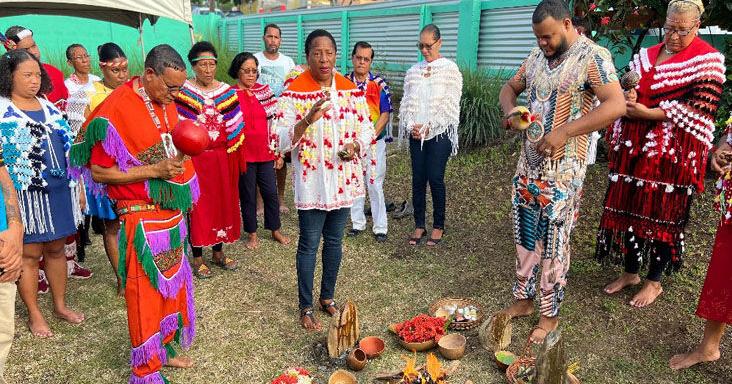
On the occasion of the United Nations International Day of the World’s Indigenous Peoples, Trinidad and Tobago’s Opposition Leader Pennelope Beckles has reaffirmed a long-overdue foundational truth of the nation: the twin islands were first a homeland for Indigenous peoples, and remain that homeland to this day.
As the Member of Parliament for Arima, a district that is home to the country’s prominent Santa Rosa First Peoples Community, Beckles emphasized that this annual observance is not a symbolic gesture disconnected from daily life in her constituency. Over years of engagement, she has walked alongside the community through its core cultural traditions, including the annual Santa Rosa Month celebrations, the sacred Water Ritual, and the historic reburial of ancestral Indigenous remains at Trinidad’s Red House government building. Far from being just a community hosted by Arima, Beckles noted, Indigenous culture and history are core to what defines the district’s identity.
Beckles extended specific praise to Chief Ricardo Bharath Hernandez, the community’s leader, whose decades of relentless advocacy have carried Indigenous Trinidadian voices to leading global institutions including the Inter-American Development Bank (IDB), the Caribbean Development Bank (CDB), and the United Nations. Throughout his work, Chief Bharath Hernandez has consistently called for formal national recognition of Indigenous rights aligned with the UN Declaration on the Rights of Indigenous Peoples.
Beyond the Santa Rosa community, Beckles also acknowledged the full breadth of Indigenous descendants across the Republic of Trinidad and Tobago. This includes Warao communities that have formed kinship ties in the country, people connected to the ancient Banwari Trace archaeological site in San Francique, and the thousands of ordinary citizens whose Indigenous ancestry is woven into their names, traditional cuisine, and national cultural heritage.
Challenging outdated narratives that relegate Indigenous peoples to a marginal footnote in national history, Beckles stressed that First Peoples are the very foundation of Trinidad and Tobago’s national story. Long before the first European vessels arrived in the Caribbean, Indigenous communities cultivated the land of the twin islands and established the region’s first permanent settlements more than 7,000 years ago. Every subsequent wave of migration to Trinidad and Tobago came to land that was already stewarded and inhabited, Beckles noted.
While the government has taken incremental positive steps, including the 2017 establishment of a public holiday for Indigenous peoples and the 2019 Red House ancestral reburial, Beckles argued that partial progress does not equal full justice. “Recognition without redress is not enough,” she said.
Drawing on her own long history of engagement with the issue across multiple senior government roles, Beckles recalled her early work as Minister of Social Development and later Minister of Culture and Tourism in the Manning Cabinet, portfolios that put her at the center of shaping national cultural and community policy. She also highlighted her time as Minister of Planning and Development under Prime Minister Rowley, where she stood alongside Chief Bharath Hernandez at the Red House reburial and successfully advocated for IDB recognition of Trinidad and Tobago’s First Peoples at the bank’s Ottawa meeting, bringing their story to a global audience.
Beckles confirmed that advancing Indigenous rights and recognition will be a core priority under her leadership, outlining five key policy commitments:
First, her administration will advance permanent legal recognition of the Santa Rosa First Peoples Community and align all national policy with the UN Declaration on the Rights of Indigenous Peoples. Second, it will complete and fully fund the stalled First Peoples Heritage Village project in Arima, positioning it as a respected national heritage site rather than an abandoned initiative. Third, the government will establish a permanent, adequately resourced consultation protocol between the state and Indigenous communities for all decisions related to heritage, land management, and cultural policy. Fourth, it will embed accurate Indigenous history and cultural knowledge into the national education curriculum to ensure all Trinidadian students learn the true foundational story of their nation. Fifth, it will support the community’s regional and international advocacy efforts as a genuine equal national partner.
Closing her statement, Beckles offered a firm pledge to Chief Bharath Hernandez, the Santa Rosa First Peoples Community, and all Indigenous descendants across Trinidad and Tobago: “Your rightful place at our nation’s foundation will be defended.”