New official data from the US National Oceanic and Atmospheric Administration (NOAA) confirms that last month was the hottest July ever recorded across the contiguous United States, marking a new milestone in accelerating human-caused global warming that is reshaping weather patterns across the globe.
NOAA’s dataset, which stretches back to 1895, shows that the average temperature across the Lower 48 states in July hit 3.3 degrees Fahrenheit above the 20th-century baseline. This margin edged out the previous all-time records set in July 1936 and July 2012 by 0.1 to 0.2 degrees Fahrenheit, according to the agency’s findings. Every single one of the contiguous 48 states recorded above-average temperatures for the month, with 13 states ranking their July temperatures among the top five hottest on record. Wyoming achieved an unprecedented milestone, recording its hottest July and hottest month of any month since record-keeping began.
The extreme heat was driven largely by a persistent pattern of heat domes that shifted across different regions of the country throughout the month, guided by contortions in the high-altitude jet stream. Heat domes function like a sealed lid on a cooking pot, trapping warm air near the surface and allowing temperatures to climb steadily over time. By the end of the month, more than 600 new monthly temperature records — for both highest daily maximum and lowest daily minimum temperatures — were broken across the country. In contrast, fewer than 50 new cool-temperature records were set, a stark deviation from the natural balance that would see roughly equal numbers of hot and cool records in an average month. Researchers say this lopsided pattern is a clear signature of human-induced climate change driven by fossil fuel combustion.
Long-term temperature trends underscore the rapid pace of warming across the US. Independent analysis from non-profit climate research group Climate Central finds that average July temperatures in 229 US cities have risen by 2.6 degrees Fahrenheit since 1970, with the fastest warming rates concentrated in the Pacific Northwest and Southwest. Major metropolitan areas including Denver, Salt Lake City, Miami, Los Angeles, and Minneapolis all recorded one of their top five hottest Julys this year, with the Intermountain West seeing the most extreme anomalies relative to historical averages.
Climate scientists point to two overlapping factors driving this summer’s extreme heat. The primary driver remains long-term global warming caused by greenhouse gas emissions from human activity, which has made heat waves more intense, longer-lasting, and far more frequent than they were a century ago. A second contributing factor is the rapidly strengthening El Niño event developing in the tropical Pacific, which pushes up global average air and sea surface temperatures. However, multiple studies confirm that the individual extreme heat events hitting the US this summer are far more strongly linked to long-term climate change and natural weather variability than to the current El Niño cycle.
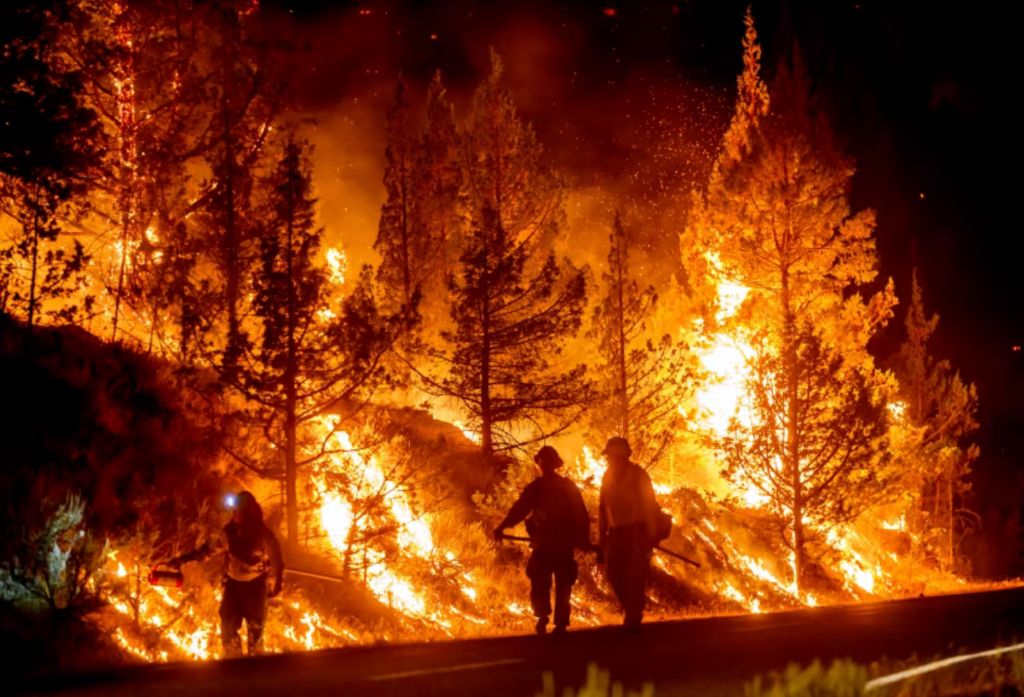
The extreme heat is not isolated to the United States. Much of Southern and Western Europe has also faced repeated, intense heat waves this summer, with the Copernicus Climate Change Service confirming that the first two months of the 2023 summer are the hottest on record for Western Europe. Just like in the Pacific Northwest of North America, the record heat has primed landscapes for destructive wildfires, with major blazes breaking out across Spain, France, Greece, and the United Kingdom in late July and early August.
The dangerous extreme weather has carried into the start of August, with no immediate sign of relief. In the US Pacific Northwest, a complex of three fast-moving wildfires near Spokane, Washington, has already damaged or destroyed hundreds of structures, spreading rapidly amid persistently hot, dry, and windy conditions. Further south, the combination of decades of warming, prolonged drought, and reduced winter snowpack has pushed Lake Mead — the nation’s largest reservoir, which supplies drinking water to 20 million people across the Southwest — to a new record low water level, worsening existing water insecurity across the region.