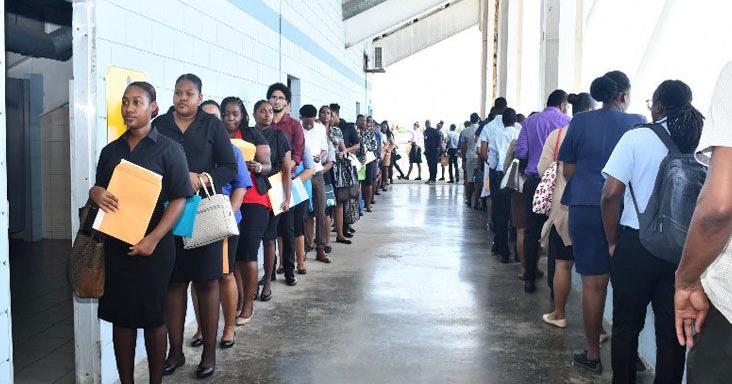
Against a backdrop of ongoing public scrutiny and criticism of the Trinidad and Tobago Police Service (TTPS) from multiple sectors, the organization’s most recent recruitment drive has defied expectations, drawing more than 5,000 eager young candidates seeking to join the national force. Senior TTPS leaders have framed this overwhelming turnout as clear proof that citizens across the country retain a strong desire to serve their communities through the police service.
On a single processing day at the St James Police Academy last week alone, officials logged roughly 1,950 completed applications, cementing the high level of public interest in the recruitment cycle. Deputy Commissioner of Police (Administration) Junior Benjamin shared his perspective on the strong response in an interview with the *Sunday Express*, noting that while critical conversations about the TTPS circulate in public discourse, young people in particular remain committed to joining the force and believe in its core mission.
Benjamin emphasized that the TTPS’s recruitment goal extends far beyond just growing the overall size of the service. Instead, the organization is focused on handpicking high-caliber candidates who can lift national policing standards and improve public outcomes. “We are putting structures in place to identify the cream of the crop, because our ultimate priority is upgrading the quality of service we deliver to the Trinidad and Tobago public,” he explained.
The rigorous selection process includes multiple screening stages, from written exams to in-depth interviews, that will eliminate a large share of applicants as the process moves forward. Benjamin acknowledged that many candidates will be weeded out through these checks, but expressed confidence that the most capable, motivated candidates will rise through the ranks to become officers who can drive meaningful change. He added that the successful new recruits will strengthen the TTPS’s operational capabilities and advance the service’s core mission of building safer, more secure communities across Trinidad and Tobago.
Drawing in skilled, committed new officers is especially critical as the TTPS works to rebuild public trust and modernize its practices, Benjamin noted. Modern policing requires far more than just enforcing laws, he explained: the service needs officers who prioritize public service and center community needs. “Competence is non-negotiable, but we also need officers who bring care and concern for the people they serve,” he said.
Benjamin outlined that the TTPS is seeking candidates who combine knowledge, compassion, and a dedication to delivering excellent public service, arguing that stronger, trust-based bonds between police and community members will create long-term benefits for the entire nation. He also encouraged prospective recruits to frame policing as a calling of public service, not just another professional job. “This is not just a role for steady employment. Being a police officer is far more than a career — it is a calling that requires commitment and sacrifice,” he said, noting that officers must be prepared to work long, demanding hours to meet the needs of the profession. Ultimately, the TTPS aims to cultivate a new generation of officers aligned with modern policing principles that center public service and meet evolving community expectations, he added.
Reacting to the high turnout, Benjamin said the TTPS executive team is elated to see so many young people stepping forward to answer the call to serve. He acknowledged that some applicants are drawn to the role for the stable employment it offers, particularly amid high youth unemployment in the country, but stressed that a large share of candidates also join out of a genuine desire to contribute to public good.
ASP Ishmael Pitt, president of the TTPS Social and Welfare Association, echoed Benjamin’s remarks and welcomed the strong response to the recruitment drive. Pitt noted that the large turnout proves that policing remains a magnet for motivated candidates, even amid the well-documented challenges that come with the profession. “Young people are coming out in droves to join the organization, and that is a very welcome development,” he said.
Pitt pointed out that the high applicant volume makes clear that many people still want to serve their country through the TTPS, despite the intense pressure, public criticism, and image challenges the profession sometimes faces. “It shows that regardless of the demands, the challenges, and the negative narratives that sometimes surround policing, people still want to serve their nation through this work,” he explained.
While Pitt could not confirm whether this year’s turnout is higher than previous recruitment cycles, he noted that police recruitment in Trinidad and Tobago has consistently drawn strong public interest, defying assumptions that criticism would dampen enthusiasm. The current recruitment cycle aligns with this long-running trend, he said, even as final official numbers are still being compiled.
For candidates hoping to succeed in the process, Pitt offered advice that aligns with the TTPS’s focus on public service: prospective officers must fully understand the heavy responsibilities that come with the role before joining. “This is an extremely demanding profession that requires you to give a lot of yourself,” he said. He also warned new recruits that they will face temptation throughout their careers, and urged them to hold fast to the core values of integrity, honesty, and respect for the law that they learn during their academy training.
At its core, Pitt said, policing is about serving the public, and all officers must prioritize integrity, decency, honesty, and professionalism in every part of their work.