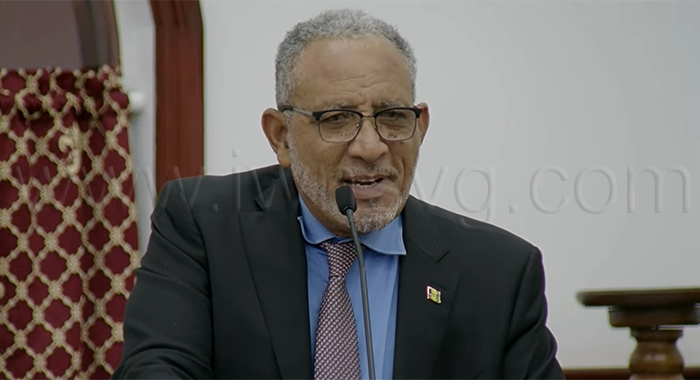
Prime Minister Godwin Friday of St. Vincent and the Grenadines has outlined a sweeping three-pillar strategy to rescue the small Caribbean nation from what he describes as a perilous fiscal cliff, with the dual goals of stabilizing its debt-burdened public finances and laying a solid foundation for future private-sector-led economic expansion. In a candid interview aired on NBC Radio this Tuesday, Friday painted a grim portrait of the country’s current fiscal state, placing blame squarely on the previous Unity Labour Party (ULP) administration, which held power from 2001 until November 2024, for accumulating an unsustainable level of national debt that left the country uniquely vulnerable to cascading global shocks. These shocks include war-driven spikes in global fuel prices and the widespread economic damage inflicted by Hurricane Beryl.
Friday, whose New Democratic Party took office in November, revealed that after assuming power his administration discovered the fiscal situation was far worse than previously understood. He recalled that multilateral institutions including the International Monetary Fund had issued warnings as early as 2016 that St. Vincent and the Grenadines was rapidly approaching a state of formal debt distress. Currently, the country’s public debt sits at 113% of gross domestic product, and without urgent intervention, official projections show that figure will balloon to 124% of GDP within just a few years. Even at current levels, debt servicing consumes 39 cents of every dollar of revenue the government collects, leaving extremely limited room for investment in public services, infrastructure, and social programs.
“You can’t have development, you can’t have rising standards, you can’t sustain a quality of life if you’re doing it on a credit card. Eventually, the bill comes due,” Friday warned. “We are now in that situation where they’re saying, ‘Well, listen, you can’t afford this, you can’t afford that.’”
Compounding the crisis, recent actions by global credit rating agency Moody’s have further restricted the country’s fiscal options. Moody’s downgraded St. Vincent and the Grenadines’ sovereign credit rating from B3 to Caa1, a shift that Friday says acts as both a symptom of the existing fiscal instability and a driver of deeper problems. The downgrade has made new external borrowing significantly more expensive and harder to access at a time when the country desperately needs fiscal breathing room to implement recovery measures.
Against this challenging backdrop, Friday emphasized that his administration is not focusing solely on criticizing the previous government’s mismanagement, but is taking concrete action to resolve the crisis through a three-pillar strategy that targets immediate stabilization, debt restructuring, and long-term growth.
The first core pillar of the plan is restoring fiscal discipline to “stabilise the ship” after years of politically motivated overspending. Friday accused the outgoing ULP administration of ramping up unsustainable borrowing over its final five to six years in office, using borrowed funds to finance populist projects and programs designed to retain power rather than building a durable, productive economic base. To reverse this trend, Friday’s government is implementing strict new fiscal rules that will bind all current and future administrations, ensuring that any government borrowing is directed toward capital projects that expand the nation’s productive capacity, rather than covering recurring operating expenses like public sector salaries and utility bills.
Comparing the nation’s fiscal predicament to an overextended household that has to dip into its children’s education and medical savings to pay off a maxed-out credit card, Friday noted, “At some point, you’re not going to be able to afford the payments, and they could come and reclaim [what you bought]. In terms of government financing, it’s not much different.” He added that borrowing to cover routine day-to-day spending is equivalent to “digging a hole to fill a hole,” a practice his government will end immediately.
The second pillar of the strategy is a comprehensive debt restructuring and refinancing initiative that centers on swapping existing high-cost loans for lower-interest, concessional financing from multilateral development institutions. Friday pointed out that several peer Caribbean nations have already completed similar debt swap operations, many of which are tied to climate action and sustainable development goals, and his government is studying those successful case studies to adapt the model for St. Vincent and the Grenadines.
As a first step in this process, the government has formally joined the Central American Development Bank (CAF) and is already in active negotiations with other multilateral institutions that are prepared to offer low-cost concessional funding for national development programs. The long-term goal of this effort is to shift the country’s borrowing profile away from expensive local and bilateral loans toward longer-term, low-interest financing from development banks. Friday explained that a successful refinancing campaign, paired with stronger economic growth, will gradually bring down the debt-to-GDP ratio and free up critical public resources for social spending and development investments.
“As the GDP grows, even if the nominal debt is increasing slower, the debt-to-GDP ratio will decline,” Friday said, adding that the sweeping fiscal reforms are designed to send a clear signal to global creditors and investors that St. Vincent and the Grenadines is committed to long-term fiscal sustainability.
While fiscal stabilization and debt refinancing will create the necessary breathing room for recovery, Friday stressed that only accelerated, private-sector-led economic growth can deliver a permanent solution to the nation’s debt crisis. “You’re not going to grow out of the debt situation, you’re not going to solve the problem simply by being more efficient and being more fiscally responsible,” he noted. With the government’s borrowing capacity severely constrained, the state can no longer serve as the primary driver of large-scale infrastructure and development projects, making private investment — both domestic and foreign — the centerpiece of the government’s long-term growth strategy.
“Our standard of living will not improve unless we generate more business activity in the country. Government depends on [business]. Either you do that, or you’re just borrowing money… and running up the debt without any means of really paying it back,” Friday said.
The prime minister laid out that his administration’s core role in this new growth model is to build an attractive, competitive business environment by upholding the rule of law, cutting unnecessary red tape, and ensuring all investor concessions and incentives are transparent and directly tied to measurable development benefits for the nation. He pushed back against criticism that offering tax breaks and duty concessions to large foreign investors amounts to “selling out the country,” noting that such incentives are standard global practice and are already extended to local investors.
“Even local investors here, they come, they’re investing in a hotel, they get concessions … Because you want them to generate economic activity, and so government will get its piece later on when we tax your earnings, your profits, and the jobs that you create,” he explained.
Friday also pledged to act as a “ruthless negotiator” on behalf of all St. Vincent and the Grenadines people, noting “I have one client… and that is the people of this country. So whenever there is a deal, we are going to make sure that it’s the best that we can possibly do under the circumstances.” As the country builds up a larger pipeline of approved investment projects across key sectors including tourism, infrastructure, and fisheries, Friday said the government will gain greater leverage to secure more favorable terms from prospective investors. He also issued an open invitation to Vincentians living in the diaspora to position themselves as “preferred investors,” urging them to bring their capital, skills, and expertise back home to contribute to national growth.
In closing, Friday acknowledged that the process of fiscal consolidation and economic transition will require “some measure of adjustments for everybody” across the country. However, he made a clear commitment that the burden of adjustment will not fall on the nation’s most vulnerable populations, who did not create the current fiscal crisis. “I will not impose that burden on the most vulnerable people in our society, because first of all, they didn’t cause it,” he said. “To ask them to pay… I cannot do it in all good conscience.”