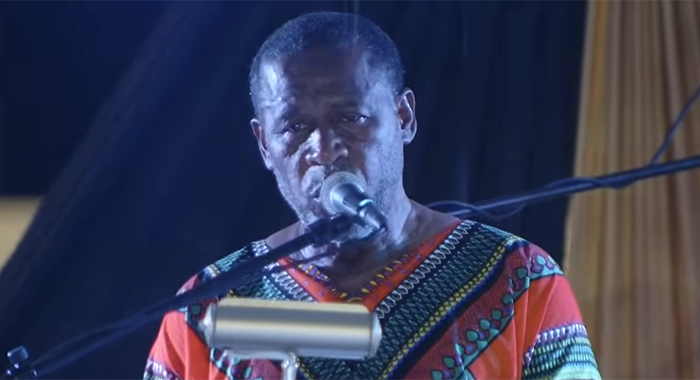
At the National Emancipation Rally held Saturday at Independence Park, prominent Vincentian historian Michael Dennie has launched a public call for a radical reexamination of the nation’s freedom narrative, demanding that Nelly the Ebo—an enslaved African woman who killed a powerful aristocratic plantation owner on the island of Mayreau before being executed alongside four other co-conspirators—be formally recognized as St. Vincent and the Grenadines’ first Black national hero by next year’s Emancipation Day.
Dennnie’s address upends the long-held framing of emancipation as a charitable gift granted by British colonial authorities, arguing instead that the freedom enjoyed by modern Vincentians was purchased not only with financial cost but with the blood of generations of enslaved people who resisted their subjugation.
Citing archival records, Dennie recounted that Nelly, an Ebo woman held in bondage, carried out a targeted act of lethal resistance against the plantation owner: an elite aristocrat who controlled multiple estates across St. Vincent and other Caribbean territories. As the planter rode his horse across the estate, Nelly attacked him with a hoe, inflicting fatal wounds. She and four other enslaved women then disposed of his body by throwing it into the sea. When the killing was uncovered, colonial authorities quickly arrested all five women. Four were hanged directly on the estate, while Nelly was transported to the capital Kingstown for a public trial and execution.
Archives label the five women “conspirators,” a term Dennie rejects outright. “That is the wrong word—they are co-freedom fighters,” he told the assembled crowd, noting that their sacrifice places them at the center of the national story of liberation. He emphasized that enslaved women in St. Vincent were not passive victims of chattel slavery, but active, courageous leaders in the ongoing fight for freedom.
Beyond the call for Nelly’s recognition, Dennie laid out three core arguments to reshape how Vincentians understand their national history. First, he noted that St. Vincent had the shortest period of organized chattel slavery of any territory in the British Caribbean—a distinction he says deserves far greater national recognition and celebration. Second, he pointed out that a portion of the population, particularly members of the Garifuna community, were never enslaved at all. While the British carried out a mass expulsion of Garifuna after their conquest of the island, Dennie explained that the expulsion was not total, and many Garifuna families remained in communities such as Greiggs, retaining their freedom throughout the colonial slavery era.
Finally, Dennie reiterated that emancipation, achieved in partial form in 1834 and full legal form in 1838, was not the result of colonial benevolence. Resistance to enslavement began long before enslaved Africans arrived in the Caribbean, he explained: most people captured for the transatlantic slave trade were captives of war who already fought for their freedom, losing many comrades on African soil and during the middle passage. “Africans simply didn’t say, ‘Okay, here we are, take us across the Atlantic,’” he said. “Those who fought on land, many died. Those who fought at sea, many died. And when they arrived here in the Caribbean and in St. Vincent, they fought again, and many died.”
Dennie framed his address as part of a broader collective effort by historians at the rally to unpack the full cost of emancipation. He focused his remarks on the blood price of freedom, leaving discussion of the financial cost—including the controversial policy that compensated enslaved owners rather than the people they had enslaved—to fellow historian Dr. Adrian Fraser, who spoke after him.
He described Nelly’s act of resistance as extraordinary both in its own time and today, arguing that formal recognition of her heroism would send a clear message about which national stories the country chooses to honor and pass to future generations. “This is not something which was possible in colonial times, but it is our government now. We have the capacity to decide who are our heroes,” Dennie said. “We have to understand which stories must be told, which stories have a reverence to which our children must be acquainted. The story of Nelly the Ebo, a Black woman standing against slavery, and with other Black women giving their lives so that we today could enjoy freedom — let us remember them in the most positive way we can. Make Nelly the Ebo a national hero.”
Closing his remarks, Dennie urged that this unspoken history of Black resistance be taught, widely shared and institutionalized in national commemorations, starting with the formal honoring of Nelly and the four other freedom fighters who gave their lives. “Those who gave their lives deserve that honour,” he said.