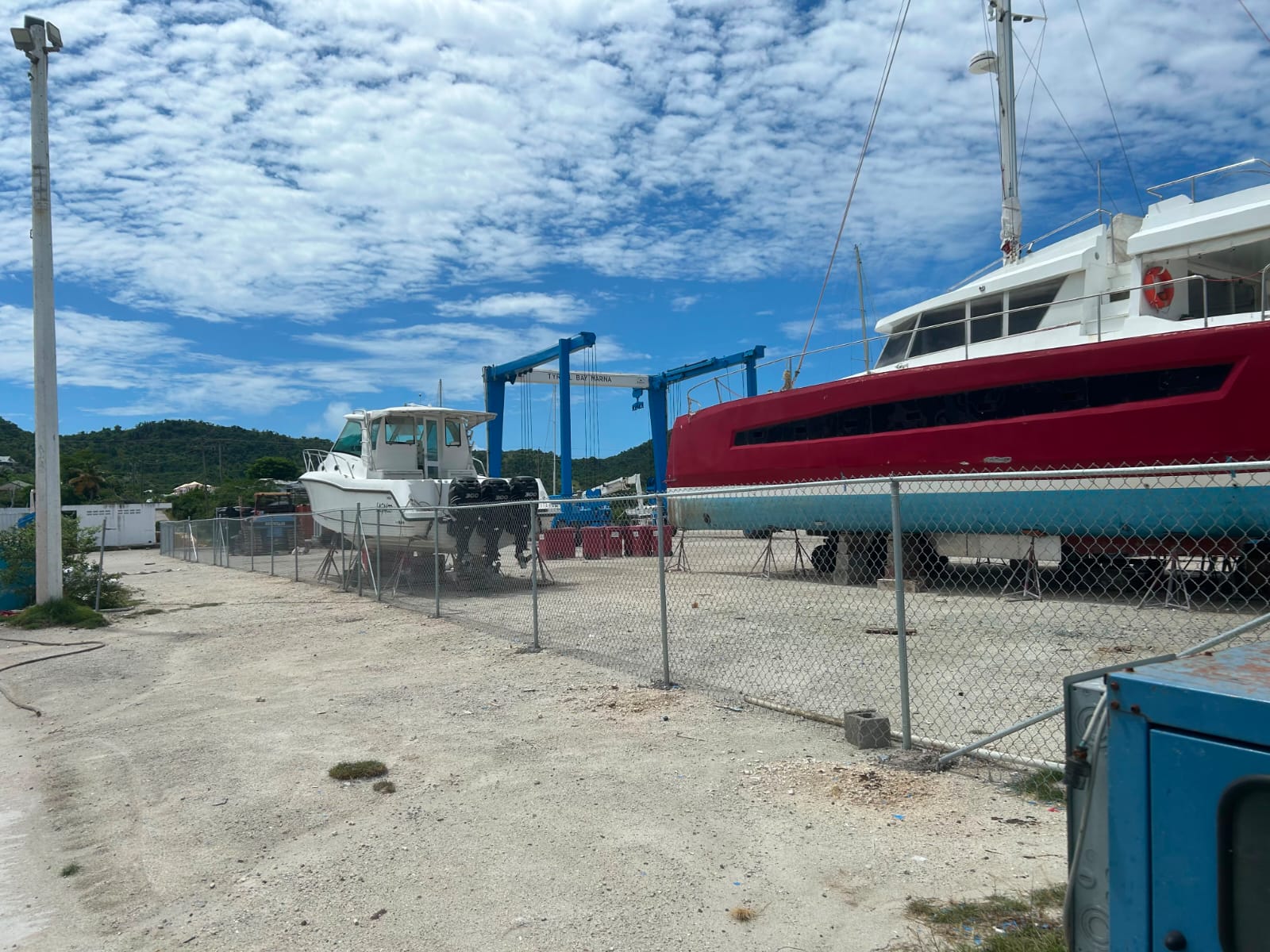
A long-running property dispute in Tyrell Bay, Carriacou has left roughly a dozen foreign yacht owners stranded, their vessels trapped ashore and their lives, livelihoods and travel plans upended by actions they had no part in triggering. For full-time liveaboard boaters who call the Caribbean waters their home, the ongoing legal battle between marina developers and the heirs of a local landowner has turned into an unprecedented crisis that shows no sign of immediate resolution.
The origins of the conflict stretch back to 2013, when Carriacou Devcor Ltd (CDC), the developer behind the Tyrell Bay Marina project, secured government approval to lease 7 acres of adjacent mangrove land to expand the facility. The agreement was immediately challenged by the heirs of the Samuel Corion estate, who argue the parcel was originally granted to Samuel Corion in 1914 and forms part of his family’s legacy. After more than a decade of litigation, the Judicial Committee of the Privy Council issued a 2023 ruling that affirmed the Corion estate holds legal title to the disputed land, but declined to rule on the separate question of physical possession. That issue is still pending before the High Court, leaving a murky legal status for the marina’s access points.
That legal uncertainty boiled over earlier this year, when the Corion estate erected a fence overnight that blocks access to the marina’s launch ramp. The barrier has trapped eight vessels on dry land, stranding roughly 10 people who either live aboard their boats or depend on them for work. For many of those affected, the fallout has been life-altering.
French national Lou Le Sommer is one of the most impacted boat owners. She arrived in Carriacou at the end of March 2026, and hauled her 24-foot monohull *Malumau* out of the water on April 19 for routine scheduled maintenance, with a relaunch planned 10 days later. The unexpected fence left her boat stranded ashore. For Le Sommer, the boat is not just a recreational vessel – it is her full-time home, a replacement for the boat she lost to Hurricane Beryl in Carriacou two years prior. She was scheduled to return to her job in Martinique shortly after the repairs, but the inability to relaunch has already cost her two positions. “This situation has had a huge impact on me because my home is stranded on land,” Le Sommer explained. “It’s been incredibly difficult.”
Le Sommer and other stranded owners told reporters that after the blockade went up, the Corion family initially offered to arrange a crane to move the boats, but cut off all communication shortly after. Local police declined to intervene, labeling the conflict a civil matter outside their jurisdiction.
Leslie Bell-Friedel, a U.S. citizen who owns the 62-foot sailing catamaran *SY Nizhoni* with her husband, said the disruption extends far beyond mere inconvenience. The couple lives and works aboard their vessel full-time, and while they have been able to continue working remotely, many other owners have not been so lucky. Five of the eight trapped boats are permanent full-time residences, and two additional owners were actively preparing to depart when the blockade went up. Dozens more boat owners who planned to haul their vessels out of the water ahead of the annual Caribbean hurricane season have been forced to travel south to Grenada or Trinidad instead, costing the marina and the local island economy thousands in lost revenue.
For Bell-Friedel, the disruption has also derailed critical conservation work. She serves as a director for Turn the Tide, a non-profit focused on eradicating invasive lionfish populations that threaten Caribbean marine ecosystems. The organization had planned a three-month lionfish removal campaign in the Tobago Cays that Bell-Friedel was set to lead, but the team has been forced to proceed without her, creating major delays to the project.
The financial damage from the blockade has already surpassed $85,000 for all affected boat owners combined, Bell-Friedel said. The losses include missed wages, cancelled yacht charter bookings, changed and rebooked flights, unused immigration fees, inflated accommodation costs for those forced off their stranded boats, and a range of unexpected expenses that would not exist if the dispute had not trapped them on land.
Bell-Friedel also raised urgent safety concerns about the blockade. The fence blocks emergency vehicle access to the northern section of the marina yard, where four people live full-time on stranded vessels – one of whom has pre-existing medical conditions that could require emergency response at any time. “This lack of access is putting lives at risk,” she noted.
Legal efforts to resolve the impasse have so far failed. CDC, the marina developer, filed a legal challenge to the fence with the Eastern Caribbean Supreme Court, but Justice Agnes Actie dismissed the request for interim relief to remove the barrier. Affected boat owners also filed a motion to have their third-party harms considered in the proceedings, but their application was rejected over a procedural technicality, leaving their interests unaddressed in the ongoing court case.
It remains unclear whether the Corion family obtained all required construction permits and regulatory approvals to build the blocking fence. The local Planning and Development Authority (PDA) has declined to take enforcement action, however, noting that the entire land dispute is before the High Court. A PDA source told reporters that the authority’s legal counsel has advised against intervening while the matter is still pending in court, even though under normal circumstances the agency would have taken action to address the harm the fence causes to marina occupants.
NOW Grenada reached out to all key parties involved in the dispute – legal counsel for the Corion estate, Tyrell Bay Marina management, and local government minister Hon. Tevin Andrews – for comment ahead of publication, but no party responded to requests for comment within the five-day waiting period before press time.
For the stranded boat owners, the complex legal arguments behind the dispute are secondary to the daily disruption of their lives. Their homes, work, and travel plans all remain in limbo as they wait for a resolution. The boat owners have hired legal counsel to advocate for the release of their vessels, but say they remain committed to finding an amicable solution rather than joining the ongoing litigation.
The owners have also reached out to their respective national embassies for assistance. Embassy officials have raised the owners’ concerns with Grenada’s prime minister and attorney general, Bell-Friedel said. With the dispute still unresolved, embassies have issued a formal warning that they may update their national travel advisories for Grenada over the ongoing violation of their citizens’ rights.