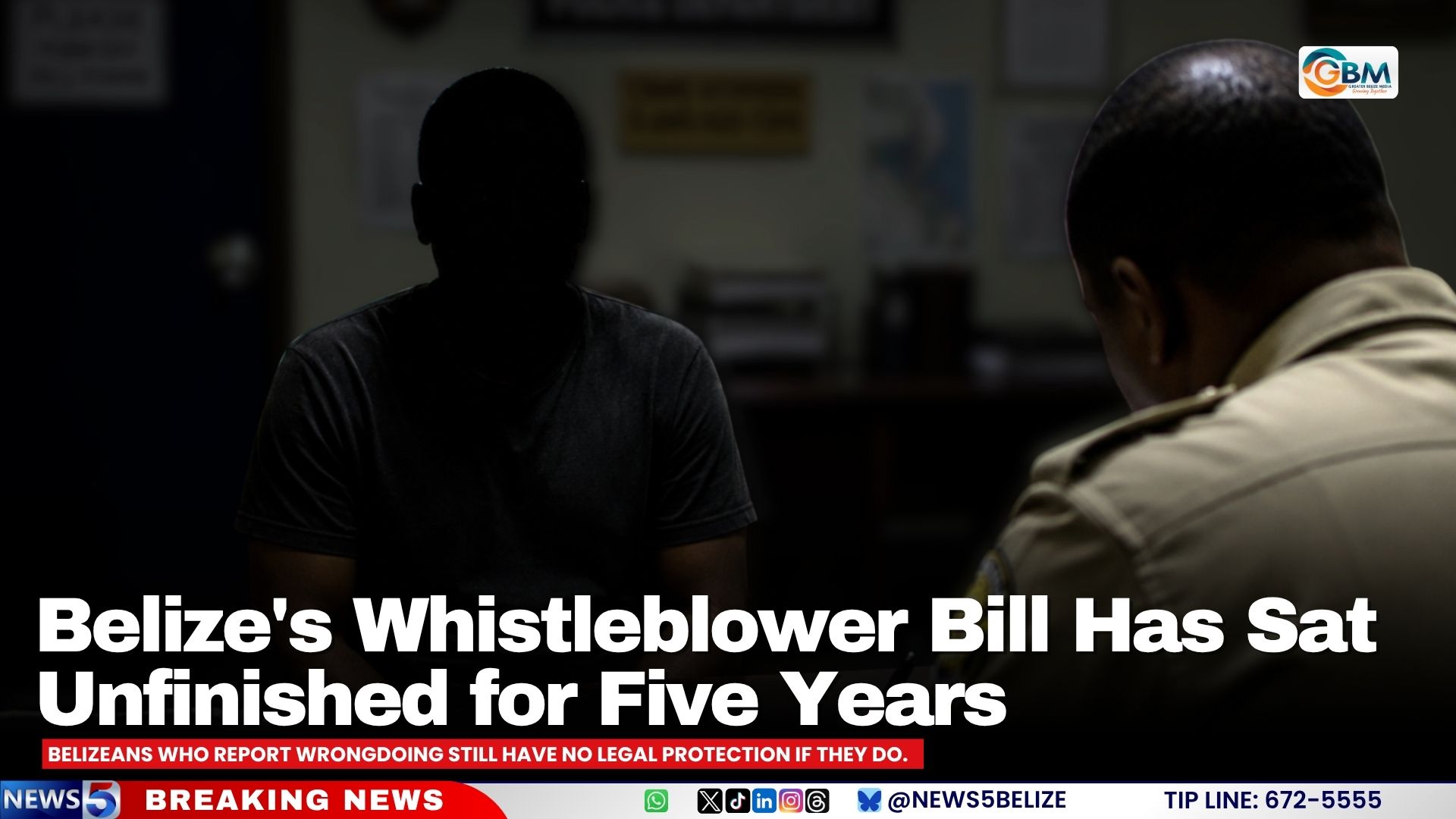
For people in Belize who dare to speak out against systemic corruption, the personal costs can be catastrophic: lost employment, threats to personal safety, and even displacement from their homes. Half a decade after the Belizean government first completed a draft of a national whistleblower protection bill, the legislation remains stuck in legislative limbo, and a new independent review has concluded that even the current working draft falls far short of the safeguards needed to properly protect the people the law is meant to shield.
In remarks delivered at a public accountability event earlier this July, Prime Minister John Briceño struck a firm tone on addressing government wrongdoing. “When we see these mistakes, we don’t hide it. We don’t put it under the rug. We fix it,” Briceño told attendees. “Because you put us to work for you. You are our bosses.” Yet despite this public commitment to transparency, no binding whistleblower protection law has been enacted, leaving Belizeans who report misconduct with no legal recourse if they face retaliation for coming forward.
Dean Flowers, president of Belize’s Public Service Union, explained that demands for formal whistleblower protections stretch back far longer than the 2021 draft bill. According to Flowers, the first formal calls for this legislation emerged back in 2012 during the Barrow administration, tied to a good governance initiative that the union first included in its 2009 collective bargaining proposals. It would take until 2020 before the Briceño administration made a formal commitment to draft the legislation.
Belize is not an outlier in this regulatory gap. Across the 56-member Commonwealth, fewer than half of member states have enacted standalone, comprehensive whistleblower protection legislation. Within the Caribbean Community (CARICOM), only a small handful of nations — Jamaica being one of the few exceptions — have successfully implemented formal protected disclosures laws.
The dangers of leaving whistleblowers without legal protection are not abstract, long-time Belizean attorney Richard “Dickie” Bradley warned, pointing to the 2013 Immigration Department corruption scandal that sparked public demands for the resignation of then-Minister of State Edmond Castro. Alvarine Burgess, the whistleblower who exposed the misconduct, was a resident of Independence Village in southern Belize who went public with her allegations on local outlet News Five. According to Bradley, Burgess ultimately was forced to flee the country to avoid retaliation.
More recently, the Briceño administration has faced ongoing public scrutiny over leaked documents revealing massive oversight gaps in Ministry of Defense payments processed through the Smart Stream digital system, with relevant government ministries still shifting blame for the failures onto one another. A sitting whistleblower could help resolve the many open questions surrounding the scandal, but with no whistleblower protection law in place and the Office of the Ombudsman vacant since late 2025, fear of retaliation has overridden pushes for accountability, according to former Ombudsman Major Gilbert Swaso.
“Fear is defeating integrity,” Swaso said, noting that the government is the country’s largest employer, a fact that amplifies the culture of silence around misconduct. “Because of the fact that there’s a culture of fear, and fear is defeating integrity, several people are afraid to do the right thing.”
After the draft bill was completed, both the Public Service Union and the Belize Chamber of Commerce and Industry (BCCI) conducted independent reviews and flagged critical gaps in the text, most notably inadequate protections against retaliation and weak confidentiality safeguards.
Reyhan Rosado, BCCI’s chief policy analyst, explained that the current draft only offers minimal protection for whistleblowers and their family members when measured against widely accepted international standards. The text also lacks any formal reward system, an incentive structure that Rosado noted is a standard component of effective whistleblower protection regimes around the world.
Specific shortcomings of the current draft identified by stakeholders include: no full legal protection for anonymous reports, no framework for financial rewards for disclosures that recover public funds, no guaranteed provisions for physical safety protection, limited authorized reporting channels, no mandate for an independent oversight agency to manage whistleblower claims, and no reverse burden of proof — a key provision that would shift the legal burden to employers to prove they did not retaliate against a reporting whistleblower.
While Belize already has existing accountability institutions, including the national Integrity Commission, reform supporters argue that standalone oversight bodies are not sufficient on their own. What remains missing, they argue, is a dedicated, specialized system designed explicitly to accept whistleblower reports and protect the people who file them.
Bradley linked the stalled whistleblower reform to a broader national concern: undue political influence over public service hiring. He argues that Belize’s Constitution assigns hiring authority exclusively to the independent Public Service Commission, not elected politicians, and when political appointments override this independent process, it creates fertile ground for corruption to take root. “If we continue as a young country to allow politicians to give their supporters these important jobs, Belize is on the way to become a failed state,” Bradley warned, adding that unregulated political hiring opens the door for collusion between politicians and public servants to embezzle or waste public resources.
Reform advocates have put forward a package of proposed amendments to address the gaps in the current draft, calling for major additions including an independent national whistleblower protection agency, formal police protection for at-risk reporters, financial rewards tied to recovered public funds, secure anonymous reporting channels, extended legal protection for whistleblowers’ family members, harsher penalties for retaliation, and faster legal relief for people who experience retaliation after reporting misconduct.
Attorney General Anthony Sylvestre confirmed that these reform recommendations have been formally submitted to the government and are currently under internal review. “The unions and other stakeholders and social partners have raised that as an issue,” Sylvestre said. “As to that live issue, no final determination has been made, but certainly it is something that has been brought to government’s attention.”