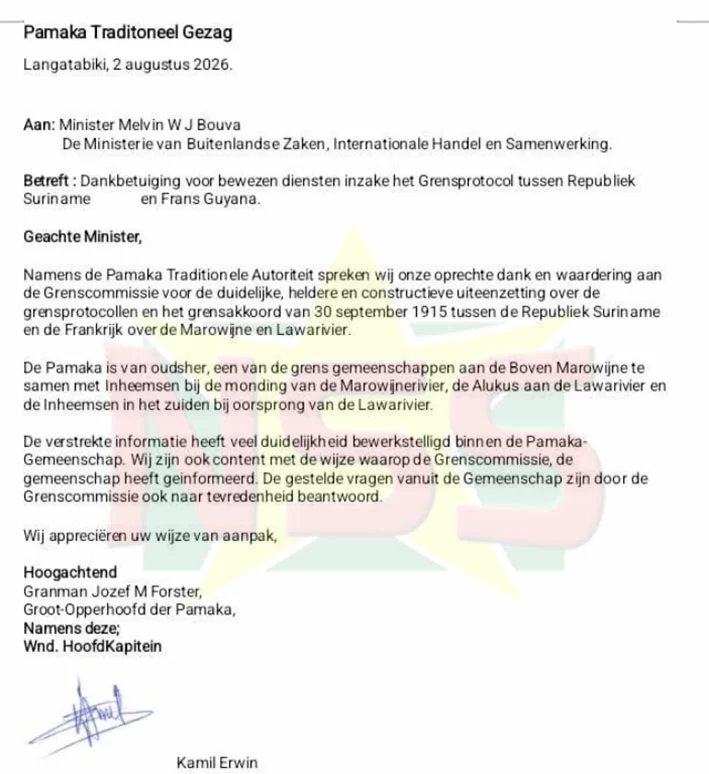
A rare show of public support has emerged amid heated domestic and political debate over a new border protocol between Suriname and France, with the traditional leadership of the indigenous Pamaka community publicly praising the outreach and transparency work carried out by the Suriname Border Commission. In an official letter addressed to Melvin Bouva, Suriname’s Minister of Foreign Affairs, International Trade and Cooperation, the Pamaka leadership extended formal gratitude to the commission for what it described as a “clear, straightforward and constructive explanation” of both the newly negotiated border protocol and the historic 1915 border agreement that forms the foundation of current territorial arrangements between the two nations. This public expression of approval stands in stark contrast to the wave of criticism that has swept through political circles and other inland indigenous communities in Suriname over the past week. Most prominently, Ronnie Brunswijk, chairman of the opposition ABOP party, announced during a public community gathering at Liba Krutu on Stoelmanseiland on Sunday that his party will vote against ratification of the protocol, claiming the proposal does not have the backing of local border communities. The Pamaka Traditional Authority emphasized in its correspondence that the public information sessions hosted by the Border Commission have successfully resolved widespread uncertainty within the Pamaka community. “The information provided has brought much greater clarity to the entire Pamaka community. We are very satisfied with the approach the Border Commission has taken to engage and inform our community,” the letter states. The leadership also confirmed that all questions raised by community members during the information session received full, satisfactory answers from the commission team, and commended the inclusive, accessible engagement strategy the body implemented. The letter was signed on behalf of Granman Jozef M. Forster, the paramount chief of the Pamaka people, by acting head captain Kamil Erwin. Discussions over the border protocol accelerated dramatically last week, after indigenous leader Granman Bono Velanti requested that the Suriname National Assembly delay consideration of the ratification bill to allow additional time for consultation with affected traditional authorities. Multiple other border communities also echoed calls for more comprehensive public information before parliament takes a final vote on the agreement. The Pamaka community’s public statement of support underscores a clear divide in local experiences with the Border Commission’s outreach efforts: while some traditional leaders argue that further explanation and consultation are still required, the Pamaka has become the first major affected community to publicly endorse the commission’s work and the clarity of the information provided.
Pamaka gemeenschap spreekt waardering uit voor voorlichting over grensprotocol