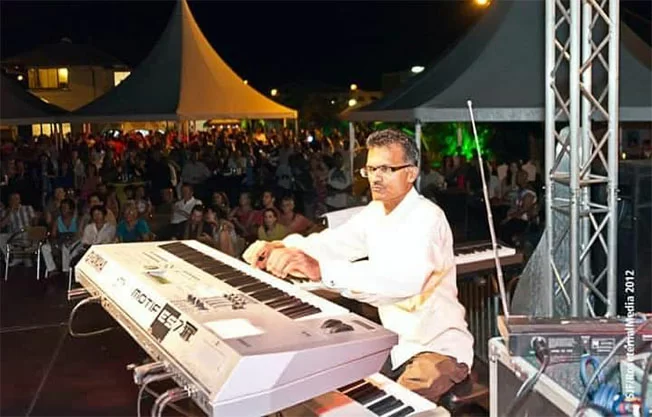
In a reflective opinion piece shared in early August, Surinamese artist and musician Sonny RJ Khoeblal draws a parallel between musical harmony and national unity to address recent tensions that have shaken the country’s National Assembly. Drawing on four decades of experience creating art that fosters connection and hope, Khoeblal frames his argument around a simple but powerful lesson he learned through music: true harmony is never achieved when every instrument sounds identical. Instead, it emerges when distinct, diverse tones learn to collaborate, lifting one another up to create something greater than the sum of its parts. Our societies, he argues, work exactly the same way, functioning as a vast, multi-voiced orchestra where difference is not a flaw, but the foundation of collective strength. Recent upheaval in the National Assembly has laid bare a critical truth, Khoeblal writes: when raw human emotion is allowed to dominate political discourse, the core mission of public service—representing and serving the Surinamese people—fades into the background. Too often, after conflict erupts, the only question the public and politicians ask is, “Who is in the right?” But according to Khoeblal, we must push ourselves to ask more constructive, wiser questions that move the conversation forward. Do our current responses breed further division? Do they amplify tension? Or do they spark new creation, generate solutions, and rebuild collective trust? For more than forty years, Khoeblal says he has dedicated his career and his life to cultivating what he calls theta: the life-giving energy of creativity, hope, inspiration, and connection. Against the negative, enturbulated energy of conflict, confusion, and division—what he terms entheta—stands a far more powerful, universal force: the innate human ability to create something new and better, no matter how deep the current rift. Khoeblal emphasizes this creative capacity is not reserved for a select few. It lives in every member of society, from members of parliament and small business owners to artists, parents, and young people. Every single person gets to make a choice: to react from a place of raw anger and emotion, or to create from a place of intentional awareness, mutual understanding, and compassion. Great nations, he reminds readers, are not built by people who never make mistakes. They are built by communities that can step back after conflict, ask what they can learn from the division, work together to repair broken trust, and move forward as one. Suriname, Khoeblal argues, is blessed with extraordinary untapped potential. It holds rich, diverse cultural traditions, world-renowned musical heritage, vast natural treasures stretching from mineral-rich soil to lush ancient rainforests and open skies, and an inherently creative population that has long thrived in spite of challenge. He closes with a call to action for all Surinamese people, wherever they live: let us choose to shift our collective energy from being controlled by conflict to being driven by the desire to build something better. He highlights the elegant parallel in the phrases “reactie” and “creatie”—the two words are made up of exactly the same letters, but represent two entirely different paths forward. This shift means moving from division to collaboration, from unregulated emotion to thoughtful wisdom. Khoeblal reminds readers that the positive energy each person holds within is always stronger than the negative energy of conflict. Closing with a traditional phrase in Suriname’s Sranan Tongo—*“Na Bun Fu Yu Mi Suku Tru, Da Na Ogri Musu Wai,”* which translates broadly to “I seek the good for you and me, so evil cannot stay”—Khoeblal calls on all Surinamese people to collectively build the future they want to see, rather than reacting to the conflict that divides them today.