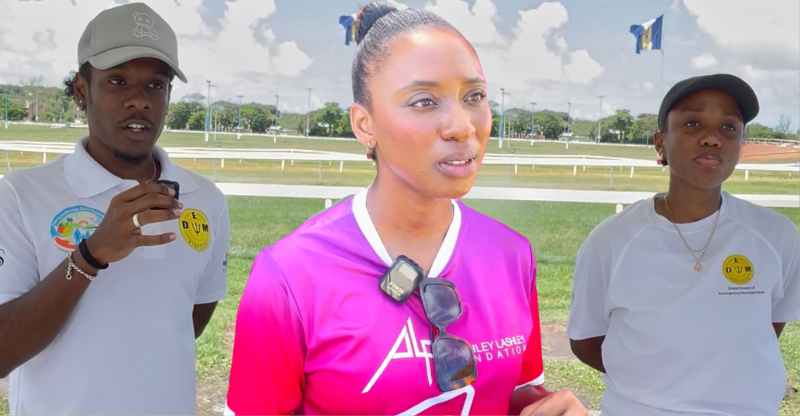
A four-week youth disaster preparedness training programme in Barbados wrapped up Friday with a hands-on, student-organized simulation exercise that put young participants’ emergency response skills to the test. Dubbed Operation Savannah Shield, the capstone activity was fully planned and led by interns with the country’s Department of Emergency Management (DEM) for participants of the Safe Coast BIM Youth Disaster and Emergency Preparedness summer camp, designed to equip teens with life-saving disaster response skills. The exercise was structured around five rotating skill stations, each targeting a core competency campers learned over the month-long programme. Participants demonstrated proficiency in clear radio communication, basic fire safety protocols, hazard identification in high-risk environments, cardiopulmonary resuscitation (CPR), general first aid, and the assembly of a well-stocked emergency go-bag. Speaking on behalf of the intern organizing team, co-lead Shakenya Jones explained the simulation was built specifically to reinforce the theoretical and practical lessons campers absorbed over the course of the programme. “We were tasked with developing a concluding exercise that tied all our learning together, so we built five stations that each focused on the key skills covered throughout the camp,” Jones said. She added that participants engaged enthusiastically with all activities, with the radio communication station emerging as a clear participant favorite. Fellow co-lead and DEM intern Edwin Workman noted the simulation was intentionally designed to mirror real-world emergency scenarios, with a core focus on building collaborative problem-solving and independent critical thinking. “We split participants into small teams, assigned every member a unique radio call sign, and tested their understanding of proper radio etiquette, observational skills, hazard assessment, and casualty response protocols,” Workman explained. “We intentionally only provided the base context and let participants lead their own responses because we wanted them to build confidence in their own skills—one day, they may need to act when more experienced responders aren’t immediately available.” Workman praised the performance of all 12 to 16-year-old campers, noting that while some teams required minor guidance to work through challenges, the overall level of engagement and teamwork exceeded expectations. “Some teams went far beyond the baseline requirements we set, and even groups that needed a little extra direction showed huge improvement over the exercise,” he said. “Overall, campers collaborated effectively, and the student team leaders stepped into their roles admirably.” Ashley Lashley, executive director of the Ashley Lashley Foundation, which partners on the Safe Coast BIM programme, emphasized that the simulation served as the critical practical capstone to a programme focused on closing a gap in youth disaster education in Barbados. The island nation is highly vulnerable to a range of climate-driven disasters, including seasonal hurricanes, widespread flooding, and chronic coastal erosion, making widespread public disaster preparedness a national priority. “Today’s exercise let students put into practice everything they learned over the past four weeks, replicating the exact work that national emergency agencies carry out when disasters threaten our country,” Lashley explained. She noted that while many young Barbadians understand the broader concepts of climate change and its local impacts, most lack concrete, hands-on knowledge of how to respond before, during, and after an emergency. “Young people are aware that climate change is affecting us, but many have never learned the practical steps they can take to keep themselves and their communities safe,” Lashley said. “That’s what makes programmes like Safe Coast so critical. They don’t just teach theory—they give young people the skills to act, and help them understand how disasters shape livelihoods and community well-being across the island.”