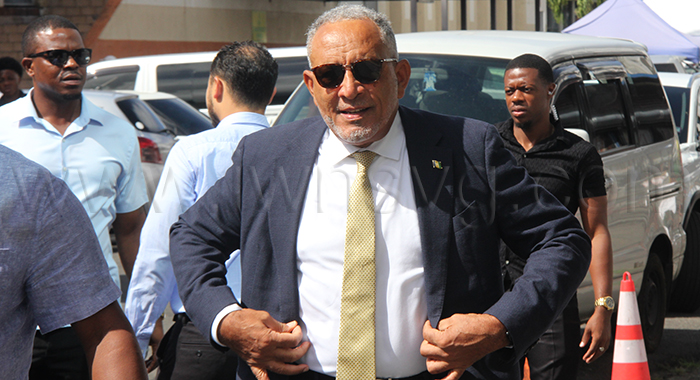
As a high-stakes election eligibility trial centered on dual citizenship reached its halfway milestone in Saint Vincent and the Grenadines on Thursday, Prime Minister Godwin Friday and his legal team have struck a confident, unyielding tone in defending their position.
The case, being heard at the Kingstown High Court before retired appellate justice and acting High Court Judge Gerthel Thom, was brought by opposition Unity Labour Party (ULP) members Carlos Williams and Luke Browne. The petitioners argue that Friday and Foreign Affairs Minister Dwight Fitzgerald Bramble are ineligible to hold their elected seats from the November 2025 general election, due to the pair holding both Vincentian and Canadian citizenship. The challenge comes after Williams and Browne lost their respective races in Northern Grenadines and East Kingstown in the November 27 poll, where Friday’s New Democratic Party secured a landslide 14-1 victory, ending 25 years of ULP rule.
Speaking to reporters after three consecutive days of witness testimony, Friday framed the proceedings as far more than a personal legal battle: he called it a critical test of both his administration’s democratic mandate and the independence of the tiny Caribbean nation’s institutions. “I am extremely upbeat about our position — our legal team has performed exceptionally well,” Friday stated. “There are actors seeking to overturn the mandate the people of this country gave me, and I will do everything in my power to protect that outcome. That is why I have been present in court every single day, and I will remain here until the court issues its ruling.”
Lead counsel for the respondents Anand Ramlogan, a former Attorney General of Trinidad and Tobago, confirmed the trial has reached its halfway point, with the petitioners having concluded all evidence testimony. Ramlogan shared that he completed cross-examination of all the petitioners’ witnesses, including Sarah McKinnis, a Canadian immigration law expert who testified virtually, and said several key revelations emerged during the intense questioning that the defense will highlight to the court. The defense will present its case when proceedings resume in the first week of September, with formal legal submissions scheduled for November. “We remain extremely confident in our position, and we trust the presiding judge will deliver a ruling aligned with law and the best interests of the public,” Ramlogan added.
Friday, who has attended every session of the trial so far, emphasized that his consistent presence is a core part of his duty to uphold the will of voters. “As prime minister, I would rather be focused on governing than sitting in a courtroom for three days of testimony, but I am here because the people placed me in this role, and I respect their mandate,” he explained. “The entire country has accepted the election result, but a small number of opponents simply cannot accept defeat, so they have turned to the courts to undermine the outcome. We will not back down from protecting and defending the mandate the people gave us.”
He added that he would not make token, occasional appearances at the trial, saying, “I will be here for every single minute of every day. I am here to represent the people of this country, and I will remain until this matter is vindicated.” Ramlogan also pointed out that the challenge comes surprisingly late, noting that Friday has served in Parliament for 25 years — making the sudden post-election objection to his eligibility “curious”.
At its core, the case turns on a long-debated question: does Saint Vincent and the Grenadines’ constitution bar dual citizens from serving in Parliament or holding senior public office? Friday argued that the law is already explicit, pointing to Section 25 of the national constitution as clear support for his position. Ramlogan, who has handled similar dual citizenship disputes across the Commonwealth Caribbean, noted that the ruling will have implications far beyond Saint Vincent and the Grenadines. “Many Caribbean island nations have larger diaspora populations living abroad than they have residents at home,” he explained. “These citizens often gain valuable international experience, advanced education and specialized expertise that they can bring back to drive national progress. Cutting off this talent pool by barring dual citizens from public office is a self-inflicted wound that holds back development.” He added that the time has come to reevaluate outdated restrictions, saying “There is no reason a loyal dual citizen who chooses to live and serve their home country should be barred from public office solely because of their second nationality.”
For their part, the petitioners framed the challenge as a legitimate effort to clarify constitutional ambiguity that serves a broader public good. “We are simply exercising our constitutional right to challenge the validity of this election, and we trust the legal process will run its course,” said petitioner Luke Browne, a ULP candidate and attorney. He added that the high-profile proceedings have already provided a valuable educational opportunity for local law students and young attorneys, who are able to observe seasoned senior counsel from across the region argue the case. Fellow petitioner Carlos Williams echoed that framing, saying “Constitutional integrity is a national priority. Where there is ambiguity in the law, it is necessary to bring the matter to court to get a clear ruling — that is exactly what we are doing here.” The petitioners are represented by Senior Counsel Stuart Young, a former Prime Minister of Trinidad and Tobago.
Bramble, the respondent and MP for East Kingstown, acknowledged the petitioners’ legal right to bring the challenge but criticized their judgment in doing so. “It is striking that after 25 years of Prime Minister Friday serving in Parliament, this objection only surfaces now after he won the general election,” Bramble said. “That demonstrates very poor judgment in how they have chosen to exercise this right. For my part, I will continue focusing on serving my constituents in East Kingstown, as I was elected to do, until the people of this constituency decide they no longer want me in office — nothing and no one else will change that.”
Throughout the proceedings, both sides have emphasized their respect for the court’s authority, even as they maintain conflicting positions on the case’s merits. Ramlogan noted that beyond legal arguments, widespread public support for Friday is on clear display outside the courthouse every day. “The law is the law, but no ruling can take away the deep public affection and support the prime minister has earned from the people of this country,” he said.