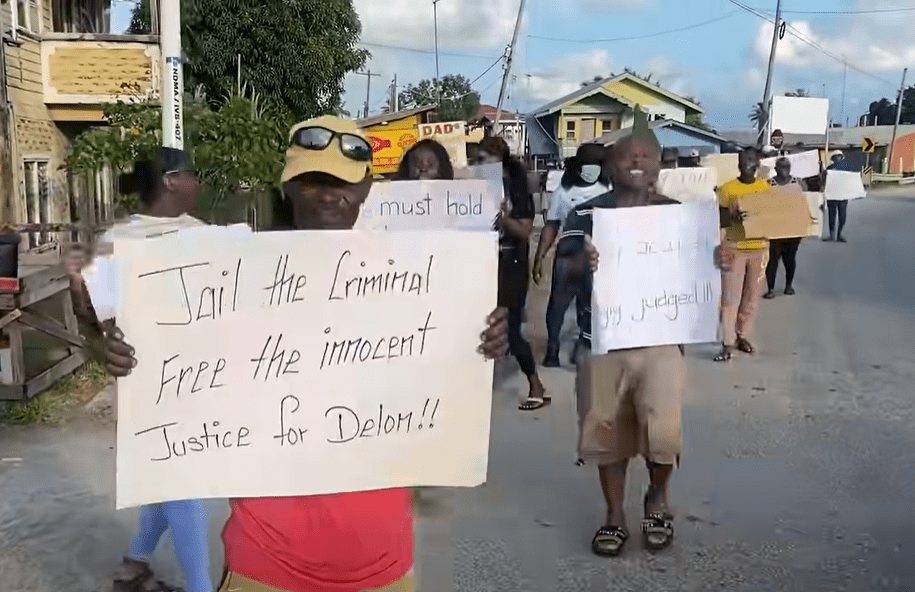
On Wednesday, July 29, 2026, widespread coordinated protests broke out across Guyana, sparked by public outrage over murder charges filed against three Transport and Harbours Department (T&HD) employees in the deadly July 18 sinking of the MV Barima passenger vessel. The disaster has left 72 people confirmed dead and another 30 missing, presumed drowned, and protesters are demanding both accountability for senior government officials and justice for the accused workers.
Demonstrations were held at three key locations: two coastal road sites on Demerara’s East and West coasts, and a mass picket outside the Office of the President in Georgetown. At Den Amstel Public Road on West Coast Demerara, roughly 30 demonstrators gathered in solidarity with 33-year-old Delon Granderson, a T&HD Goods Superintendent from Fellowship. Carrying hand-painted placards, protesters chanted “jail the criminals, free the innocent,” and called for the immediate removal of two senior cabinet members: Juan Edghill, the minister responsible for maritime transportation, and Deodat Indar, minister of maritime regulation. Placard messages included “wrongly accused, wrongly judged,” “free Delon Granderson,” and direct accusations that the two ministers “sank the evidence.”
A separate protest at Melanie Damishana Public Road on East Coast Demerara centered on support for 40-year-old MV Barima captain Kevin “KP” Price, a local villager. Protesters there joined calls to release Price, Granderson, and the third accused, Chief Mate Rondell Dwayne Roberts, while also condemning the government for what they called selective justice. Demonstrators drew a contrast between the swift murder charges against the T&HD workers and the ongoing lack of progress in the death investigation of Adrianna Young, whose body was recovered from a hotel pool in Tuschen, East Bank Essequibo. Protesters chanted that “Anil Nandlall and the DPP were silent with Adrianna’s case but they suddenly have voice,” rejecting claims of equal treatment under the law.
The three accused workers—Granderson, Price, and Roberts, 42, of Grove Public Road, East Bank Demerara—were formally charged with the murder of the 72 confirmed victims of the July 18 sinking, when the overloaded passenger vessel went down in rough coastal waters overnight.
Outside the Office of the President, a larger coalition demonstration brought together Indigenous Amerindians organized by the Amerindian People’s Association (APA), joined by civil society activists, opposition politicians, and ordinary members of the public. Many of the victims of the sinking were Indigenous people traveling to coastal communities, leading protesters to highlight systemic neglect of Indigenous safety and rights. Placards carried messages including “indigenous lives matter,” “our First People deserve first class treatment,” and calls to hold senior leaders accountable for the disaster. One protester told Demerara Waves that the tragedy exposed deep-rooted failures across Guyana’s entire public transportation system, both on land and at sea. “It is reckless, it is lawless and the protocols are not in place. The same thing translates on the sea,” he said, calling for full systemic reform and stricter enforcement of safety rules to protect all Guyanese commuters.
Representatives from three opposition groups—We Invest in Nationhood (WIN), the People’s National Congress Reform/ A Partnership for National Unity, and the Alliance For Change—joined the demonstration, with unarmed police maintaining a presence at the site. Opposition Leader Azruddin Mohamed reiterated a longstanding demand for the MV Barima wreck to be salvaged, arguing that recovering the vessel is the only way to recover remaining victims, give grieving families closure, and uncover the full truth of the disaster. He accused the government of blocking salvage efforts to avoid accountability, saying “they know they will be held accountable.” Mohamed also announced he had assembled a team of lawyers to secure substantial compensation for survivors and bereaved families, and revealed plans to organize rolling protests across all 10 of Guyana’s administrative regions in the coming weeks.
The murder charges have split official response, even within the government. On Tuesday, Prime Minister Mark Phillips publicly stated he did not believe the captain and his crew had any intention to kill the passengers on board. Lawyers for the accused have already argued there is no evidence of premeditation or intent to kill required for a murder conviction. But Director of Public Prosecutions Shalimar Hack defended her decision to recommend the elevated charges, saying the decision was rooted in evidence presented to her office, relevant legal principles, binding case law from the United Kingdom, other Commonwealth jurisdictions, and the European Court of Human Rights, as well as broader public policy considerations.
For his part, President Irfaan Ali has continued to hold one-on-one meetings with survivors and bereaved families, posting on his official Facebook page Wednesday that he remains committed to standing with affected communities through their healing process, beyond just the immediate aftermath of the disaster. “I continued my one-on-one engagements with survivors and families affected by the MV Barima tragedy,” he wrote, adding that the meetings uphold his earlier commitment to ensure all families receive the care, support, and assistance they need.
Prime Minister Phillips clarified earlier this week that any final decision on salvaging the MV Barima will be guided by the wishes of victim families. He rejected opposition claims of a government cover-up, saying “Government has nothing to hide. I can tell you up front, we have nothing to hide.” He also denied that the government was pressuring families to oppose salvage efforts, and confirmed that no compensation would be offered to families before the Commission of Inquiry investigating the tragedy releases its final findings and recommendations.