Amid harrowing accounts of systemic failures and crippling financial burdens from families of autistic people across The Bahamas, the nation’s Ministry of Education, Science and Technology has committed to fast-track the creation of a national autism registry to address unmet needs across education, therapy and post-graduation support.
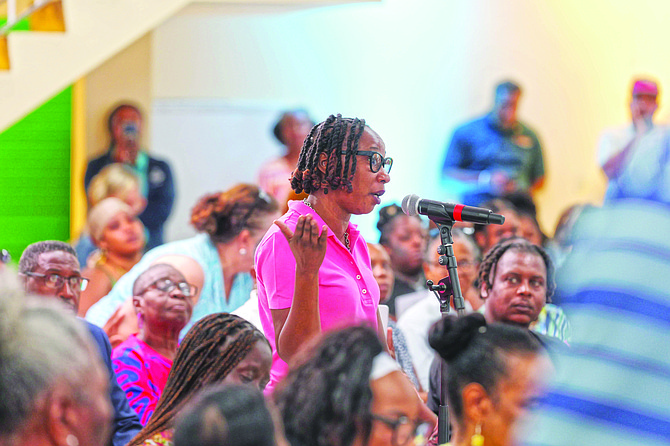
The urgent policy shift came out of a community town hall hosted at Stephen Dillet Primary School, organized in partnership with local advocacy group Resources and Education for Autism and Related Challenges. At the meeting, dozens of parents, guardians and providers shared years of struggles navigating broken support systems that have left countless families teetering on the edge of crisis.
One mother shared a devastating perspective on the lack of post-secondary support, noting that for families of autistic young people, high school graduation is far from a milestone to celebrate — it is a moment of existential fear. Many parents, she said, shared that they pray their autistic child dies before them, because no formal support systems exist to care for autistic adults after their parents pass away. “When your child reaches 12th grade, that’s usually the happiest day in a parent’s life, but when you have a special needs child, that’s your worst day, because you don’t know where your child is gonna go, you don’t know who’s gonna keep your child,” she told attendees.
Multiple caregivers shared accounts of being pushed into bureaucratic dead ends when seeking basic services. The grandmother of a 5-year-old autistic child explained she followed all required Ministry of Education procedures to enroll her grandson in public schooling, only to be turned away by public clinics due to his age, and receive no response after submitting a required online application. After months of being given “the runaround,” she only secured support through personal government connections — a solution that is out of reach for most low-income working families. She noted that while her grandson is now thriving in a specialized program, many parents cannot afford private therapy or leave full-time work to provide round-the-clock care. “If I went and I followed the proper procedures that the ministry asked me to do, why aren’t you calling us back? Where do you want the kids to go? I have to work a nine to five,” she said.
Speech-language pathologist Alicia Thompson, a Bahamian specialist who returned home after earning her undergraduate degree in 2013, highlighted another critical gap: the nation is failing to leverage its own trained workforce, leaving families stuck on months-long waitlists for services even as qualified local professionals struggle to find work. Thompson told the meeting she went months without a job offer from the Ministry of Education or Public Hospitals Authority after returning, and could not practice independently because the system failed to provide required professional supervision. She was forced to leave the field for a decade before returning to complete her master’s degree. “In a country where I wanted to help people who had the same issues as my parents, I was limited, and I had a degree that cost thousands of dollars that I could not use because there was no one to oversee me,” she said.
Even high-achieving autistic students face crippling barriers to accessing higher education, attendees shared. Reginald Wells, a top honors high school graduate and currently enrolled in culinary and hospitality studies at the University of The Bahamas, has been unable to complete his degree because he cannot pass required English and mathematics exams, and cannot access the formal accommodations he needs. Wells’ guardian explained it took 18 months to secure a required educational assessment because the family could not afford the $2,500 fee, leaving the program stalled indefinitely. “We are stuck. We can’t move forward, so he cannot graduate with a degree. All the effort and the time that we have spent – years. It took me a year and a half to get an assessment to get him into UB. I didn’t have the $2500 to assess him,” the guardian said.
Multiple parents called out predatory pricing for special needs services, noting that many private schools automatically raise tuition once they learn a child is autistic, and insurance only covers a tiny fraction of required therapy costs. One father said his family has spent thousands of dollars out of pocket on care and schooling, and questioned why so many Bahamian families are forced to relocate abroad to access affordable, comprehensive support. “I don’t think I should uproot my whole family to go to Canada where the care is free,” he said. “Why don’t we have it here? What about the parents that don’t have it at all?”
In response to the widespread calls for action, Deputy Prime Minister and Education Minister Chester Cooper announced he had already instructed ministry leadership to draft a formal white paper outlining requirements for the national autism registry, with implementation set to begin within four weeks following inter-agency consultations with the Attorney General’s Office, Ministry of Health and other key stakeholders. “This is not a talking shop. This is not a commission, and therefore I anticipate that within four weeks, after consultation with the Attorney General’s Office, the Ministry of Health and other stakeholders we will begin in earnest the process of implementation,” Cooper said.
Director of Education Dominique McCartney-Russell added that preliminary work on the registry is already underway, and the database will first be used to count how many autistic students are currently enrolled in the country’s public school system to inform future resource allocation. The ministry has also laid out broader plans to expand special education access across the country: it will launch the nation’s first formal special education diploma training program, with the first cohort of graduates expected in 2027, and extend specialized services to underserved communities across Grand Bahama, Eleuthera, Long Island and Harbour Island.
McCartney-Russell acknowledged that the ministry has made measurable progress over the past four years, including partnering with Barry University to train 14 special education teachers at the master’s level, hiring more than 40 new special education instructors, and growing the total number of special education teachers across the public system to more than 120. Still, she admitted significant gaps remain, including overcrowding at Beacon School in Grand Bahama and limited on-island support for students in the Family Islands. She outlined the ministry’s core priorities moving forward: “Earlier identification, shorter and better coordinated referral pathways, continued teacher training, increased specialist capacity, which I would say we are struggling with, stronger access for family islands, and improved transition planning.”
Cooper emphasized that early intervention will remain a top government priority, and stressed that access to life-changing support should never depend on which island a child calls home. “A child’s future should never depend on the island where that child happens to live,” he said. He added that the government’s responsibility does not end when a student graduates, noting that autism support is a lifelong commitment. “Autism is a lifelong journey. Young people need opportunities to continue learning. They need access to technical and vocational education. They need pathways into employment. They need opportunities for entrepreneurship, independent living, and meaningful participation within their communities,” Cooper said.