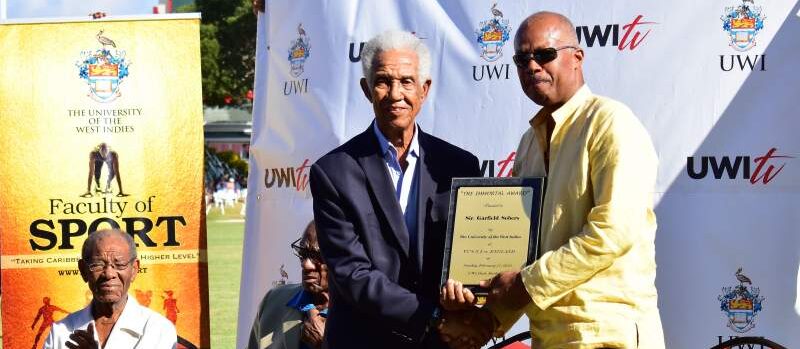
Following the passing of cricket icon Sir Garfield St. Aubrun Sobers, Professor Sir Hilary Beckles, Vice-Chancellor of The University of the West Indies (The UWI), has released a moving tribute honoring the life, legacy and far-reaching impact of the Caribbean sporting and cultural hero. The tribute frames Sobers not merely as a generational sports talent, but as a revolutionary figure who intertwined athletic excellence with the regional fight for independence and racial justice.
Emerging from the most marginalized communities of the British colonial Caribbean, Beckles writes, Sobers blazed a trail of possibility for Black and working-class people across the region and the colonized world. Born and raised in Barbados, a territory shaped by the brutal chattel sugar plantation system that systematically blocked upward mobility for enslaved descendants, Sobers broke every preconception placed on poor, Black athletes. By the age of 25, he had already cemented his reputation as the greatest all-round cricketer in the world, his on-field productivity setting records that statisticians continue to study as unmatched in modern cricket history.
Beckles emphasizes that Sobers’ greatness extended far beyond the numbers recorded on scorecards. He was a distinctly West Indian artist of the game, whose style, grace and confidence inspired both intellectual leaders and working-class communities across every Caribbean island. His message was unmistakeable: when God-given talent is unshackled from colonial oppression and given space to shine on the global stage, even the loftiest goals are within reach. He galvanized generations, proving that the children of poor, enslaved communities could reach the pinnacle of global achievement.
Sobers’ rise to leadership was nurtured by legendary West Indian captain Sir Frank Worrell, who identified his talent early and named him as his successor in 1964. At the time, the West Indian Test cricket team had languished as an also-ran since its founding in 1928, but Worrell saw that Sobers had the skill and leadership to lift the side to new heights. That promise came to fruition in 1965, when Sobers led West Indies to a historic victory over the defending world champions from Australia, securing the region’s first official title as Test Cricket World Champions. This landmark win laid the foundation for decades of continued West Indian cricket excellence under later captains including Clive Lloyd and Viv Richards.
Beyond the cricket pitch, Sobers’ success reshaped the political trajectory of the Caribbean. Beckles argues that his historic achievement made colonial rule untenable: if Barbados had produced the greatest cricketer in the world, a leader who had taken his people to the top of global sport, it had no place remaining under imperial bondage. Sobers’ call for talent to be freed from colonial oppression directly empowered Barbados’ independence movement, turning his athletic excellence into a political statement that accelerated the end of imperial rule. He reimagined the very structure and style of cricket, breaking from the rigid traditions of the old colonial order and creating a new, distinctly West Indian approach to the game that made him the defining symbol of Caribbean excellence in the age of independence.
At a time when regional political federation efforts stalled across the Caribbean, Beckles notes, cricket became the unifying force that bound the imagined West Indian nation together, and Sobers stood as its central icon. He left a lasting lesson: regional institutions must proactively identify, nurture and support talent, rather than leaving future genius to chance. In addition to his athletic and political legacy, Beckles highlights Sobers’ universal dignity and unwavering human decency, framing him as a guiding light for the Caribbean.
In recognition of his extraordinary contributions to regional sport, culture and independence, The University of the West Indies awarded Sobers an Honorary Doctor of Laws (LL.D.) degree in 1992. Beckles closes the tribute by affirming that Sobers will forever remain the brightest visionary star in the Caribbean constellation, whose legacy continues to shape the region’s identity and aspirations. The tribute was released alongside a 2019 UWI Photo Archive image showing Sobers being honored as a UWI Vice-Chancellor’s XI ‘Immortal’ by Beckles.