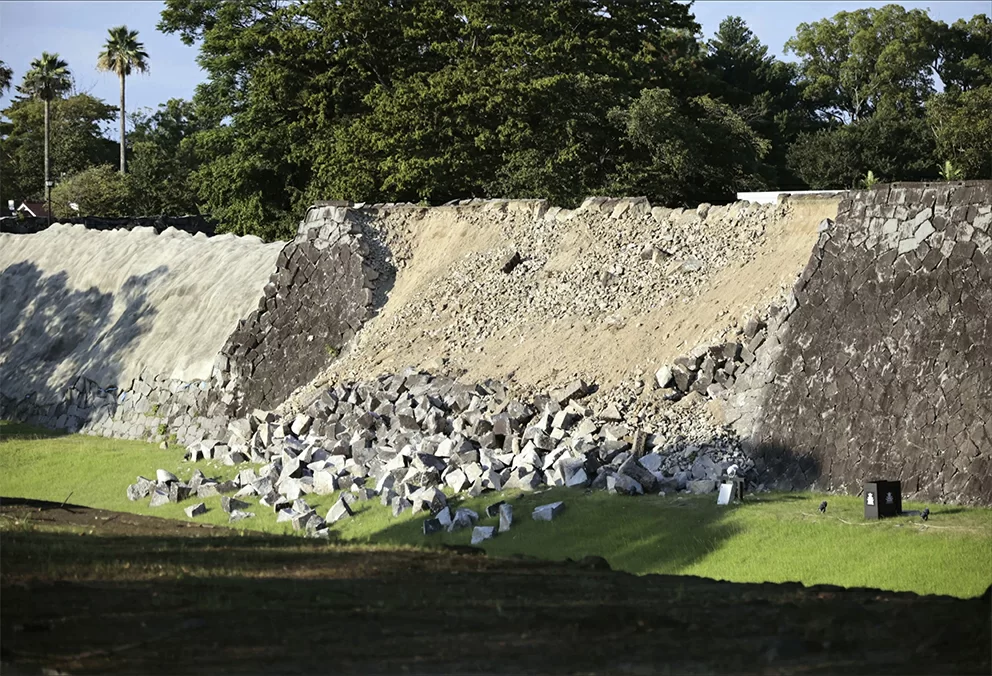
On Tuesday, a powerful 7.1-magnitude earthquake hit Kumamoto Prefecture, located on Japan’s southern island of Kyushu, leaving a trail of destruction across the region and triggering a major emergency response from national authorities. The tremor, whose epicenter was recorded just 10 kilometers beneath the surface near the city of Uki, south of central Kumamoto, was strong enough to be felt across six neighboring prefectures: Nagasaki, Kagoshima, Fukuoka, Saga and Miyazaki.
Initial impact assessments confirm widespread disruption to critical infrastructure. More than 40,000 households have been left without power, while roads and bridges across the prefecture have sustained significant damage. The disaster also triggered a large explosion at the Aeon Mall shopping center in Kashima, Kumamoto, which left a thick plume of smoke hanging over the area and ash-like debris falling on surrounding neighborhoods. While all shoppers and staff were evacuated immediately after the quake, multiple fatalities are suspected, and rescue teams are working to locate people thought to be trapped beneath rubble. As of the latest update, public broadcaster NHK reports over 50 people have been injured, including several passengers on a high-speed Shinkansen train that derailed during the tremor.
In a public address shortly after the quake, Japanese Prime Minister Sanae Takaichi confirmed the scale of the damage and urged residents to prioritize their safety. “We have received reports of injuries, power outages, fires and widespread damage to roads, bridges and buildings across affected areas,” she said. “I urge all residents to take immediate steps to protect themselves, including evacuating to designated safe locations if necessary.”
Roughly 300,000 people have been ordered to evacuate to emergency shelters by Japan’s disaster management agency, and Takaichi has deployed 3,600 Japanese Self-Defense Force personnel to support search, rescue and early recovery efforts, even as persistent aftershocks continue to rock the region. Authorities have issued repeated warnings for residents to remain alert for strong secondary tremors, which are common after major seismic events.
All high-speed Shinkansen services and local rail operations across Kyushu have been suspended to allow for urgent safety inspections of tracks and infrastructure. Aso Kumamoto Airport has also closed its main runway, with no estimated timeline for reopening announced as inspection teams continue to assess damage. Initial checks by Japan’s nuclear regulatory authority have found no abnormalities at three nuclear power plants located near the quake zone, easing fears of a radiological incident. A tsunami warning that was issued immediately after the initial quake has since been lifted.
Several major manufacturing firms with production facilities in the affected region have initiated precautionary measures. Sony and Fujifilm have already evacuated all staff from their sites in the area, while Taiwan Semiconductor Manufacturing Company (TSMC) also operates a facility in Kumamoto, though full damage assessments for industrial infrastructure are still ongoing.
The latest earthquake has also inflicted new damage on a historic landmark that is still recovering from a major seismic disaster a decade earlier. Sections of the stone outer walls of Kumamoto Castle, which were undergoing restoration following two devastating 2016 quakes that killed 275 people and injured nearly 2,740 across the prefecture, have collapsed in the latest tremor.
Japan sits along the Pacific Ring of Fire, a geologically active zone that makes it one of the most earthquake-prone countries in the world. On average, the country records a seismic event every five minutes, with many of these reaching magnitude 6 or higher.