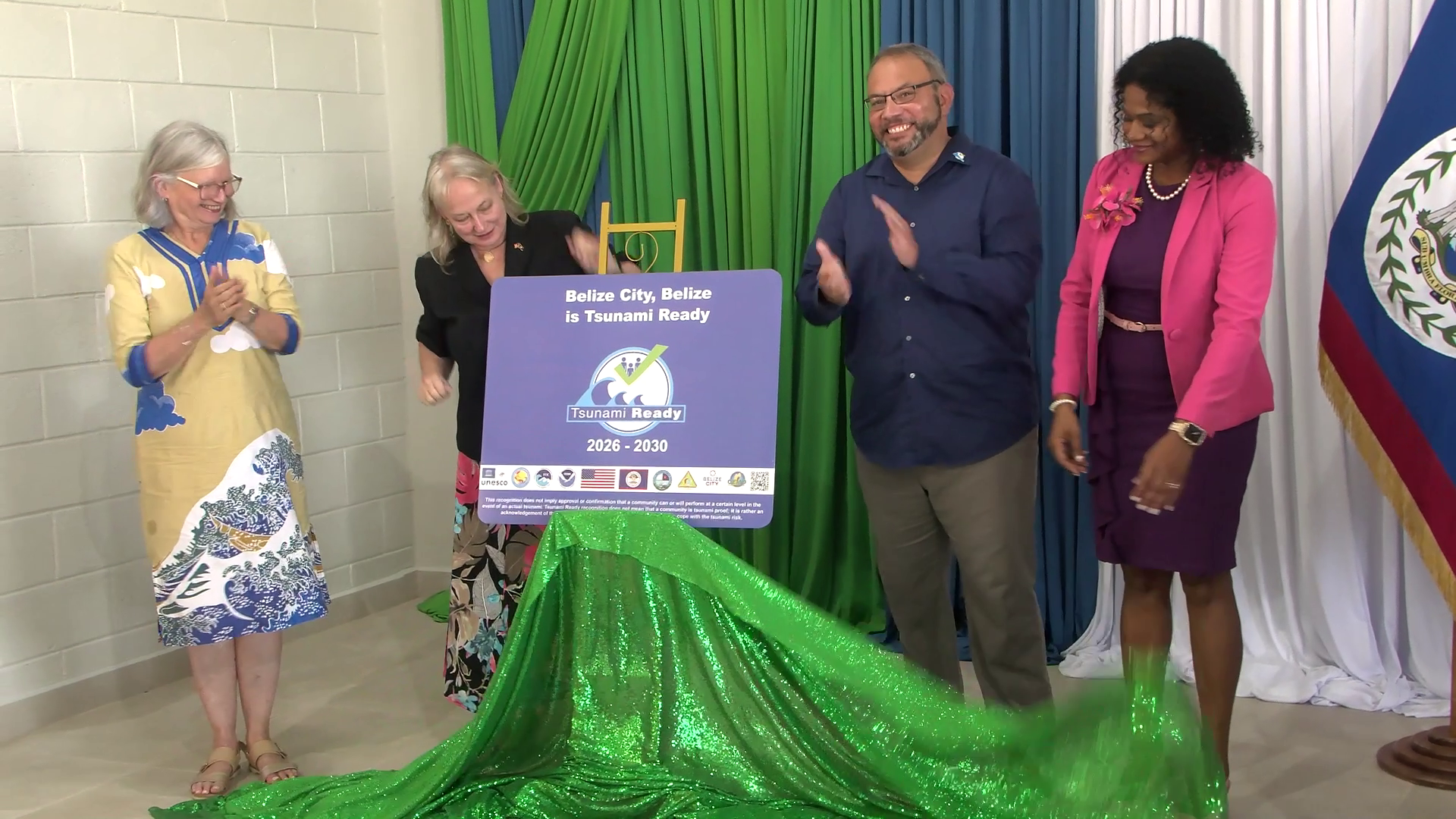
July 27, 2026 — For coastal communities across the globe, the threat of a tsunami looms as a silent, fast-moving disaster that can level shorelines in minutes, leaving little to no time for residents to evacuate to safety. While modern history has not recorded a catastrophic tsunami strike on Belize’s shores, three tsunami warnings issued since 2009 have forced the country’s coastal leadership to confront a critical question: are we prepared for when the threat becomes reality? This week, Belize City — Belize’s largest urban municipality — answered that question by becoming the first community in the nation to earn the United Nations Educational, Scientific and Cultural Organization (UNESCO) Tsunami Ready designation, an international certification that confirms the city has met rigorous global standards for disaster preparedness, early warning systems, emergency evacuation planning, and public risk education.
The path to this recognition was not a linear one, stretching back nearly eight years of intermittent progress and renewed commitment. According to Christa Von Hillebrandt-Andrade, manager of the International Tsunami Information Center, initial efforts to launch the Tsunami Ready certification process in Belize began in 2018 and 2019, with an introductory on-site workshop, the first round of flood modeling, and the completion of an initial evacuation route map. But the project stalled short of meeting all requirements: the map was never finalized and approved, emergency evacuation signage was never installed, widespread public education campaigns never launched, and formal national and local preparedness protocols were never adopted. With U.S. funding for the initiative set to expire, international partners shifted their focus to another country, where a community successfully earned the certification.
It was not until 2024 that the Belizean government reached back out to the U.S. National Oceanic and Atmospheric Administration (NOAA) and the National Weather Service, reaffirming its commitment to completing the certification process and acknowledging the urgent need for comprehensive tsunami preparedness. That renewed commitment kicked off months of intensive cross-sector collaboration, bringing together Belize’s National Emergency Management Organization (NEMO), international technical partners, local government agencies, and community stakeholders to check off every remaining requirement.
For Henry Charles Usher, Belize’s Minister of Disaster Risk Management with oversight over NEMO, the UNESCO designation serves as a critical reminder that disaster preparation cannot be put off until a catastrophe unfolds. He noted that Belize has already faced two tsunami warnings in recent years — one in 2018 and another most recently in 2025 — neither of which resulted in a damaging tsunami. While tsunami events are far more common in the Pacific Ocean, Usher emphasized that the Caribbean is not immune to the threat, and public awareness of tsunami and earthquake risk lags far behind the deep knowledge the country has built for more frequent hurricane disasters. “It’s something that is good that we get this type of education,” Usher said of the certification process, which has helped fill that gap in public awareness.
The United States, through NOAA, played a central technical and financial role in supporting Belize City to reach the milestone. U.S. Embassy Chargé d’Affaires Rhonda Slusher noted that the certification is far more than a symbolic honor: it represents hundreds of hours of behind-the-scenes work that will save lives when minutes matter. Just this year, NOAA specialists worked alongside NEMO teams to stress-test evacuation plans, refine coastal flood inundation maps that show which areas will be flooded by a tsunami, and complete dozens of unpublicized required tasks to meet international standards. “We can bring resources and expertise, but effective partnership requires a mutual investment, and you brought it,” Slusher said, crediting local leaders and community members for the genuine commitment that made the achievement possible.
While tsunamis are often perceived as distant disasters that only impact other regions, historical records tell a more urgent story: the Caribbean basin has documented more than 75 confirmed tsunami events over its history, making the threat rare but not zero. For Belize, a low-lying coastal nation heavily dependent on its shorelines for population centers and economic activity, Belize City’s new certification marks a major step forward in protecting residents and visitors from a potentially catastrophic disaster. Reporting for News Five, Shane Williams.