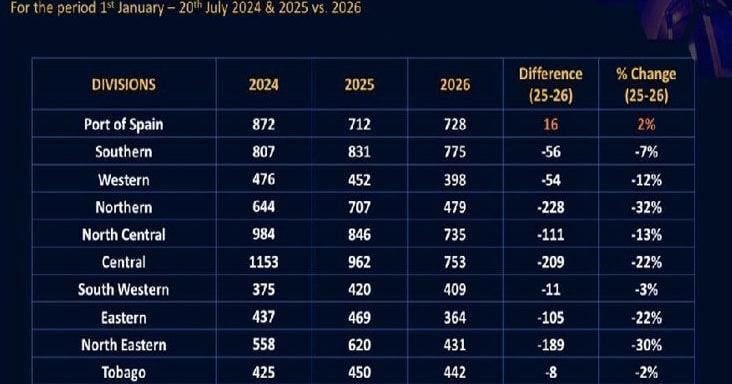
Mid-year crime performance data released by the Trinidad and Tobago Police Service (TTPS) shows the agency has outperformed its 2026 national public safety targets across multiple major crime categories, though persistent gaps in murder reduction, case detection and illegal firearm recovery remain areas of urgent priority. The latest COMPSTAT assessment, published July 21, 2026, draws on official crime data pulled from the TTPS Versadex system, comparing reported offenses between January 1 and July 20 2026 against the same period in 2025 to measure year-over-year trends.
Against a benchmark 10% reduction in nationally reported serious crime, the TTPS recorded a 15% overall drop, cutting total serious incidents from 6,469 in 2025 to 5,514 this year – a net reduction of 955 offenses. Violent crime, defined by the report as including murders, woundings, shootings, sexual offenses, kidnappings, robberies and home invasions, also outperformed expectations with a 12% national decrease, exceeding the 10% target. Road traffic safety outcomes delivered even more dramatic improvements: fatal road accidents fell 24% year-over-year, while serious non-fatal accidents dropped 29%, both far outstripping the agency’s 5% reduction target for traffic incidents.
A breakdown of results across the country’s 10 police divisions shows broad progress, with nine divisions recording reductions in serious crime. Northern Division led with a 32% drop in serious offenses, followed by North Eastern at 30%, and Central and Eastern Divisions both posting 22% reductions. Most major crime categories shared in the decline: robberies fell 31% (333 fewer incidents), shootings and woundings dropped 26%, kidnappings decreased 20%, motor vehicle larceny fell 18%, and illegal firearms possession dropped 25%.
Despite these overall gains, the report flags multiple critical areas that have failed to meet performance targets. Most notably, murder reduction fell short of the 5% target, with only a 3% nationwide drop (from 220 to 213 incidents) year-over-year. Murder trends also varied sharply across divisions: Central Division cut murders by nearly half from 41 to 21, a major improvement, while North Central Division saw murders surge from 9 to 27, a 200% increase. Other divisions reporting rising murder counts include North Eastern, South Western and Tobago, while Port of Spain held steady at 23 murders.
Case detection rates, a key measure of police investigative effectiveness, also remain below target across multiple high-priority categories. The national murder detection rate sits at just 16% for 2026, unchanged from the seven-year average and well below the TTPS 23% target. Only 35 of the 213 murders recorded this year have been solved, with some divisions reporting particularly poor outcomes: Port of Spain and Western Division each solved just one murder despite recording 23 and 20 murders respectively. Fraud detection is an even larger gap: the 13% detection rate for fraud offenses is 12 percentage points below the 25% target, the widest performance gap identified in the assessment. Overall serious crime detection also fell from 37% in 2025 to 33% this year.
Illegal firearm recovery is another underperforming area: the TTPS targeted a 10% increase in recoveries, but actually recorded an 11% drop, from 395 recovered weapons in 2025 to 351 this year. Excluding weapons from a seized Municipal Police cache, the actual net recovery of new illegal firearms falls to 305, a 23% drop from last year’s figure. A small number of crime categories also recorded unexpected increases: home invasions jumped from zero reported cases in the 2025 comparison period to 181 this year, while ransom kidnappings rose from 5 to 7 cases.
A divisional-level breakdown reveals uneven performance across different regions. Southern Division cut overall serious crime by 7% but saw violent crime rise from 292 to 339 offenses, driven by increases in sexual offenses and shootings, even as murders and robberies fell in the region. Central Division posted strong reductions in both murders and overall serious crime, but recorded a sharp jump in home invasions, from zero to 56. North Eastern Division cut serious crime by 30% but saw its overall detection rate drop from 31% to 28% year-over-year.
In addition to major crime trends, the report also published data on minor offenses for the first half of 2026: 1,609 minor crimes were recorded with a 45% detection rate, while 3,429 minor offenses (most commonly assaults, threats and breach of peace incidents) had a 16% detection rate. Central Division recorded the highest volume of minor crimes in the first half of the year.
In its concluding analysis, the COMPSTAT assessment categorizes results into clear operational victories and unaddressed strategic gaps. The TTPS counts the 15% drop in serious crime, 12% drop in violent crime, and sharp reductions in fatal and serious road accidents as key wins for the period, while identifying six priority areas for improvement: murder reduction, murder detection, violent crime detection, fraud detection, general larceny reduction, and illegal firearm recovery.