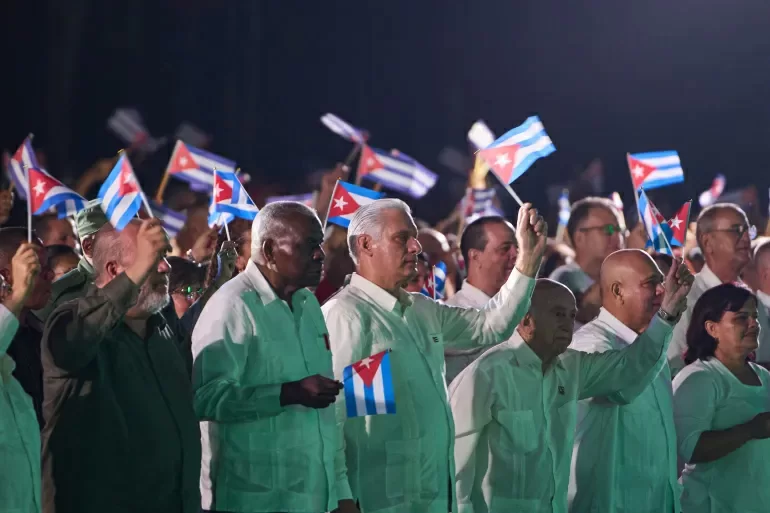
HAVANA — Speaking at a national commemoration marking the 73th anniversary of the start of the Cuban Revolution on Sunday, Cuban President Miguel Díaz-Canel issued a scathing rebuke of the United States, accusing Washington of orchestrating deliberate genocide against the Cuban people and pursuing overt plans to seize control of the island nation.
The event, held in the western Cuban province of Pinar del Río, brought together government officials and revolutionary supporters to honor the 1953 uprising that would eventually oust the US-backed Fulgencio Batista regime six years later. Notably absent from the gathering was 92-year-old former President Raúl Castro, the iconic revolutionary leader who stepped down from power in 2018 and is the brother of late revolutionary icon Fidel Castro.
Díaz-Canel’s harsh words come amid a deepening humanitarian and economic crisis on the island, fueled by a longstanding US trade embargo that was tightened in recent years, particularly a oil embargo imposed earlier this year that has triggered crippling nationwide power outages that can last more than 20 hours a day. According to on-the-ground reports, the embargo has pushed Cuba into one of the worst economic collapses in its modern history.
The Cuban leader labeled the sweeping US sanctions “cold-blooded, calculated genocide” and framed the punitive measures as an act of “economic strangulation” designed to break the will of the Cuban people and force regime change on the island. “Today, Cuba is waging a historic struggle against the walls of genocidal policy, aimed at suffocating an entire people to take ownership of the country,” Díaz-Canel told the assembled crowd.
The tangible impacts of the embargo are already widespread across Cuba: domestic manufacturing facilities have been forced to halt operations, employers have had to slash working hours amid energy shortages, and the country is facing acute shortages of clean water, pharmaceutical products, and other essential basic goods. Major international firms, including financial giants Visa and Mastercard, Spanish hospitality chain Meliá Hotels International, and leading airlines Air Canada and Air France, have already pulled their operations out of Cuba to avoid falling afoul of US sanctions and navigate the worsening domestic crisis.
Bilateral relations between Washington and Havana have been strained for decades, but tensions have deteriorated sharply during the current administration of former US President Donald Trump. Trump has previously openly stated his intention to “take over” Cuba, a threat that gained traction after the controversial detention of Venezuelan President Nicolás Maduro, a key Cuban ally, earlier this year.
In recent months, US accusations against Cuba have intensified: the US State Department recently claimed that Havana operates a sprawling network of espionage and political influence targeting Washington and Latin American neighboring countries. In May, the US leveled criminal charges including murder against retired leader Raúl Castro over his alleged involvement in the 1996 downing of two civilian aircraft operated by a Cuban exile group, an incident that killed four people.
The Cuban government has vigorously rejected all of these accusations, condemning the escalatory rhetoric from the Trump administration. Bilateral talks between the two nations have been largely frozen since June, leaving no clear path to de-escalation in the near term. The 1959 Cuban Revolution, led by Fidel and Raúl Castro, ended five years of armed insurgency to overthrow the US-aligned Batista dictatorship and established the socialist state that has governed Cuba ever since.