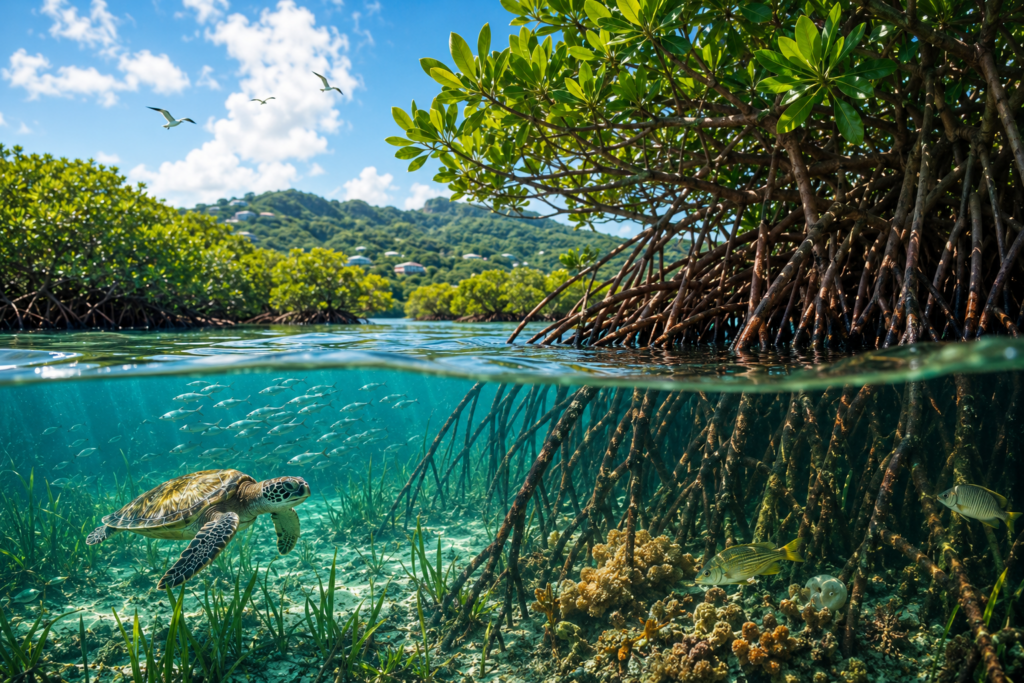
ST. JOHN’S, Antigua – In a push to highlight the irreplaceable ecological and economic value of mangrove forests to the twin-island nation, Antigua and Barbuda’s Department of the Blue Economy has organized a full slate of educational and community-focused events to observe the International Day for the Conservation of the Mangrove Ecosystem.
In an official statement released to mark the annual observance on Sunday, the department outlined the wide-ranging, critical roles mangrove ecosystems play across the country. Beyond anchoring coastlines to slow erosion and buffer against destructive storm surges, these coastal forests underpin marine biodiversity, act as highly effective carbon sinks, and boost the nation’s overall capacity to adapt to the accelerating impacts of climate change.
The first of this year’s scheduled activities took place July 24, when department organizers hosted an interactive educational workshop for attendees of the National Library Summer Camp. Through a mix of engaging educational games and hands-on learning experiences, young campers explored core themes including local marine biodiversity, coastal protection strategies, marine pollution prevention, and the natural water purification function mangrooves provide.
The series of observance events will continue July 27 with a community mangrove-themed public mural project, led entirely by students from J.T. Ambrose Primary School. The mural will be painted at the Recreation Ground on Independence Drive, located directly opposite the Roman Catholic Church of St. Joseph and St. Patrick, with work running from 9 a.m. to 3 p.m. and open to public observers.
Department officials emphasized that while mangroves rank among the most biologically productive ecosystems on the planet, they are also one of the most threatened. These coastal forests serve as critical nursery habitats for commercially important marine species including fish, crabs and lobsters, providing a natural foundation that supports the nation’s commercial fishing industry, coastal tourism sector, and small coastal communities that rely on both for livelihoods.
Data shared by the department adds further context to mangroves’ outsized environmental impact: Healthy mangrove ecosystems naturally filter industrial and agricultural pollutants from coastal waters, boosting water quality for both marine life and human communities, while reducing the destructive force of hurricanes and seasonal flooding. On a global scale, mangrove forests can store up to four times more carbon per hectare than most terrestrial tropical forests, and provide permanent or migratory habitat for hundreds of species of fish, birds and other wildlife.
To extend the impact of the international observance beyond scheduled events, the Department of the Blue Economy is calling on all Antigua and Barbuda residents to join ongoing mangrove conservation efforts. Simple actionable steps the department highlights include cutting down on single-use plastic consumption to reduce marine plastic pollution, avoiding damage to intact coastal mangrove habitats, participating in local community coastal clean-up drives, and spreading public awareness of mangroves’ importance to friends and family.
Closing the official message, the department adopted the event slogan “Healthy Mangroves. Healthy Oceans. Stronger Communities,” and encouraged local residents to share their own personal mangrove conservation activities on public platforms to honor the international observance and inspire broader action.