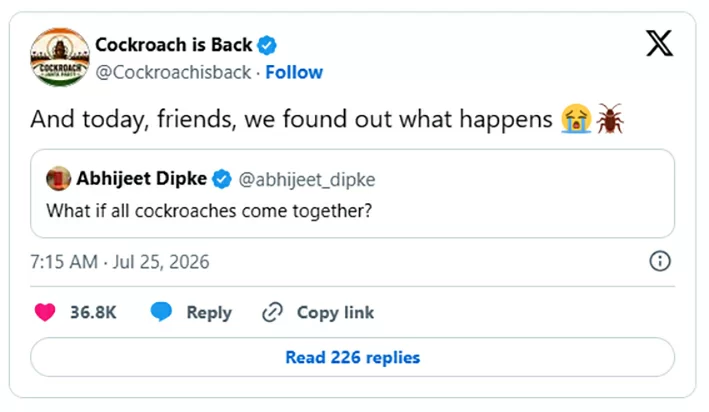
It began with a single provocative question posted online: “What if all the cockroaches unite?” Thirty-six days later, that offhand social media post by activist Abhijeet Dipke has grown into a nationwide youth-led movement that scored a historic political victory: India’s Education Minister Dharmendra Pradhan announced his resignation on Saturday, bowing to relentless public pressure over a massive exam leak scandal that has rocked Prime Minister Narendra Modi’s sitting cabinet. Pradhan’s stepping down was the central demand of the months-long cross-country protests that have put Modi’s ruling Bharatiya Janata Party (BJP) under unprecedented political strain.
The movement that brought down a cabinet minister took its unlikely name and identity from a insult. When India’s top judge publicly compared unemployed Indian youth to “cockroaches” and “parasites”, dismissing widespread youth frustration as the griping of lazy, unproductive people, Dipke leaned into the slur to found the Cockroach Janta Party (CJP), a satirical grassroots opposition movement that tapped into deep-seated anger over systemic failures in India’s education sector.
That anger boiled over after a large-scale exam leak affected millions of Indian students, forcing widespread exam cancellations that upended young people’s academic and career plans. The crisis pushed dozens of desperate students to die by suicide, a tragedy that became a rallying cry for the movement. When Pradhan’s resignation was announced, Dipke stood before thousands of cheering supporters gathered at New Delhi’s iconic Jantar Mantar protest site — where local authorities had already shut down internet access to disrupt the movement — and shouted “We did it, we did it!” He read aloud the names of the students who had died by suicide amid the scandal, dedicating the movement’s victory to their memory. The announcement sparked jubilant celebrations across the protest camp, with crowds dancing and waving homemade signs.
Nineteen-year-old protester Lavanya Bharti, who has spent weeks at the New Delhi camp, embraced the movement’s anti-establishment identity with a laugh. “They called us lazy and unemployed. We are lazy enough to camp out and sleep on Parliament Street for days; we are unemployed, brother,” she said. “But we have wiped out the fear that Modi built up over years. Cockroaches crawl all over you, Modi.”
The protest movement gained national traction after violent police crackdowns on peaceful demonstrators went viral online. On July 20, a peaceful march to India’s parliament turned violent when police and paramilitary forces attacked protesters with batons and tear gas, leaving more than 100 people injured. Footage of the crackdown spread rapidly across social media, sparking outrage and drawing tens of thousands of new protesters to demonstrations in major cities including Bengaluru, Jaipur, Lucknow, Mumbai and Patna.
After the government conceded to all of the movement’s core demands — which include compensation for the families of deceased students, amnesty for all participating protesters, and a public apology from police and paramilitary forces for the violent crackdown — CJP organizers called on demonstrators to return home peacefully. For many who traveled hundreds of kilometers to join the protest, the resignation marks a watershed moment for youth power in India. Twenty-five-year-old Mehdi Hasan traveled more than 1,120 kilometers from his home in Begusarai, Bihar, to camp at Jantar Mantar for a month. “I am going home happy now,” he said, holding a sign demanding government accountability. “We are the people of this country, and we have shown the government that its power is not absolute.”
Not all protesters are ready to declare the fight over, however. Eighteen-year-old Shruti Bedi, one of the young movement organizers, warned that Pradhan’s resignation, while a critical win, is only a first step. “We need total systemic reform; the government needs to be fully accountable to the people,” she said, noting that deep public anger against the ruling establishment remains unaddressed. She pointed out that the most important achievement of the Gen Z-led movement is that it has given ordinary citizens their voice back. “How much longer will we accept that politicians send their own children to study abroad while we get beaten by police on the streets for demanding our basic rights?” she asked. Bedi and other protesters carried copies of the popular Japanese manga *One Piece*, a global symbol adopted by Gen Z protest movements fighting inequality, mass unemployment, and outdated authoritarian leadership.
As the protest camp slowly emptied, the CJP’s official social media account posted a public response to Dipke’s original viral question, writing: “And today, friends, we have discovered what happens when the cockroaches unite.”
Pradhan’s resignation marks an unprecedented rebuke to Modi, who has held power for 12 years and carefully cultivated an image as an unassailable strongman. That image has been increasingly tested by the widespread, viral organizing of Gen Z activists across Indian social media. Since Pradhan stepped down, the Indian government has moved forward with new measures to address the exam leak crisis and rebuild student trust, including pledged improvements to exam oversight mechanisms and greater transparency around testing processes. The CJP and allied youth movements say they remain vigilant, and continue to demand full systemic education reform to prevent similar scandals from happening again.
Local and national media are continuing to monitor the ongoing situation, as youth organizations across India keep pushing for greater accountability and equity in the country’s education system. The protest movement has cemented its place as a landmark moment for youth political power in India, marking a shift as the country’s largest demographic increasingly organizes to demand tangible political change.