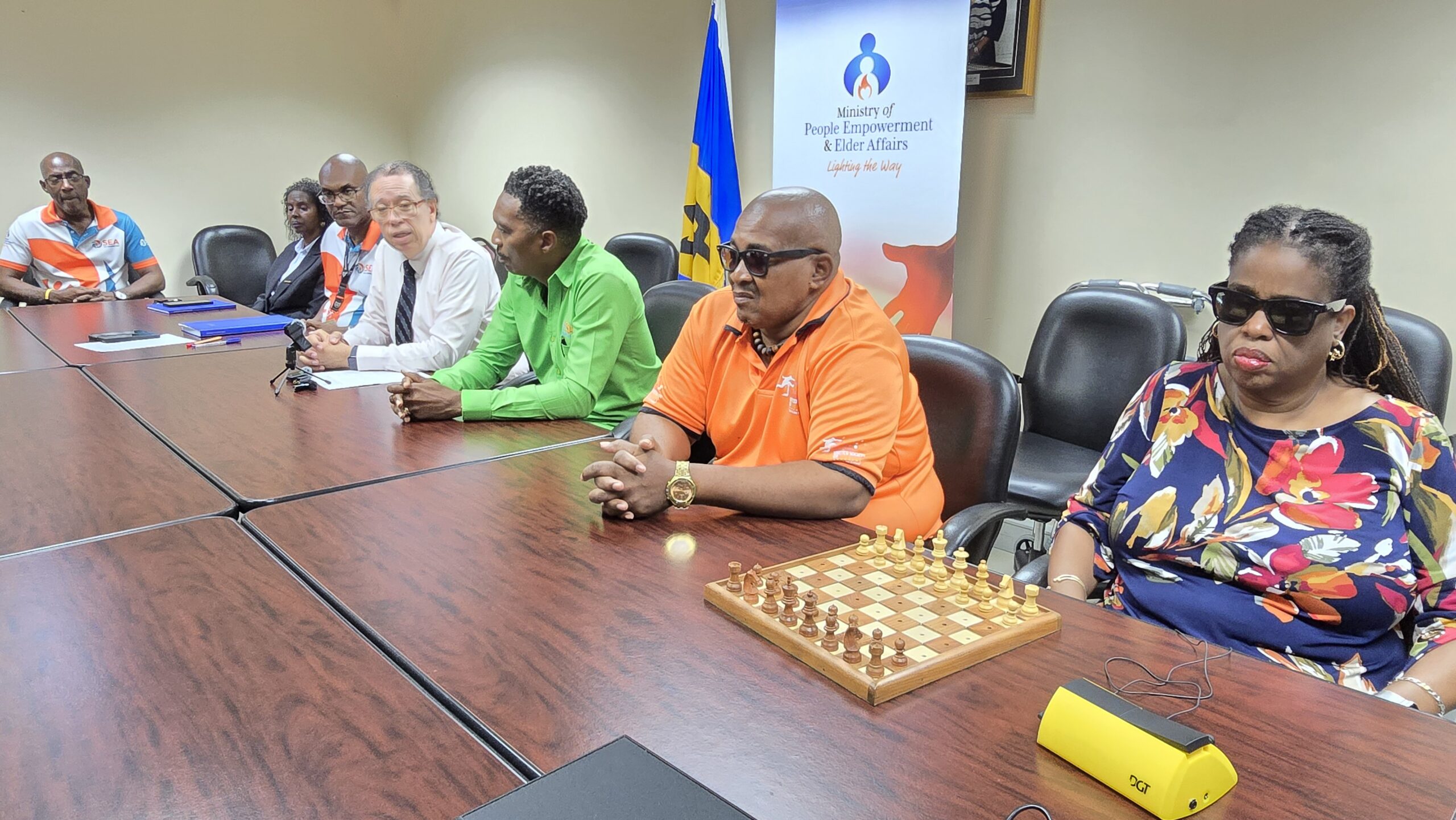
Barbados is breaking new ground in accessible sports with a landmark national initiative designed to expand recreational opportunities for blind and visually impaired community members, paving the way for competitive participation both locally and on the global stage. The Barbados Chess Federation (BCF), in partnership with the Ministry of People Empowerment and Elder Affairs and the National United Society of the Blind (NUSB), has officially received specialized adaptive chess equipment from the International Chess Federation (FIDE), enabling the island nation to host its first-ever official national championship for visually impaired chess players.
During a formal handover ceremony held Friday, the BCF presented 10 custom braille chess sets and five adaptive chess clocks to NUSB, gear tailored specifically to meet the unique needs of players with limited or no vision. BCF President Allan Herbert explained that the request for specialized equipment grew out of introductory training sessions launched with visually impaired participants last year. Standard chess gear designed for fully sighted players simply does not work for those with visual disabilities, Herbert noted, prompting the federation to reach out to FIDE for support. The global governing body responded with a grant that covered the cost of the adaptive equipment.
With the custom gear now in hand, visually impaired players can transition from remote online training to in-person over-the-board competition for the first time in Barbados. “The core goal of this project from the start was to secure the proper tools to make competitive, in-person chess accessible,” Herbert said. “Now that we have that equipment, we can move forward with building structured, traditional competitive play for this community.”
A new round of community training is scheduled to kick off next month, designed to recruit and train new participants from the visually impaired community. The training period will conclude later this year with the historic first national championship for visually impaired chess players, a milestone for inclusive sports on the island. Looking ahead to the long term, the BCF has set an ambitious target: to develop a competitive national team that can represent Barbados at the FIDE World Team Championship for Persons with Disabilities within the next two to four years, where the tournament is held every two years. “We are starting from an early, developing stage,” Herbert explained. “But we are confident that in the coming years, we will have a team ready to compete at the international level.”
Minister of People Empowerment and Elder Affairs Adrian Forde praised the initiative, framing it as a reflection of the Barbadian government’s ongoing commitment to advancing equal opportunity for people living with disabilities across all sectors of society. “Our ministry’s work must be balanced to ensure that people with disabilities get the same access to opportunities as every other member of our community,” Forde said. “Inclusivity isn’t just a buzzword — it’s a value we want every Barbadian to live by, and this program embodies that.”
Forde emphasized that meaningful partnership for disability inclusion requires tangible action, not just empty rhetoric at international forums. “Partnership has to mean real opportunities for people with disabilities here at home,” he said. The minister also announced plans to support the future hosting of an international blind chess tournament in Barbados, expanding the impact of the initiative beyond national borders. “Under my watch, we will fulfill our mandate to guarantee equal opportunity for people living with disabilities,” Forde added. “Before long, we will welcome competitors from across the region and beyond for an international blind chess tournament right here in Barbados, to showcase the incredible talent in our community.”
NUSB President Ralbert Ashton noted that the programme opens a critical new avenue for visually impaired Barbadians to demonstrate their skills and contribute to national life. “We have a saying: ‘There’s life after blindness,’” Ashton said. “We already saw the incredible talent our community has shown in the national Calypso competition, and our members excel in so many different fields. Our community has so much to give back to Barbados — all we need is the opportunity to showcase that. This collaboration between the BCF, the Social Empowerment Agency and NUSB gives us exactly that chance, and helps us continue advocating for full inclusion for people with disabilities.”
Kerryann Ifill, immediate past president of NUSB, recalled that the effort began when the organization reached out to the BCF to explore accessible chess programming, and was met with immediate enthusiasm — a welcome change from the pushback disability advocates often encounter. “When you work in this space, you get used to people saying no, saying they don’t know if it will work,” Ifill said. “It was so refreshing to have the BCF say yes immediately, that they were ready to make this happen.”
Ifill also singled out chess coach Dirk Austin for praise, noting that he volunteered his time to learn how to work with blind players and has been a consistent supporter of the programme. “Dirk had never worked with blind chess players before, but he stepped up without hesitation,” Ifill said. “He’s always available to encourage our players and help the programme grow.”
Currently, participants train on an accessible online chess platform that offers a dedicated blind mode, which allows visually impaired players to compete against sighted opponents seamlessly, often without their opponents even noticing their disability. “Once you enable blind mode, the platform adapts completely for screen readers, and you can just sit back and enjoy the game of chess,” Ifill explained. Now, with the new braille equipment, players will get the chance to test their skills in person for the first time, building toward the historic national championship later this year.