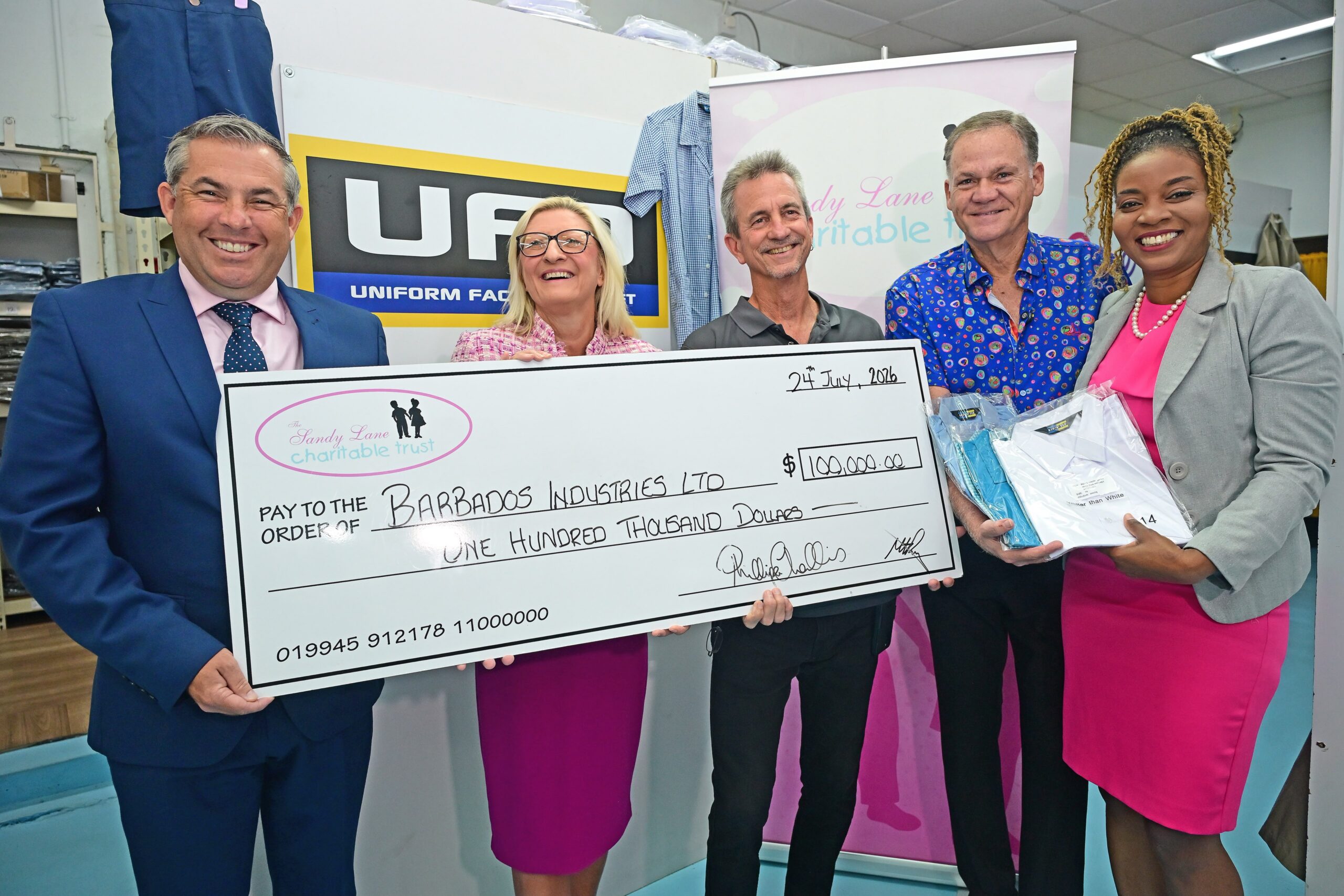
Against a backdrop of soaring living costs that have stretched household budgets thin, the Sandy Lane Charitable Trust has rolled out an expanded back-to-school support initiative to help low-income families prepare their children for the upcoming academic term, backed by a $100,000 investment in school uniforms and a brand-new program that will deliver 500 pairs of school shoes to children in need. However, retail partner Uniform Factory Outlet has called on the government to step up and amplify the impact of the donation, urging the finance minister to waive value-added tax (VAT) on the contribution that would free up an extra $15,000 to put toward more school supplies for struggling families.
Pippa Challis, a trustee for the organization, explained that the trust chose to increase its investment in this year’s program after observing growing financial strain on parents across the country. Many households have been left unable to cover the unexpected, substantial cost of outfitting children for the new school year amid stagnant wage growth and skyrocketing inflation. “This year we have decided to continue the support to those organisations I’ve mentioned previously, but also to add a little bit more into the pot,” Challis said during the donation handover ceremony. “I think that’s because it’s needed, greatly needed. The cost of living has gone up, wages haven’t grown significantly, but I think the reality is, and we have to be honest with ourselves, people live hand to mouth.”
Challis added that while many families are just barely able to cover core monthly expenses like rent and groceries, sudden costs for school supplies push budgets beyond breaking point. Uniform costs alone can run anywhere from $300 to $500 per child, a sum that is out of reach for many low-income households even when they are managing to meet other basic needs. “The big problem comes these days when all of a sudden you have the uniforms. And that uniform bill comes to $300, $400, $500. Regardless of your number of children, you’ve obviously got to find more money,” she noted.
Unlike open, unregulated distribution, the assistance will be allocated via a pre-vetted list of eligible families compiled in partnership with local community organizations. Beneficiaries will receive store credit to redeem for uniforms through Uniform Factory Outlet, alongside the new school shoes and other targeted support. “They have a list of families. I’m afraid it’s not a free-for-all. There is a pre-agreed list of families and children’s names and they will be working with us hand in hand with that list and within our parameters,” Challis explained.
At its core, the program is designed to give children the confidence to start the school year on equal footing with their peers, Challis emphasized. When students have properly fitting, new uniforms and supplies, they do not stand out from their classmates and can focus on learning from day one. “For me, it’s about getting the children off to school with a good start. You walk into school with a good uniform on, you look like everybody else, you feel like everybody else, and you have the confidence to start the new term afresh,” she said.
Beyond uniforms and shoes, the expanded program includes additional support through partnerships with local retailers, which will help families access discounted or free textbooks, stationery, and other essential back-to-school supplies. The 500 pairs of school shoes included in this year’s initiative were sourced directly from the United Kingdom to expand the scope of assistance beyond the trust’s traditional offerings.
Dean Straker, director of Uniform Factory Outlet, echoed Challis’s comments on the mission of the program, noting that a proper uniform does far more than meet school dress code requirements – it builds students’ self-esteem from their first day back. He praised the Sandy Lane Charitable Trust for its substantial $100,000 contribution, which represents a major investment in local children’s education, but stressed that a VAT exemption would unlock far more impact. Without the exemption, $15,000 of the donation will go toward paying tax to the government rather than buying more supplies for children in need.
“One hundred thousand dollars is no little contribution and it’s a great example of what people can do,” Straker said. “What I would like to beg the Minister of Finance for is that he will make that cheque VAT exempt so that we do not pay $15 000 out in VAT to government. I really hope that we will get a break with that so that we can give more uniforms to more children, and that’s what it’s all about.”
Straker closed by thanking the trust for its partnership, reaffirming the shared goal of helping every child start the school year with confidence and the tools they need to succeed.