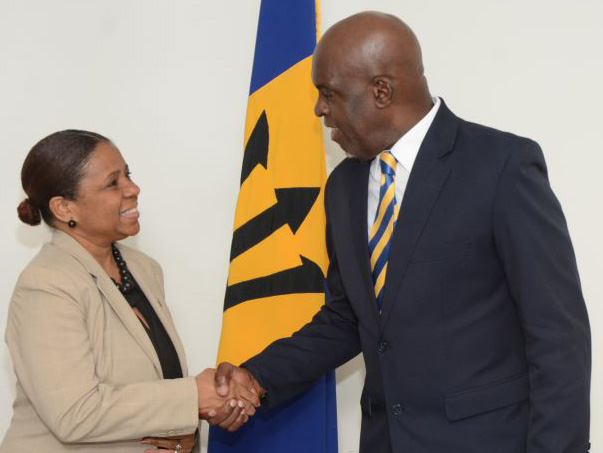
Diplomatic engagement between Barbados and Cuba has taken a focused turn toward public safety and justice system collaboration, as Cuba’s ambassador to Barbados, Yanet Stable Cárdenas, held a formal courtesy meeting with Barbados’ Minister of Legal Affairs and Criminal Justice, Michael Lashley, to advance shared priorities in crime reduction and offender rehabilitation. The discussions centered heavily on protecting young people from exposure to violence and criminal activity, an issue that resonates on both Caribbean islands.
Cárdenas opened the talks by pushing for deeper mutual knowledge exchange between the two nations’ criminal justice frameworks, arguing that shared understanding is the foundation for coordinated progress on one of the region’s most pressing challenges: unregulated firearms possession. She outlined Cuba’s long-standing approach to gun control, highlighting the country’s 2008 foundational decree on firearms supervision and control, which received comprehensive updates in 2025 to address emerging threats. Crucially, Cárdenas emphasized that Cuba’s strategy extends far beyond restrictive legislation, pairing regulatory rules with proactive social prevention programs that educate youth on the risks and responsible management of firearms.
Beyond gun control, the ambassador also voiced Cuba’s interest in partnering with Barbados to strengthen social reintegration programming for people returning to communities after incarceration. She noted that widespread buy-in from all segments of society, especially the private sector, is essential to helping former offenders rebuild stable, productive lives and reduce recidivism rates. By working together, both countries can refine models that help communities understand their collective role in supporting successful reintegration, she added.
Minister Lashley echoed Cárdenas’ priorities, confirming that private sector participation is a make-or-break factor for the success of any reintegration effort. He outlined the broader direction of his ministry’s work, which balances strict law enforcement with targeted prevention and rehabilitation initiatives designed to address the root causes of crime. A key existing effort is Barbados’ National Peace Program, which proactively engages at-risk community members to provide access to rehabilitation and transformative support before involvement in serious crime.
Lashley also shared updates on ongoing systemic reforms across Barbados’ criminal justice sector, which cover the court system, law enforcement training for police officers, and operational improvements for court marshals. Looking ahead, the Barbadian government is preparing to launch a new diversion program aimed at intervening early with individuals who have come into contact with the justice system, particularly young offenders. The program will focus on character building, teaching core values around respect for life and personal property, and addressing barriers to learning that can push people toward cycles of crime. By intervening early, officials hope to stop criminal patterns from taking root before they become permanent.
In addition to these initiatives, Lashley revealed he has proposed reestablishing a dedicated drug court in Barbados, pointing out that a large share of interactions between citizens and the criminal justice system are directly linked to substance use disorder. A specialized court, he argued, would allow for more targeted, rehabilitative intervention rather than punitive measures that do not address the underlying addiction driving offenses.
By the end of the meeting, both officials reaffirmed their commitment to continuing bilateral discussions, exploring expanded collaborative projects, and increasing cross-border information sharing to advance shared goals. This latest engagement builds on more than five decades of formal diplomatic relations between the two nations, which were first established on December 8, 1972.