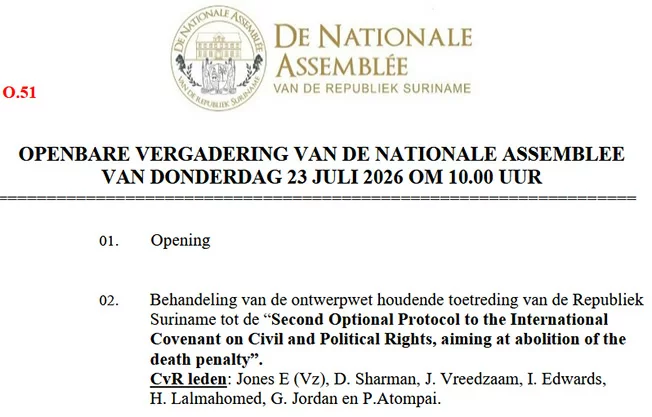
On July 23, Suriname’s National Assembly (DNA) began consideration of a draft bill that would pave the way for the South American nation to join the Second Optional Protocol to the International Covenant on Civil and Political Rights (ICCPR), a United Nations agreement focused on permanently eliminating capital punishment.
Adopted by the UN General Assembly in 1989, the Second Optional Protocol binds all participating states to legally commit to ending all use of the death penalty. Signatory nations are prohibited from carrying out executions, and are barred from reintroducing capital punishment into their national legal systems, with only extremely narrow exceptions permitted under the treaty’s terms.
While Suriname has not executed any prisoners or applied the death penalty in judicial proceedings for decades, accession to the protocol would enshrine the country’s de facto abolition as a binding international legal obligation. This creates an additional layer of legal protection that prevents future governments from reversing the current practice and reinstating capital punishment, aligned with the limited reservations allowed under the protocol for accession states.
Suriname is already a full party to the core International Covenant on Civil and Political Rights, a foundational human rights treaty that codifies fundamental protections including the right to life, the right to a fair trial, and other core civil and political guarantees for all citizens. The Second Optional Protocol is a supplementary agreement that builds on these core commitments, with its sole focus being the permanent abolition of the death penalty globally.
If the draft bill receives final approval from the National Assembly, the move will mark another significant milestone in Suriname’s implementation of its international human rights obligations. For years, the United Nations and global human rights monitoring bodies have repeatedly urged all countries that still retain capital punishment in their legislation to join this protocol and advance global abolition efforts.
Per the official DNA agenda, the draft bill will be debated at a public plenary session scheduled to begin at 10:00 a.m. local time on Thursday. Preparatory review of the legislation has already been completed by a special committee of rapporteurs led by chair Ebu Jones, with additional members including Dew Sharman, Jennifer Vreedzaam, Iona Edwards, Hakiem Lalmohamed, Genevievre Jordan and Poetini Atompai.