When this year’s Common Entrance exam results revealed a worrying steep drop in national English test scores, education policymakers moved quickly to address growing fears that thousands of incoming secondary school students were not prepared for the academic demands of high school. The result is a targeted, intensive summer literacy intervention that is already reporting measurable early gains for the learners who need it most.
As part of the country’s National Literacy Programme, the Ministry of Education Transformation launched the Summer Learning Pod initiative, with a pilot site hosted at Westbury Primary School. Currently, 70 students between the ages of 11 and 13, all of whom showed critical gaps in reading and writing proficiency in this year’s exams, are receiving specialized daily support designed to close literacy gaps before they begin secondary school. The 3-week programme, set to conclude this Friday, relies on two evidence-based instructional frameworks developed by Lindamood-Bell: Seeing Stars and the Visualizing and Verbalizing approach, delivered through small-group instruction tailored to each student’s skill level.
Each structured method targets a core component of literacy proficiency. The Seeing Stars framework helps learners build word recognition and spelling skills by training them to create clear mental images of letter sequences within words, a technique that strengthens automatic decoding. The Visualizing and Verbalizing approach, by contrast, boosts reading and listening comprehension by teaching students to form mental imagery of the content they read, then rephrase that content in their own words to deepen understanding. With a strict 1:5 instructor-to-student ratio, every learner receives personalized attention that is often hard to access in crowded standard classroom settings.
The intervention was launched in direct response to newly released national data showing that the average English score dropped from 72.5 in 2025 to 64.2 in 2026. Education officials flagged widespread weaknesses in core skills including grammar, vocabulary, reading comprehension, and analysis of expository nonfiction texts, gaps that experts warn could create persistent barriers to success as students move to the more rigorous curriculum of secondary school. To remove common barriers to access, the programme also provides all participating students with free daily transportation and school lunches, ensuring that low-income learners are not excluded from the support they need.
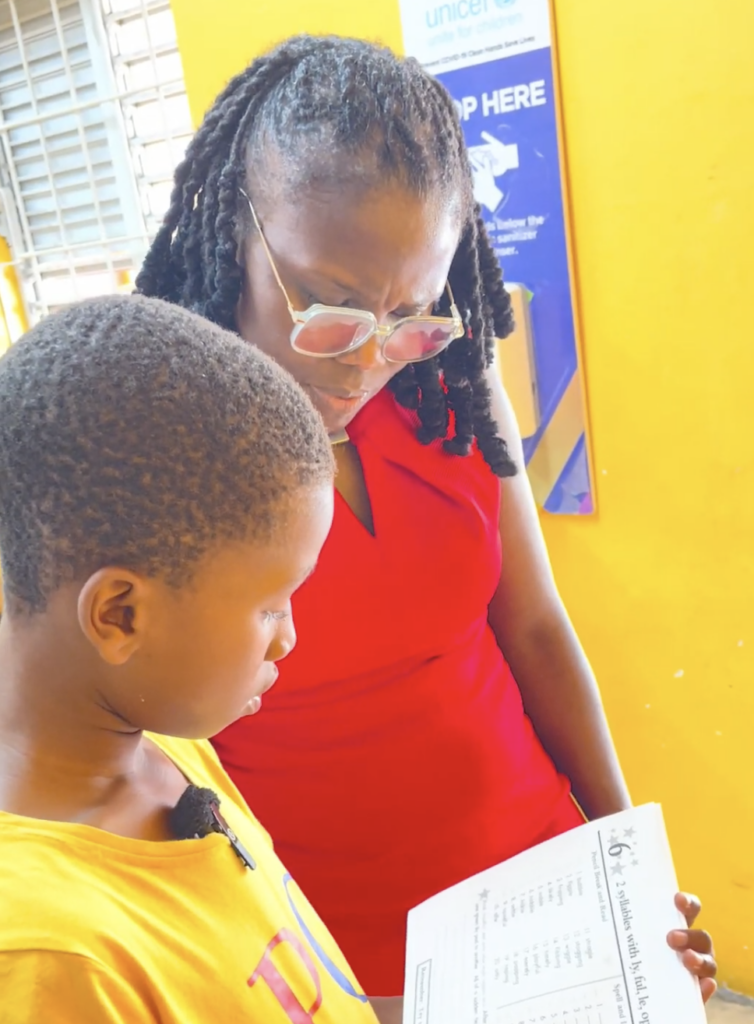
Project consultant Isabel Medellin says early progress assessments already show clear, transformative improvements for many participants, pointing to the rapid growth of one 11-year-old student named Jayden as a striking example. When Jayden first joined the programme, initial baseline testing placed his reading proficiency at roughly a first-grade level, with extremely weak foundational skills that left him struggling to decode even short, simple words. “When we first began his instruction, he was working on words with single syllables, two or three sounds. So words like ‘cat’ or ‘boat,’” Medellin explained.
After less than three weeks of daily targeted instruction, observed in part by peripatetic teacher support officer Lee Carter, Jayden’s skills and confidence have both surged dramatically. “So now he’s working on two-syllable words. He is reading passages with more complex single-syllable and two-syllable words. He’s increasing his sight word recognition, and his confidence has increased so much,” Medellin said. She added that the shift in Jayden’s classroom engagement has been as notable as his academic progress: “He is always raising his hand to answer the questions, and it’s been really great to see that within just barely three weeks, he has gone from struggling to decode words with two or three letters to now he can take on two-syllable words and decode them back to back.”
All participants complete a baseline assessment at the start of the programme and a follow-up assessment at the end to measure growth, allowing educators to document exactly how much progress each student makes over the three-week intervention. Education officials say the early results from the pilot will inform future expansion of targeted summer literacy support to address ongoing declines in secondary school readiness.