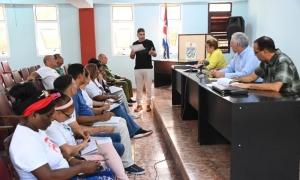
On a Tuesday afternoon in late July 2026, Cuban President Miguel Díaz-Canel Bermúdez, who also serves as First Secretary of the Central Committee of the Communist Party of Cuba, concluded his 13th municipal tour of the capital Havana with visits to the Municipal Defense Councils of Regla and Guanabacoa. Across the entire island, this on-the-ground tour represents more than routine governance: it is a daily battle to protect and sustain the lives of ordinary Cuban people.
As the reporter embedded in the visit observed, the moments captured on this trip reveal two defining truths of contemporary Cuba: the unyielding resilience of the general population, and the extraordinary dedication of grassroots leaders who have become the backbone of the country’s crisis response. These local leaders do not govern from distant offices; they know the communities they serve by name, memorize individual household needs, and turn institutional frameworks into on-the-ground support that reaches every vulnerable resident. Their expertise and commitment stand as living proof that Cuba’s pool of capable, community-focused leadership is far from exhausted.
During meetings with local leadership in both municipalities, Díaz-Canel received detailed briefings on the most pressing challenges facing local residents. Unlike one-size-fits-all national policy approaches, local leaders have tailored their responses to the specific needs of their territories—an approach Díaz-Canel has repeatedly endorsed. In Regla, for example, leaders stressed the critical interdependence of two core public services: maintaining a stable electricity supply to keep water pumping operations running for all residents. Across both regions, the list of core priorities acts as a roadmap for preserving community well-being: protecting civilian safety, streamlining energy distribution programs, securing consistent food access for all households, and directing extra support to the most vulnerable demographic groups.
The Regla visit marked the 12th stop on Díaz-Canel’s statewide municipal tour, with conversations across all stops centering on consistent, citizen-focused priorities: expanding local food production, improving solid waste collection, expanding support for at-risk populations, strengthening the Community Youth Network’s on-the-ground work, and improving coordination between all types of economic actors to speed up problem-solving for residents. In Regla specifically, the conversation turned to the urgent need to map out-of-school youth and unemployed residents to connect them with support opportunities. Díaz-Canel emphasized the importance of granular, up-to-date data on unemployment to target assistance effectively. Local officials also updated the president on the number of vulnerable residents identified through recent census work, the performance of the municipality’s four existing Family Care Systems (SAF), and ongoing efforts to improve service quality.
Discussions in both municipalities also highlighted the work of the Community Youth Network, a grassroots initiative that has delivered meaningful impact despite limited resources. The network has organized volunteer efforts to deliver food to elderly residents living far from SAF distribution points, provided support to pregnant people in underserved areas, and run community social programs that strengthen local social cohesion.
The tour underscored a core lesson repeated across every municipal stop: every territory faces unique challenges, solutions, and community dynamics, even as they share common systemic struggles. Guanabacoa, the 13th and final stop on this leg of the tour, offers a clear example of this uniqueness: the municipality is home to 115 housing complexes and more than 10,000 vulnerable residents, with a particularly high prevalence of elderly adults living alone. To meet these unique needs, local economic actors have partnered with government entities to streamline pension delivery, strengthen SAF operations, and prepackage food for rapid distribution to the highest-need areas. The Ministry of Transportation has provided dedicated support for these efforts, and even for persistent capital-wide issues like solid waste collection, local leaders are testing creative, low-resource solutions including the use of animal traction for collection routes.
Closing out his visit in Guanabacoa, Díaz-Canel reflected on the ongoing national process of 176 economic and social transformations, emphasizing the critical role of municipal autonomy in driving effective change. He confirmed that 80 of these transformation initiatives have already received formal approval for implementation, backed by 57 new legal frameworks to support rollout. These reforms, Díaz-Canel explained, open new pathways to coordinate cross-sector action between all types of economic actors, improve the efficiency of public organizations and entities, and make it faster and simpler to solve persistent local problems. The president has long advocated for a gradual, incremental approach to reform, focused on delivering tangible improvements for residents one step at a time.
As one young local leader in Guanabacoa told the presidential delegation, progress is being made every single day, even amid immense pressure. This quiet daily work is a titanic struggle: Cuba continues to face what Cuban leaders describe as a “genocidal” international siege that has strained the country’s economy and public services, but grassroots leaders and residents remain committed to building a better future for the next generation. During his walk through Guanabacoa, Díaz-Canel stopped to speak with a group of children on a street corner, chatting with them about soccer and sharing smiles. That interaction, the visit made clear, is the core motivation for all the ongoing work: the fight to ensure current and future generations can live freely and securely in the land they love.