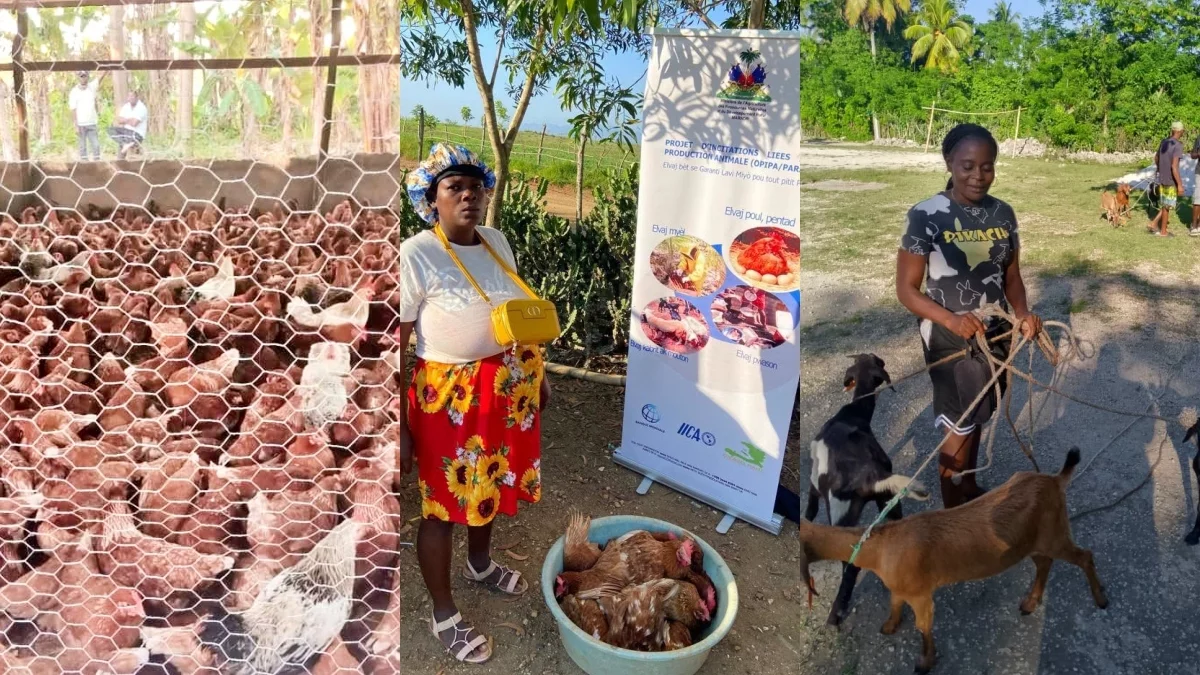
Haiti continues to grapple with a persistent national food insecurity crisis, and a new multi-stakeholder agriculture initiative is stepping in to rebuild one of the country’s most under-supported food production sectors: family livestock farming. Known as the Resilient Agriculture for Food Security Project (PARSA), the 30-month initiative is led by Haiti’s Ministry of Agriculture, with core funding provided by the World Bank. Its specialized livestock production incentive sub-component is delivered with technical expertise from a partnership between the Inter-American Institute for Agricultural Cooperation (IICA) and local Haitian non-governmental organization Giradel-Haiti.
The project targets 32 communes across four of Haiti’s departments: Central, Grande Anse, Nippes, and South. A full breakdown of participating communes includes Maïssade, Thomassique, Hinche, Cerca la Source, Cerca Cavajal, and Thomonde in the Central Department; Roseaux, Jérémie, Marfranc, Beaumont, Moron, Corail, and Pestel in Grand’Anse Department; Petit Trou de Nippes, Baradères, Miragroane, Fonds des Nègres, L’Azile, and Arnaud in Nippes Department; and Saint-Louis-du-Sud, Cavaillon, Aquin, Chantal, Arniquet, Saint-Jean-du-Sud, Les Anglais, Les Chardonnières, Tiburon, Maniche, Camp-Perrin, Torbeck, and Les Cayes in the South Department.
To deliver long-lasting impact, the project has built a localized expert team including one sector specialist per target department, four department-level coordinators, and 32 community-based facilitators. This on-the-ground structure focuses on strengthening local capacity, ensuring that interventions remain resilient and self-sustaining once initial project activities wrap up.
By the end of 2026, the initiative will reach 16,636 small-scale livestock farming households across four priority production sectors: beekeeping, aquaculture, poultry farming (focused on laying hens and guinea fowl in Haiti’s Central region), and small ruminant farming (goats and sheep). Notably, 55% of all identified beneficiaries are women, a demographic disproportionately impacted by Haiti’s food and economic insecurity. Each household will receive a customized technical support package tailored to the specific needs of their operation.
Rachelle Pierre Louis, Technical Cooperation Coordinator for IICA-Haiti, emphasized that the project’s scope goes far beyond one-time material support. “Our goal is not only to provide animals and equipment, but above all to offer concrete technical support to vulnerable livestock farmers in the affected areas to rebuild their livestock activities and strengthen their resilience to shocks by adopting resilient farming practices,” she explained. The initiative combines initial capital recapitalization for beneficiary households with ongoing guidance to embed long-term sustainability into every activity.
A core pillar of the project is integrating innovative, climate-adapted practices to modernize small-scale livestock farming and boost long-term productivity. Key innovations include artificial insemination to improve the genetic stock of small ruminants, nutrient-dense lick blocks to support animal health during frequent drought periods, vermiculture to produce low-cost organic protein for poultry feed, and shared apiculture reference centers that give small-scale beekeepers access to expensive equipment needed to produce high-value hive products such as propolis, royal jelly, and raw honey. For aquaculture producers, the project is testing the integration of compost into fish feed to cut input costs. Cross-departmental internship opportunities will also help spread successful practices across regions.
Emmanuel Calixte, Executive Director of GIRADEL Haiti, noted that livestock farming has long been sidelined in Haitian agricultural development policy, despite its outsized role for rural households. “The project helps to promote livestock farming, often neglected in favor of other production sectors, even though it constitutes an important source of income, savings, and a means of improving food security,” he said. Calixte added that hands-on training from project extension workers builds the technical skills producers need to navigate challenges and capitalize on opportunities to grow their operations.
Early beneficiary testimonials highlight the transformative impact of the project on rural household livelihoods. Fleury Marducia, a participant in Asile commune’s Changeux section, explained that the layer chickens provided through the initiative have already generated steady income. “The chickens the project gave me allowed me to produce enough eggs. I was able to sell them so far for 7,500 gourdes. With this money, I bought a pig. Today, the pig is growing well, and I cherish it,” she said.
Caristil Angelo, a beneficiary from Moron commune’s Source-Chaude section, received three female goats and one male goat through the project, and credits the provided training for his early success. “Thanks to the training, I know how to care for them, feed them, and monitor their health. My animals are healthy and represent a real asset for my family,” he noted.
Another Moron commune beneficiary, Mirlène Jean Pierre, echoed that sentiment, saying her four goats have already put her household on a path to improved food security. “The females will soon give me kids, which will double my capital. It’s invaluable help for me and my family. I thank the project for this support,” she said.
All beneficiaries are scheduled to receive their full technical packages by October 2026. Prior to distribution, participants complete practical training modules focused on four core skills: developing low-cost animal feed from local resources, preventing common livestock diseases, managing small farms both technically and financially, and effective marketing techniques for farm products.