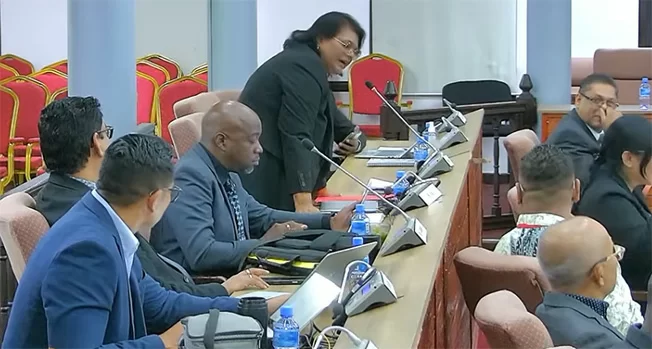
On July 21, members of Suriname’s National Assembly issued a urgent call for the national government to ramp up traffic law enforcement, driven by a steady upward trend in traffic-related deaths that has disproportionately claimed the lives of young people across the country.
Lawmakers across party lines are pushing for sweeping changes: increased daily visible police presence on roads, more frequent speed limit checks, and harsher punitive action against unlicensed drivers and repeat traffic offenders. Krishna Mathoera, a VHP party legislator leading the push, emphasized that most road crashes stem from reckless road user behavior rather than vehicle technical faults, noting that these incidents leave widespread damage, long-term trauma and inconsolable grief in their wake. “The only effective way to change dangerous driving habits is through consistent enforcement and intervention,” Mathoera stated, calling for expanded traffic police units, more intensive patrols, and a higher number of official citations for violations.
Mathoera pointed to a troubling mismatch in official data from the Public Prosecution Service: while traffic fatalities continue to climb, the total number of citations for traffic offenses has actually fallen. She argued that the government must implement daily, sustained checks until deadly crash rates are reduced to manageable levels. Her concerns have been echoed by other Assembly members, including Vice President Ronnie Brunswijk of the ABOP party. Brunswijk drew attention to a recent fatal pedestrian crash in Moengo as a tragic example of the ongoing crisis, noting that reckless excessive speeding is particularly rampant within built-up residential and urban areas.
The parliamentary debate also centered on assigning clear accountability for traffic enforcement. Brunswijk argued that responsibility cannot fall exclusively on the Minister of Justice and Police, noting that police leadership, from the corps commander down to regional commanders, share an obligation to deploy personnel and organize regular checks. Jerrel Pawiroredjo, leader of the NPS parliamentary faction, clarified that criticism is targeted at policy failures, not individual officials. “We are not attacking the person, we are challenging the policy,” he said, while adding that the minister bears ultimate political accountability for the performance of the ministry and national police corps.
In response to the calls for action, Minister of Justice and Police Harish Monorath reported that the national traffic enforcement team inspected 328 vehicles in the first two weeks of July, with regular patrols also carried out by general duty police units. But Mathoera rejected these figures as woefully insufficient, calculating that this averages out to just 50 vehicle checks per day nationwide – a number she said could be matched in a single hour at one busy intersection near the National Assembly building itself. “These are not results we can accept,” she said, stressing that the public needs to see and feel a constant visible police presence on roads.
Minister Monorath acknowledged that more action is needed, pointing out that officers issue daily fines and seize unregistered or unlicensed vehicles, but framed traffic safety as a shared responsibility between the government and broader society. He noted that poor street lighting, damaged road surfaces, insufficient speed bumps, and low public awareness of traffic rules all contribute to unsafe road conditions.
Parliamentarians also put forward proposals to expand public traffic education, including reinstating mandatory structured traffic lessons in primary schools and running recurring public awareness campaigns on radio and other media. The idea of using unmarked police vehicles and motorcycles to catch reckless drivers was also raised. Monorath confirmed that police already run educational programs in schools, but these will be expanded after the national budget is approved, freeing up additional resources for intensified traffic education.
In closing, lawmakers emphasized that improving road safety cannot be achieved with statistical tweaks alone. They called for a holistic approach combining consistent visible police patrols, upgraded road infrastructure, expanded public education, and strict, consistent penalties for dangerous driving behavior to reverse the rising tide of preventable road deaths.