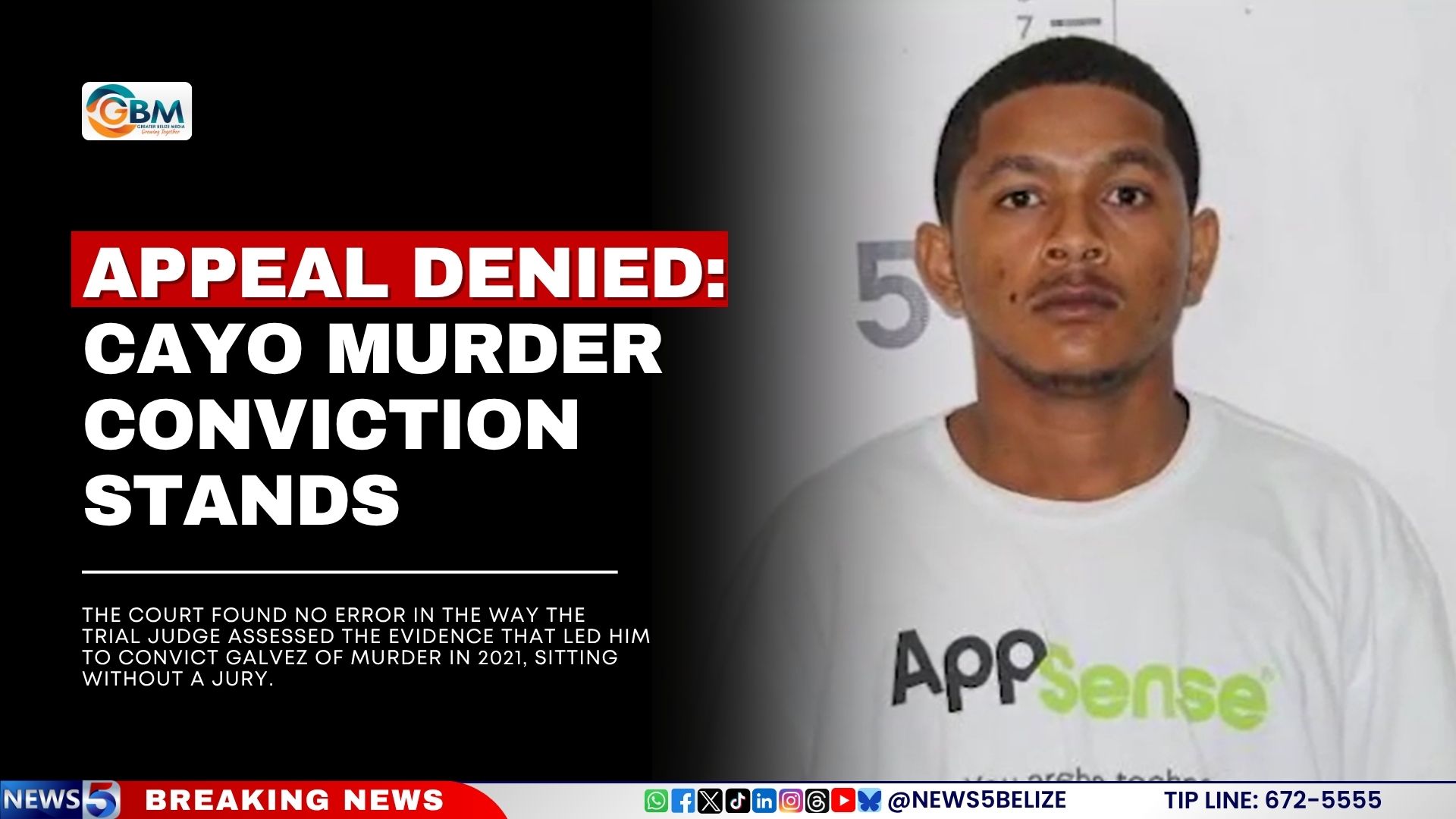
On July 21, 2026, Belize’s Court of Appeal delivered a landmark ruling dismissing an appeal against a 2021 murder conviction, leaving Dean Galvez’s life sentence for the 2018 fatal shooting of Ronnie Omar Cassasola Jr. intact.
The fatal incident traces back to the night of May 5, 2018, at the Pedrigal Bar in San Mateo, Cayo District, where a confrontation erupted between Dean Galvez, his companions, and members of the Cassasola family and their associates. When the groups left the bar, tensions did not de-escalate as the Cassasola group traveled home. According to prosecution allegations, Galvez pulled a firearm and opened fire, withdrew from the scene, then returned to fire a second volley of shots. Cassasola Jr. ultimately died from a gunshot wound sustained in the attack.
Galvez was convicted of murder in 2021 during a judge-alone bench trial, where no jury was seated. His appeal to the higher court centered on multiple claims of legal error during the original trial, chief among them arguments that the trial judge improperly relied on eyewitness identification evidence to secure a guilty verdict.
Five witnesses who had personal prior knowledge of Galvez testified that they identified him as the shooter, noting they observed him at a distance of 20 to 30 feet under clear street lighting at the time of the shooting. Galvez repeatedly denied any involvement, telling the court he was not present at the scene when the shooting began, and had fled to take cover elsewhere after hearing gunfire. While an alibi witness for the defense largely backed up Galvez’s account of his whereabouts that night, a key inconsistency over whether Galvez had jumped a fence while fleeing weakened the alibi, a gap the original trial judge cited in discounting the defense’s claim.
In his appeal arguments, defense counsel Norman Rodriguez laid out multiple grounds to overturn the conviction. He argued the trial judge incorrectly ruled that eyewitness evidence was strong enough to prove guilt beyond a reasonable doubt. He pointed to forensic evidence showing the fatal bullet was fired from behind the victim, and claimed the trial judge failed to draw a critical legal distinction between identifying an unknown suspect and recognizing a person already known to witnesses. Rodriguez also challenged the judge’s finding that lighting conditions were sufficient to support reliable identifications, and noted that no formal identification parade was conducted before trial.
Director of Public Prosecutions Cheryl-Lynn Vidal, leading the prosecution’s response to the appeal, pushed back against these claims. She emphasized that the original trial judge had fully complied with long-standing legal safeguards for eyewitness identification known as the Turnbull guidelines. Vidal also noted that all five witnesses had known Galvez for a long time before the shooting, and that favorable lighting and unobstructed lines of sight made their recognition of Galvez reliable.
The appellate court’s ruling delved deeply into the legal framework governing identification evidence, walking through the core requirements of the Turnbull principles. These guidelines mandate that trial judges explicitly warn of the risk of misidentification even when witnesses appear honest and convincing, and require close scrutiny of key factors including observation distance, lighting conditions, how long the witness had to observe the suspect, and prior familiarity with the person in question.
The appellate panel also addressed a key procedural question: how these identification safeguards apply differently in a judge-alone bench trial versus a conventional jury trial. The court clarified that a judge sitting without a jury does not need to recite every legal principle in formal, explicit terms, as long as the overall reasoning of the ruling demonstrates that all core legal issues were properly considered and addressed.
After a full review of the original trial judge’s written ruling, the appellate judges found that the lower court had properly followed all required safeguards. The trial judge had explicitly noted the risk of mistaken identification for the record, individually examined lighting conditions, observation distance, and the duration of each witness’s view of the shooter, conducted an in-person visit to the crime scene to assess visibility and sightlines, and explicitly weighed all inconsistencies in the evidence—including one witness’s failure to initially mention seeing Galvez draw the weapon—before concluding the identification evidence remained reliable.
On the contested issue of the missing formal identification parade, the court ruled that the absence of this procedure does not automatically render a conviction unsafe. In this specific case, all eyewitnesses already knew Galvez personally, and the case relied on recognition of a known individual rather than identification of an unknown stranger, making a formal parade of limited procedural value. The court also confirmed that the trial judge did not treat the in-court “dock identification” of Galvez as independent proof of guilt, only as consistent confirmation of the witnesses’ earlier out-of-court recognition of the defendant.
With all appeal arguments rejected, Galvez’s 2021 murder conviction and life sentence will stand, closing a years-long legal process stemming from the 2018 Cayo District shooting.