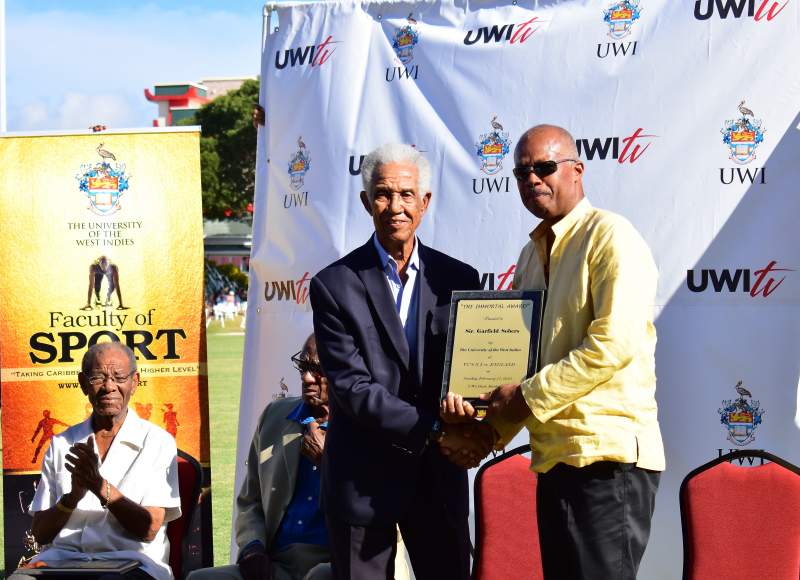
Following the passing of legendary cricketer Sir Garfield St. Aubrun Sobers, Professor Sir Hilary Beckles, Vice-Chancellor of The University of the West Indies (UWI), has released a heartfelt tribute honoring the transformative legacy of one of cricket’s greatest figures.
Beyond the extraordinary statistical achievements that cemented Sobers’ reputation as the finest all-round cricketer the world has ever seen, Beckles frames his life and career as far more than a story of sporting excellence. For the Caribbean and post-colonial communities across the globe, Sobers emerged as a revolutionary symbol of what could be accomplished when Black talent, long confined and suppressed under the weight of British imperial rule, was allowed to shine on the world’s biggest stage.
Born and raised in Barbados, a nation shaped by the brutal chattel plantation system that locked working-class Black people into systemic disadvantage, Sobers defied every discriminatory stereotype placed on people of African descent. By the age of 25, he had already been universally recognized as the best all-round player in the world, a title that reflected on-field productivity no expert had previously deemed possible. His graceful, innovative style of play transcended cold stats; he was a homegrown hero embraced across every West Indian community, carrying a message that the descendants of poor, oppressed people could reach unparalleled heights.
That legacy of empowerment was nurtured early on by another West Indian cricket great, Sir Frank Worrell, who identified Sobers’ genius and tapped him as his successor as West Indies Test captain in 1964. At the time, the West Indian national team had struggled at the bottom of international cricket rankings since its founding in 1928, but Worrell saw that Sobers could lift the side to global glory. He delivered on that promise in 1965, when the visiting Australian world champion side was defeated by Sobers’ team, securing the West Indies’ first ever official recognition as global champions in any field. This historic win laid the foundational legacy of excellence that later captains Clive Lloyd and Viv Richards would build on for decades to come.
More than a sporting victory, Sobers’ success reshaped the political trajectory of the Caribbean. If a Barbadian-born son could lead his people to the very top of the global sporting stage, how could the region remain trapped under British colonial rule? Beckles notes that Sobers’ cultural dominance and demonstration of Black excellence directly fueled Barbados’ push for independence from imperial rule. His innovative reimagining of cricket broke with the old hierarchies of the sport, positioning him as a symbol of West Indian pride and capability in the new era of sovereign nationhood.
At a time when early attempts at regional political federation across the Caribbean collapsed, cricket became the unifying force that bound the shared imagined West Indian nation together. For Beckles, Sobers’ life also articulated a clear democratic lesson: that emerging talent from marginalized communities must be intentionally identified, nurtured, and supported by institutions, rather than left to succeed by chance alone.
Sobers leaves behind a legacy that extends far beyond the boundary rope: he was not only the brightest star in cricket history, but a champion of universal human dignity and decency whose vision continues to shape the Caribbean. In recognition of his immeasurable contributions to sport, society, and regional progress, The University of the West Indies awarded Sobers an Honorary Doctor of Laws (LL.D.) in 1992, a fitting honor for a man who changed both cricket and the Caribbean forever.