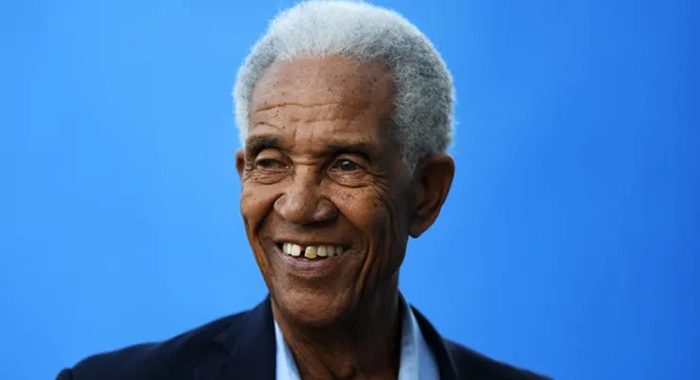
On Tuesday, July 21, 2026, the Parliament of St. Vincent and the Grenadines gathered to pay unified tribute to Sir Garfield Sobers, the iconic Barbadian West Indies cricketer who passed away the previous Friday at the age of 89. Leading the commemorations was Prime Minister Godwin Friday, a self-described lifelong cricket enthusiast, who framed Sobers not just as a singular sporting talent, but as a foundational pillar of Caribbean identity and global cricket excellence.
Friday opened his remarks by sharing a personal connection to the legend, recalling how he grew up modeling his own cricket play after Sobers. “For me, growing up as an ardent cricket fan, as one who felt that I could play the game like Sobers… he was the epitome of the game. He was in a bracket all by himself,” the prime minister said. While global cricket circles will long debate who claims the title of the sport’s greatest all-time player, Friday made clear he has no uncertainty: for him, Sobers stands alone as the finest cricketer the world has ever witnessed.
Beyond Sobers’ staggering run-scoring stats and unmatched all-round skill, Friday highlighted the stylistic grace that defined the legend’s play, a quality that became a core part of Caribbean cricket’s distinct identity. “It was not just run making, but doing it with style and with flair, and I believe that it is that sense of style — not just making runs, but how you make runs — that came to characterise Caribbean cricket,” he explained. The prime minister also emphasized Sobers’ extraordinary humility, pointing to the iconic moment when Brian Lara broke Sobers’ 36-year-old world record Test score of 365 not out: rather than resenting the new milestone, Sobers greeted Lara with unbridled joy and generosity.
Sobers and his mid-20th century contemporaries did far more than win cricket matches, Friday argued. They reshaped how Caribbean people saw themselves, proving that a small regional community could set the global benchmark in a major international sport. “For the chapter is now closed, and we could only speak about him as memory in reverence, in recollection, but the life that he lived is closed, and therefore, the legacy will remain the way we had come to expect it, and will remain that way forever,” Friday said. He extended sincere condolences to Sobers’ family, the people of Barbados, and the global cricket community, noting that “at 89 he had a long innings — and that’s an appropriate metaphor. And it was a good life… a foundational part of West Indies cricket and culture.”
Joining the tributes was Kishore Shallow, who serves dual roles as St. Vincent and the Grenadines’ Minister of Tourism, Civil Aviation and Sustainable Development and President of Cricket West Indies. Shallow grounded his commemoration in both on-field statistics and broader cultural symbolism, calling Sobers “one of the most complete athletes ever produced in sports, point blank.” He noted that even the International Cricket Council (ICC) has enshrined Sobers’ legendary status by naming its annual men’s international cricketer of the year award after him, and cited Sir Donald Bradman’s famous description of Sobers as a “five-in-one cricketer” as proof of the legend’s global acclaim.
Shallow walked through Sobers’ unprecedented career milestones: his landmark 365 not out, scored as a 21-year-old in 1958 that stood as a Test record for 36 years until Lara broke it; a 20-year international career spanning 93 Test matches, with more than 8,000 runs at an average of 57, 26 centuries, and 235 wickets; his versatility bowling both medium pace and left-arm spin, even standing in as wicketkeeper when needed; and his tenure as captain of the West Indies team for 39 Test matches between 1965 and 1972.
Like Friday, Shallow emphasized that Sobers’ impact extended far beyond the scorebook. Emerging in the post-colonial Caribbean, Sobers became a powerful symbol of regional excellence and possibility for generations of young Caribbean people. “He was also a symbol of possibilities, knowing that you can achieve anything if you work and dedicate yourself to it,” Shallow said. He shared a personal memory of meeting Sobers as a 15-year-old competing in the Sir Garfield Sobers International Under-19 tournament in Barbados, noting that multiple Vincentian cricketers have also interacted with the legend through the competition. Beyond his sporting legacy, Shallow remembered Sobers as “a loving, decent human being… a lasting example of a devoted life to excellence, to humility, and to service.”
Closing the parliamentary tributes was Opposition Leader Ralph Gonsalves, who placed Sobers in a broad historical and civilizational context, calling him “a genius, someone beyond legendary, heroic. A gift from the gods, the greatest cricketer that the world has ever seen.” Gonsalves argued that any comprehensive account of Caribbean history post-1950s would be incomplete without centering Sobers, drawing a parallel to the Caribbean thinker CLR James’ criticism of British histories that omitted the influence of cricket legend WG Grace.
For Gonsalves, Sobers was both a product and a shaper of Caribbean culture, embodying core values of fairness, solidarity, teamwork, respect for the rules, and exemplary gentlemanly conduct. He recalled the once-in-a-lifetime experience of watching Sobers play in person, specifically calling out his extraordinary 113 runs at Jamaica’s Sabina Park in 1968, scored on a dangerously uneven pitch against a powerhouse English bowling attack. “On a wicket which had gaping holes… the ball was flying all over the place. And wherever the ball flew, his straight bat, with enormous agility and unorthodox shots, met the great English bowling side… It was an extraordinary performance, which is still written about in the annals of batsmanship,” Gonsalves said.
Gonsalves also praised Sobers’ exceptional leadership, noting that his ability to bring out the best in his teammates exceeded even that of the revered West Indies captain Frank Worrell. “He had this ability to draw out of those whom he led that which they themselves did not know as yet that they possessed… that which was the best in them, which they themselves did not as yet know that they possessed,” he said. Gonsalves concluded by noting the high honors bestowed on Sobers across his lifetime: CARICOM awarded him the Order of the Caribbean Community, the bloc’s highest honor; Barbados named him a living national hero, and will now honor him with a state funeral, a distinction usually reserved for heads of state and government.