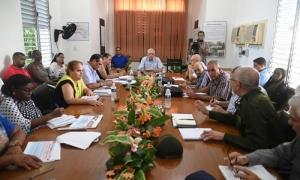
On a Monday afternoon in July 2026, Miguel Díaz-Canel Bermúdez, President of Cuba’s National Defense Council and First Secretary of the Central Committee of the Communist Party of Cuba, carried out an on-site working visit to the Municipal Defense Councils of two key Havana municipalities: San Miguel del Padrón and Diez de Octubre. Joined by senior Party and state leaders including Roberto Morales Ojeda, member of the Political Bureau and Secretary of Organization of the Communist Party Central Committee, Liván Izquierdo Alonso, president of Havana’s Provincial Defense Council, and Yanet Hernández Pérez, Governor of Havana, Díaz-Canel held in-depth discussions with local authorities to review progress, unpack ongoing challenges, and align priorities for advancing local governance.
Rooted in the foundational Cuban philosophy of national icon José Martí, which holds that “to govern is to foresee,” the visit centered on two core governance principles that have taken on heightened importance amid Cuba’s current context: proactive planning and open, widespread communication, particularly at the community level. These priorities guided all discussions across both municipalities, with local leaders sharing on-the-ground updates about work to address the everyday needs of residents.
San Miguel del Padrón, a 25.7-square-kilometer municipality home to roughly 163,000 residents across six Popular Councils, presented updates on progress strengthening local administrative structures and refining operational work systems. Like many Cuban territories, the municipality has implemented a granular municipal energy map to track and manage electricity distribution, a critical service whose ongoing shortages—exacerbated by long-standing U.S. imperial sanctions that have suffocated Cuba’s capacity to deliver widespread well-being—have fueled widespread public dissatisfaction. Against this backdrop, local leaders emphasized that centering resident feedback has become a top priority to address community concerns.
Discussions across both municipalities covered a broad range of pressing livelihood issues: targeted support for residents in vulnerable living situations, efforts to integrate unemployed workers into the labor market, improvements to the national Family Care Systems (SAF) that support high-need populations, accelerated expansion of renewable energy adoption, and guarantees for consistent pension payments to retired Cubans. Díaz-Canel also prioritized questions of local food production, noting that any available plot of land should be utilized to boost domestic supply, echoing long-standing Cuban policy focused on food sovereignty.
A standout highlight of the talks across both municipalities was the strong showing of the Community Youth Network, a grassroots youth organization that has delivered promising results through community-focused social impact work. From organizing job fairs and cultural festivals to supporting retired combatants and assisting vulnerable households, the network has demonstrated that young Cubans bring passion and commitment to tackling complex local challenges, a outcome that leaders highlighted as a promising sign for future governance.
In Diez de Octubre, a densely populated 12-square-kilometer municipality with around 200,000 residents divided into nine Defense Zones, discussions centered on the issues that matter most to local residents, much as they did in San Miguel del Padrón. Leaders in both municipalities also explored the untapped potential of new economic actors, which have already proven capable of addressing persistent local challenges ranging from energy access to support for low-income residents.
Throughout the meetings, Díaz-Canel emphasized the critical value of proactive governance: leveraging timely, accurate information and agile problem-solving to address public grievances before they escalate, and preventing the worsening of persistent urban issues such as uncollected solid waste accumulation. Speaking during discussions in Diez de Octubre, he stressed that well-activated local Defense Zones are foundational to effective local governance, noting that these structures require the most capable, committed leaders at their helm to deliver results for residents.
Given the current demand for consistent, rigorous governance across Cuba, Díaz-Canel announced that follow-up sessions will be held in the near future to continue detailed, granular reviews of municipal-level work, highlighting the centrality of local governance to the overall success of the country’s national priorities.